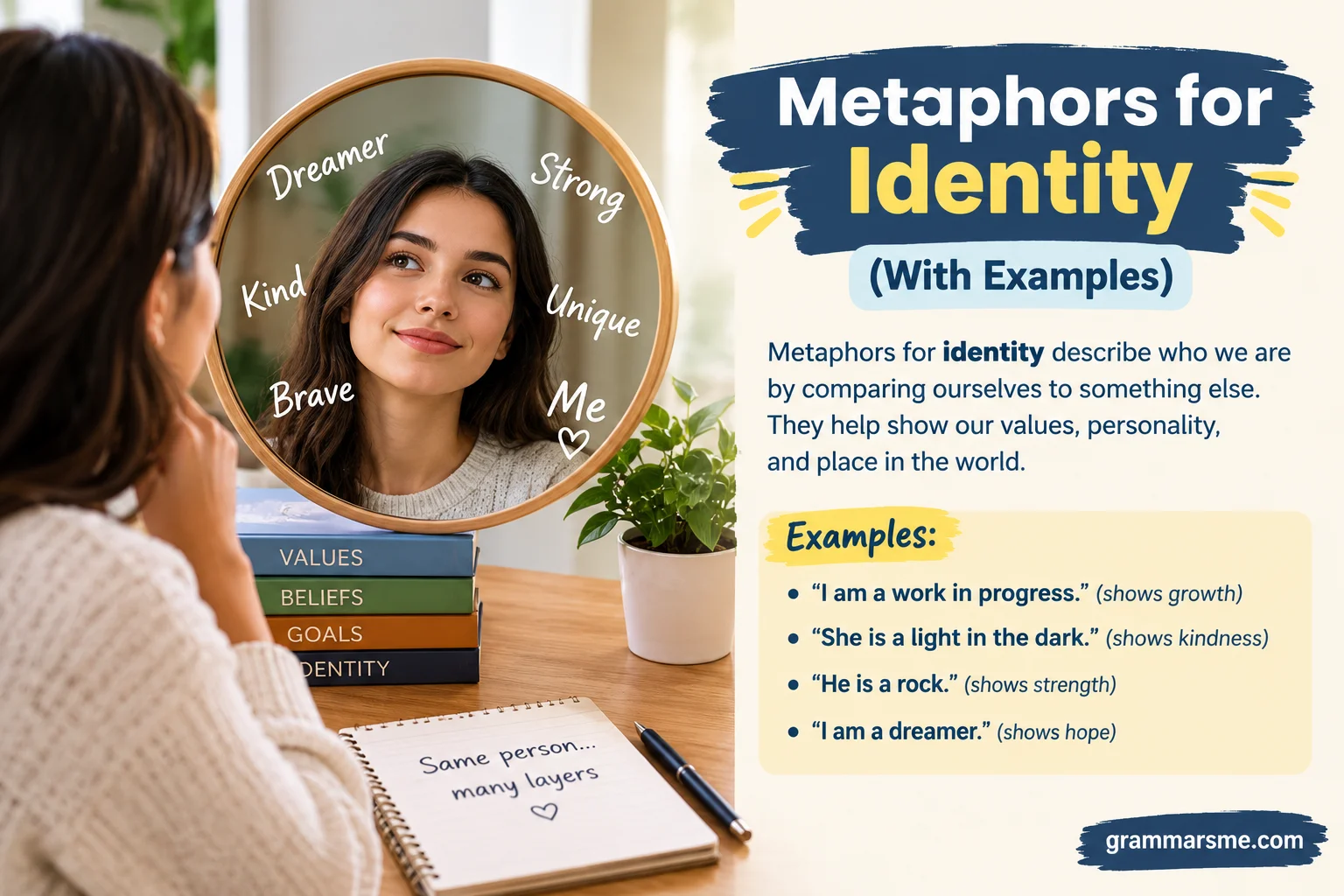

20 Metaphors for Identity (With Examples) can make identity easier to understand by turning an abstract idea into a vivid picture of who we are and how we see ourselves.
Identity is more than a name, role, or set of labels; it is a collection of experiences, memories, relationships, choices, decisions, and values that shape our personal identity. In writing, plain descriptions and a simple sentence may not show your personality, character, beliefs, emotions, feelings, inner world, or inner life clearly. A metaphor for identity gives these deeper parts of the self a vivid picture.
A mirror can represent reflecting the past, a tree can show growing through changing seasons, and a compass can represent searching for true direction. These meaningful metaphors can turn identity into a story, personal story, or narrative, helping readers visualize identity through imagery, images, and comparison. They can also express individuality, uniqueness, culture, cultural identity, heritage, background, belonging, and community in a natural, memorable, and deeply personal way.
1. Identity Is a Fingerprint
Meaning: This metaphor compares identity to a fingerprint because every person has a distinct combination of qualities and experiences.
Detailed explanation: No two fingerprints are exactly alike, and people are similarly individual. Our personality, beliefs, memories, relationships, interests, and life experiences combine to create something that belongs uniquely to us. This metaphor emphasizes individuality and uniqueness.
Examples in sentences:
- “Her identity is a fingerprint, shaped by every experience she has lived through.”
- “My identity is like a fingerprint; no one else carries exactly the same story.”
3 other ways to say it:
- Identity is one of a kind.
- Identity is a personal signature.
- Identity is uniquely your own.
2. Identity Is a Mosaic
Meaning: This metaphor presents identity as a mosaic made from many different pieces.
Detailed explanation: A mosaic contains separate pieces that come together to form one larger picture. Similarly, identity can include family, friendships, culture, education, beliefs, achievements, mistakes, and memories. Each piece contributes something meaningful to the whole person.
Examples in sentences:
- “Her identity is a mosaic of cultures, memories, and dreams.”
- “Every chapter of his life became another piece in the mosaic of his identity.”
3 other ways to say it:
- Identity is a collection of life experiences.
- Identity is a picture built from many pieces.
- Identity is a blend of different influences.
3. Identity Is a Mirror
Meaning: Identity can be described as a mirror because it reflects how we see ourselves and how our experiences have shaped us.
Detailed explanation: A mirror shows a reflection, while identity reflects our inner understanding of who we are. This metaphor can also suggest self-awareness, because discovering identity often requires looking inward and recognizing our strengths, values, fears, and aspirations.
Examples in sentences:
- “Her identity became a mirror of everything she had learned.”
- “Understanding yourself means looking honestly into the mirror of your identity.”
3 other ways to say it:
- Identity reflects the self.
- Identity is a reflection of our experiences.
- Identity reveals how we understand ourselves.
4. Identity Is a Tapestry
Meaning: This metaphor compares identity to a tapestry woven from many threads.
Detailed explanation: A tapestry is created by combining different threads into one design. In the same way, identity develops from relationships, memories, values, traditions, challenges, and hopes. Some threads may be bright while others represent difficult moments, but all of them contribute to the final pattern.
Examples in sentences:
- “My identity is a tapestry woven from family, friendship, and experience.”
- “Every challenge added another thread to the tapestry of her identity.”
3 other ways to say it:
- Identity is woven from experiences.
- Identity is a pattern of many influences.
- Identity is made from interconnected life stories.
5. Identity Is a Tree
Meaning: Identity can be compared to a tree with roots, a trunk, and branches.
Detailed explanation: The roots can represent family, heritage, memories, and origins. The trunk represents the person’s developing character, while the branches represent choices, relationships, ambitions, and future possibilities. This metaphor highlights both stability and growth.
Examples in sentences:
- “Her identity is a tree with deep roots and ever-growing branches.”
- “His family history forms the roots of the identity he carries today.”
3 other ways to say it:
- Identity grows from our roots.
- Identity has roots and branches.
- Identity develops over time.
6. Identity Is a Compass
Meaning: This metaphor presents identity as a compass that helps guide our choices.
Detailed explanation: A compass helps travelers determine direction. Similarly, knowing who we are can help us decide what matters, which values to follow, and what paths to pursue. Identity doesn’t always provide every answer, but it can offer a sense of direction.
Examples in sentences:
- “Her values became a compass for her identity.”
- “When life became confusing, he relied on his identity as a compass.”
3 other ways to say it:
- Identity guides our choices.
- Identity provides direction.
- Identity helps us stay true to ourselves.
7. Identity Is a Story
Meaning: Identity can be described as a story that develops throughout life.
Detailed explanation: A story contains chapters, turning points, characters, conflicts, and changes. Human identity works similarly. Childhood, relationships, achievements, setbacks, and discoveries can become different chapters in a person’s life. Most importantly, the story continues to develop.
Examples in sentences:
- “My identity is a story that I continue writing every day.”
- “Her childhood was one chapter, but it didn’t define the entire story of her identity.”
3 other ways to say it:
- Identity is an ongoing life story.
- Identity is a collection of personal chapters.
- Identity develops through our experiences.
8. Identity Is a Puzzle
Meaning: This metaphor compares identity to a puzzle made from many pieces.
Detailed explanation: Understanding ourselves can take time because different parts of our personality and history may not immediately seem connected. Like a puzzle, identity becomes clearer when individual experiences, values, relationships, and memories begin to fit together.
Examples in sentences:
- “Discovering my identity felt like putting together a puzzle.”
- “Every new experience helped her understand another piece of her identity.”
3 other ways to say it:
- Identity is made of many pieces.
- Identity takes time to understand.
- Identity comes together gradually.
9. Identity Is a Garden
Meaning: Identity can be compared to a garden that requires care and continues to grow.
Detailed explanation: A garden changes with attention, time, and changing conditions. Likewise, identity isn’t necessarily fixed. Our interests, perspectives, confidence, and priorities can develop as we experience new situations. This metaphor emphasizes personal growth and self-discovery.
Examples in sentences:
- “Her identity is a garden that she continues to nurture.”
- “New experiences planted seeds that changed the garden of his identity.”
3 other ways to say it:
- Identity grows with experience.
- Identity needs room to develop.
- Identity changes as we mature.
10. Identity Is a House
Meaning: This metaphor describes identity as a house built from different parts of our lives.
Detailed explanation: A house has rooms, foundations, doors, windows, and spaces that serve different purposes. Identity can work in a similar way. Our values may form the foundation, while our interests, relationships, memories, and ambitions become different rooms. Some parts may change while the foundation remains strong.
Examples in sentences:
- “Her identity is a house built on strong values.”
- “His experiences became different rooms in the house of his identity.”
3 other ways to say it:
- Identity is built over time.
- Identity has many dimensions.
- Identity rests on personal values and experiences.
11. Identity Is a River
Meaning: Identity can be compared to a river that keeps moving and changing.
Detailed explanation: A river has a source, follows a course, encounters obstacles, and changes as it travels. Identity can also evolve as people encounter relationships, challenges, opportunities, and new perspectives. This metaphor shows that change doesn’t erase who we are; it can become part of our development.
Examples in sentences:
- “Her identity is a river, constantly moving toward new experiences.”
- “Like a river, his identity changed direction without losing its source.”
3 other ways to say it:
- Identity is always evolving.
- Identity flows through life experiences.
- Identity changes while carrying its history forward.
12. Identity Is a Canvas
Meaning: This metaphor compares identity to a canvas that becomes filled through life experiences and choices.
Detailed explanation: A blank canvas offers possibilities, while each brushstroke adds something to the final image. In a similar way, choices, relationships, beliefs, successes, and challenges can shape how identity develops. The metaphor emphasizes creativity, freedom, and personal expression.
Examples in sentences:
- “Her identity is a canvas painted with experiences and dreams.”
- “Every decision added another brushstroke to the canvas of his identity.”
3 other ways to say it:
- Identity is something we shape.
- Identity is a picture created through experience.
- Identity reflects our choices and values.
13. Identity Is a Lighthouse
Meaning: Identity can be seen as a lighthouse that provides guidance during uncertain moments.
Detailed explanation: A lighthouse helps ships navigate safely through darkness and difficult conditions. Likewise, a clear sense of identity can remind us of what we value and who we want to become when circumstances become confusing.
Examples in sentences:
- “Her identity became a lighthouse during difficult decisions.”
- “His values stood like a lighthouse when he wasn’t sure which path to choose.”
3 other ways to say it:
- Identity provides inner guidance.
- Identity can guide us through uncertainty.
- Identity helps us find our direction.
14. Identity Is a Patchwork Quilt
Meaning: This metaphor describes identity as a quilt created from different pieces of life.
Detailed explanation: A patchwork quilt combines pieces that may differ in color, texture, and pattern. Together, they create something meaningful. Similarly, identity includes different experiences, relationships, backgrounds, interests, and memories that become part of one personal story.
Examples in sentences:
- “Her identity is a patchwork quilt of memories and experiences.”
- “Each place he lived became another square in the quilt of his identity.”
3 other ways to say it:
- Identity combines many experiences.
- Identity is formed from different life moments.
- Identity brings diverse experiences together.
15. Identity Is an Anchor
Meaning: Identity can act as an anchor that keeps us connected to our core values.
Detailed explanation: An anchor keeps a boat steady even when the water is moving. In the same way, a strong sense of identity can provide stability during periods of change. It can remind us of our principles, origins, and personal priorities.
Examples in sentences:
- “Her family traditions became an anchor in her identity.”
- “His core values served as an anchor when everything around him changed.”
3 other ways to say it:
- Identity provides stability.
- Identity keeps us grounded.
- Identity connects us to our core values.
16. Identity Is a Fingerprint on the World
Meaning: This metaphor suggests that identity is the unique mark each person leaves through their actions and relationships.
Detailed explanation: A fingerprint identifies an individual, while the metaphorical fingerprint represents the impact a person makes. The way we treat people, create things, solve problems, and contribute to our communities can leave a distinct personal impression.
Examples in sentences:
- “Her kindness became a fingerprint she left on everyone around her.”
- “His creativity was the fingerprint of his identity.”
3 other ways to say it:
- Identity leaves a personal mark.
- Identity shapes our impact.
- Identity influences the impression we leave.
17. Identity Is a Compass Rose
Meaning: A compass rose represents different directions, making it a metaphor for the many dimensions that influence identity.
Detailed explanation: People often have multiple roles and interests. Someone may be a friend, parent, student, professional, artist, athlete, or community member. These dimensions can point in different directions while still belonging to the same person.
Examples in sentences:
- “Her identity is a compass rose pointing toward family, creativity, and service.”
- “His many interests formed different directions within his identity.”
3 other ways to say it:
- Identity has many dimensions.
- Identity includes different roles and values.
- Identity brings multiple parts of life together.
18. Identity Is a Book
Meaning: Identity can be compared to a book filled with chapters, characters, memories, and turning points.
Detailed explanation: A book allows readers to discover a person or world gradually. Identity can work the same way. Some parts are visible to others, while other chapters remain deeply personal. As life continues, new chapters are added.
Examples in sentences:
- “Her identity is a book with chapters that continue to unfold.”
- “You can’t understand his identity by reading only one chapter of his life.”
3 other ways to say it:
- Identity contains many chapters.
- Identity unfolds over time.
- Identity is deeper than first impressions.
19. Identity Is a Seed
Meaning: This metaphor presents identity as a seed containing the potential for growth.
Detailed explanation: A seed begins small but can develop into something much larger under the right conditions. Similarly, identity may begin with early influences but develop through education, relationships, challenges, reflection, and personal choices. The metaphor highlights potential and transformation.
Examples in sentences:
- “Her childhood interests were seeds of the identity she developed later.”
- “Confidence became a seed that grew into a stronger sense of identity.”
3 other ways to say it:
- Identity has room to grow.
- Identity develops from early influences.
- Identity contains personal potential.
20. Identity Is a Constellation
Meaning: Identity can be described as a constellation made from many individual points that create a recognizable pattern.
Detailed explanation: A constellation consists of separate stars that appear connected when viewed together. Likewise, our memories, relationships, values, experiences, beliefs, and dreams may seem separate, but together they create the pattern we recognize as ourselves. This is a powerful metaphor for the complexity of identity.
Examples in sentences:
- “Her identity is a constellation of memories, values, relationships, and dreams.”
- “Each experience became another star in the constellation of his identity.”
3 other ways to say it:
- Identity is a pattern of experiences.
- Identity is formed from many connected parts.
- Identity is a collection of qualities that create a whole.
MCQs:
1. Which metaphor emphasizes that every person’s identity is unique?
A. Identity is a river
B. Identity is a fingerprint
C. Identity is a garden
D. Identity is a lighthouse
2. Which metaphor describes identity as many pieces forming one complete picture?
A. Mosaic
B. Compass
C. Anchor
D. Seed
3. “My family history is the foundation from which I continue to grow.” Which metaphor fits best?
A. Identity is a tree
B. Identity is a mirror
C. Identity is a book
D. Identity is a canvas
4. Which metaphor focuses most strongly on identity as an evolving life story?
A. Identity is a story
B. Identity is a fingerprint
C. Identity is an anchor
D. Identity is a house
5. “Every experience added another piece to who I am.” Which metaphor best fits?
A. Lighthouse
B. Puzzle
C. Compass rose
D. River
6. Which metaphor emphasizes personal growth and nurturing?
A. Identity is a garden
B. Identity is a mirror
C. Identity is a fingerprint
D. Identity is a book
7. Which metaphor suggests that values can guide our decisions?
A. Identity is a compass
B. Identity is a mosaic
C. Identity is a quilt
D. Identity is a seed
8. “My culture, memories, friendships, and dreams are woven together.” Which metaphor fits best?
A. Identity is a tapestry
B. Identity is a lighthouse
C. Identity is a river
D. Identity is a mirror
9. Which metaphor emphasizes that identity can provide stability during change?
A. Identity is a canvas
B. Identity is an anchor
C. Identity is a puzzle
D. Identity is a seed
10. Which metaphor compares identity to something that can be shaped creatively?
A. Identity is a canvas
B. Identity is a compass
C. Identity is a lighthouse
D. Identity is a fingerprint
11. “I have different roles in my family, career, and community, but they all belong to me.” Which metaphor fits best?
A. Identity is a compass rose
B. Identity is a seed
C. Identity is a mirror
D. Identity is an anchor
12. Which metaphor emphasizes that identity continues to change while carrying its past?
A. Identity is a river
B. Identity is a house
C. Identity is a fingerprint
D. Identity is a mosaic
13. “You cannot understand me from one moment of my life.” Which metaphor best expresses this idea?
A. Identity is a book
B. Identity is a garden
C. Identity is a compass
D. Identity is a seed
14. Which metaphor focuses on potential and development?
A. Identity is a seed
B. Identity is a mirror
C. Identity is an anchor
D. Identity is a lighthouse
15. Which metaphor presents identity as many separate experiences forming one recognizable pattern?
A. Identity is a constellation
B. Identity is a house
C. Identity is a fingerprint
D. Identity is a compass
Answer Key:
1-B, 2-A, 3-A, 4-A, 5-B, 6-A, 7-A, 8-A, 9-B, 10-A, 11-A, 12-A, 13-A, 14-A, 15-A
FAQs:
What is a metaphor for identity?
A metaphor for identity compares who a person is to something familiar, such as a fingerprint, tree, mosaic, story, or constellation. These comparisons make abstract ideas about identity easier to understand and express.
What is the best metaphor for identity?
There isn’t one single best metaphor. “Identity is a fingerprint” works especially well when emphasizing uniqueness, while “identity is a tree” highlights roots and growth. “Identity is a mosaic” works well when describing many experiences coming together.
Why use metaphors to describe identity?
Metaphors make descriptions of identity more vivid, emotional, and memorable. They can help readers understand complicated ideas such as personal growth, heritage, individuality, values, and self-discovery.
Can I use these identity metaphors in an essay?
Yes. These metaphors can work well in personal essays, reflective writing, speeches, poetry, stories, and creative assignments. Choose a metaphor that genuinely matches the idea you want to communicate, then explain the comparison clearly.
How can I create my own metaphor for identity?
Think about what has shaped you most, such as family, memories, goals, values, challenges, or personal growth. Then compare those influences to something familiar. For example, if your experiences have helped you become stronger, you might describe your identity as a tree with deep roots and strong branches.
Conclusion:
Metaphors for identity give us a creative way to explain something deeply personal. Identity can be a fingerprint representing uniqueness, a tree representing roots and growth, a mosaic representing different experiences, or a constellation representing connected parts of ourselves. Each metaphor highlights a different aspect of who we are. The most meaningful choice depends on the message you want to communicate. When used thoughtfully, these comparisons can make personal writing, conversations, speeches, and reflections feel more vivid and authentic. Most importantly, identity is rarely one simple thing—it is a living combination of experiences, values, relationships, memories, and possibilities that continues to develop throughout life.