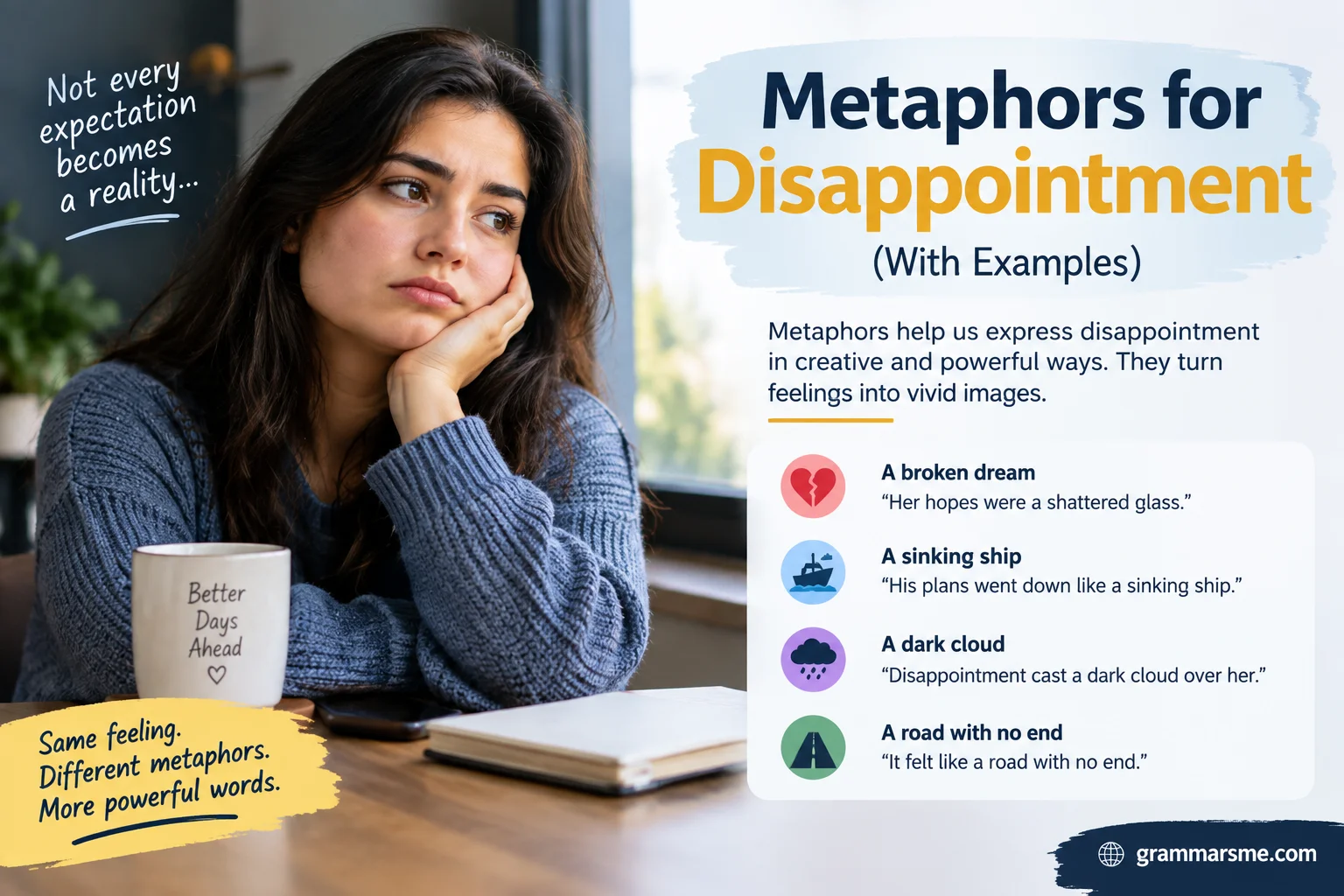

Successes can bring joy, but disappointments can feel heavy; 20 Metaphors for Disappointment (With Examples) helps writers find better ways to explain this feeling.
When disappointments, including greatest disappointments and today’s disappointments, create a shadow over tomorrow’s dreams, disappointment can change how we react. Henry Ward Beecher reminds us that successes can follow hard moments. In a story, writers may give characters hurdles, obstacles, and challenges. I have discovered that, after many times using disappointed in a WIP, undue repetition can weaken writing, so alternatives can rescue the work.
Metaphors make disappointment easier to picture because a metaphor says one thing is another thing. A heart can be a balloon that has popped, turning sadness into a simple picture that readers can see and understand. Simple metaphors can help describe difficult emotions in a smart and kind way. Finding the right words is difficult when emotions feel heavy or complicated, and a simple phrase may not fully capture hope fading, expectations falling, or trust being shaken. A good metaphor gives an experience a clearer shape and memorable shape without becoming overly harsh or distant..
1. Disappointment Is a Cracked Mirror
A cracked mirror represents disappointment because it changes how you see something that once seemed whole and beautiful. The mirror still reflects an image, but the cracks make everything look different. In the same way, disappointment can change how you view a person, situation, opportunity, or dream. The experience may not completely destroy what you believed in, but it can leave visible emotional cracks.
Example: “When the promise was broken, my trust became a cracked mirror, reflecting everything differently.”
Another example: “The failed opportunity felt like a cracked mirror that made me question what I had once believed.”
3 other ways to say it:
- A shattered reflection
- A fractured picture of hope
- A broken lens of expectation
2. Disappointment Is a Deflated Balloon
A deflated balloon captures the feeling of excitement slowly disappearing. Before disappointment, expectations can make us feel lifted, excited, and hopeful. When reality doesn’t match those expectations, that emotional energy can suddenly disappear. The balloon becomes a symbol of hope losing its air.
Example: “After hearing the final decision, my excitement felt like a deflated balloon.”
Another example: “Her anticipation became a deflated balloon when the plans were canceled.”
3 other ways to say it:
- Hope losing its air
- A fallen celebration
- Excitement without its spark
3. Disappointment Is a Rain Cloud
A rain cloud is a natural metaphor for disappointment because it represents a shadow that appears over an otherwise ordinary day. Disappointment can similarly darken your mood and make everything around you feel less cheerful. The cloud may eventually pass, reminding us that difficult emotions are temporary.
Example: “The rejection followed me like a rain cloud throughout the afternoon.”
Another example: “His disappointment became a rain cloud over what should have been a joyful day.”
3 other ways to say it:
- A shadow over happiness
- A cloud over the heart
- A storm above my thoughts
4. Disappointment Is an Empty Gift Box
An empty gift box represents the difference between what we expect and what we actually receive. A decorated box creates anticipation, but opening it and finding nothing inside creates an immediate emotional drop. This metaphor works especially well when someone has promised something meaningful but failed to deliver it.
Example: “The opportunity looked promising, but it turned out to be an empty gift box.”
Another example: “His promises became an empty gift box when his actions never followed.”
3 other ways to say it:
- A promise without a present
- An expectation with nothing inside
- A beautifully wrapped letdown
5. Disappointment Is a Door That Won’t Open
A door that won’t open represents an opportunity or possibility that remains out of reach. You may stand in front of it with hope, effort, and patience, yet nothing changes. This metaphor expresses the frustration of wanting something sincerely but being unable to move forward.
Example: “The promotion felt like a door that wouldn’t open, no matter how hard I knocked.”
Another example: “That relationship became a closed door I wasn’t ready to stop standing before.”
3 other ways to say it:
- A locked opportunity
- A path blocked by reality
- A closed entrance to hope
6. Disappointment Is a Broken Promise
A broken promise is a powerful metaphor because promises often create emotional expectations. When a promise isn’t fulfilled, the disappointment can affect more than the immediate situation. It may also weaken trust and confidence.
Example: “His silence felt like a broken promise after everything we had discussed.”
Another example: “The canceled plan was more than an inconvenience; it felt like a broken promise.”
3 other ways to say it:
- A snapped thread of trust
- A vow left unfinished
- A commitment that fell apart
7. Disappointment Is a Cold Cup of Coffee
A cold cup of coffee represents something that was expected to bring comfort but instead feels underwhelming. It works especially well for everyday disappointments that aren’t devastating but still leave you feeling unsatisfied. The metaphor conveys quiet frustration rather than deep heartbreak.
Example: “The long-awaited event turned out to be a cold cup of coffee—not terrible, just deeply underwhelming.”
Another example: “The experience felt like a cold cup of coffee after all the excitement surrounding it.”
3 other ways to say it:
- Comfort that lost its warmth
- An underwhelming reward
- A promise that cooled down
8. Disappointment Is a Wilted Flower
A wilted flower symbolizes something that once carried beauty, possibility, or hope but has lost its freshness. It can describe a dream, friendship, relationship, or opportunity that slowly loses its emotional strength.
Example: “Our friendship became a wilted flower after years of unanswered effort.”
Another example: “Her dream felt like a wilted flower after repeated failures.”
3 other ways to say it:
- A fading bloom
- A flower without freshness
- A dream losing its color
9. Disappointment Is a Ship Missing the Harbor
A ship missing the harbor represents coming close to where you hoped to arrive but failing to reach your destination. The journey may have taken enormous effort, yet the final result remains outside your grasp. This metaphor is especially useful for missed goals and almost-successes.
Example: “After months of preparation, the final rejection felt like a ship missing the harbor.”
Another example: “We came so close, but the result left us like a ship that missed its harbor.”
3 other ways to say it:
- An arrival that never happened
- A destination just out of reach
- A journey ending before shore
10. Disappointment Is a Fallen Star
A fallen star represents something that once seemed bright, distant, and full of possibility but eventually lost its place in the sky. This metaphor can describe a person, dream, opportunity, or expectation that once inspired admiration.
Example: “The failed dream felt like a fallen star, bright in memory but distant from reality.”
Another example: “His expectations came down like a fallen star after the truth became clear.”
3 other ways to say it:
- A light that lost its place
- A dream that came back to earth
- A fading spark
11. Disappointment Is a Defeated Drumbeat
A drumbeat normally creates energy, movement, and anticipation. When that rhythm stops or weakens, the excitement disappears. Calling disappointment a defeated drumbeat highlights the emotional silence that follows an anticipated event.
Example: “After the announcement, the excitement inside me became a defeated drumbeat.”
Another example: “The failed plan left our enthusiasm sounding like a defeated drumbeat.”
3 other ways to say it:
- A rhythm that lost its strength
- A fading pulse of excitement
- A beat that stopped too soon
12. Disappointment Is a Road Ending in a Wall
A road ending in a wall represents progress that suddenly stops. You may have invested time and effort moving forward, only to discover that the expected path has disappeared. It communicates the feeling of being stopped after believing you were headed somewhere meaningful.
Example: “The unexpected rejection made my career plan feel like a road ending in a wall.”
Another example: “Our plans seemed promising until reality turned the road into a wall.”
3 other ways to say it:
- A path suddenly blocked
- A journey with no way forward
- A dead end for hope
13. Disappointment Is a Dimming Candle
A dimming candle symbolizes hope gradually becoming weaker. Unlike sudden heartbreak, this metaphor works particularly well when disappointment develops slowly. It describes the quiet process of losing confidence, enthusiasm, or belief.
Example: “Every unanswered message made my hope feel like a dimming candle.”
Another example: “Her confidence became a dimming candle after repeated setbacks.”
3 other ways to say it:
- A fading flame
- Hope running low
- A light growing weaker
14. Disappointment Is an Unfinished Song
An unfinished song represents something that seemed destined to reach a meaningful conclusion but stopped before its final note. It can describe relationships, plans, dreams, or conversations that never reached the ending you imagined.
Example: “Our friendship feels like an unfinished song, ending before we understood each other.”
Another example: “The abandoned project became an unfinished song filled with possibilities that were never explored.”
3 other ways to say it:
- A melody without an ending
- A story missing its final chapter
- A final note never played
Read More: 20 Metaphors for Divorce (With Examples)
15. Disappointment Is a Bridge That Collapsed
A collapsed bridge symbolizes a connection or pathway that once seemed capable of taking you somewhere. When the bridge falls, moving forward becomes difficult or impossible. This metaphor works particularly well when disappointment involves trust, relationships, or lost opportunities.
Example: “The betrayal felt like a bridge collapsing between us.”
Another example: “The failed agreement became a collapsed bridge between two teams.”
3 other ways to say it:
- A broken connection
- A pathway that gave way
- A link that could no longer hold
16. Disappointment Is a Locked Treasure Chest
A locked treasure chest represents something valuable that appears close enough to see but remains inaccessible. It captures the frustration of knowing something meaningful exists while being unable to reach it.
Example: “The scholarship felt like a locked treasure chest after I missed the deadline.”
Another example: “Her dream became a locked treasure chest, visible but temporarily beyond her reach.”
3 other ways to say it:
- A prize behind a lock
- A treasure just beyond reach
- A reward hidden behind disappointment
17. Disappointment Is a Shadow Following You
A shadow follows you without making a sound. This makes it a useful metaphor for disappointment that stays in your thoughts long after the original event has ended. It suggests a feeling that doesn’t necessarily control you but continues to linger quietly in the background.
Example: “The rejection became a shadow following me whenever I considered trying again.”
Another example: “That experience remained a shadow over her confidence for months.”
3 other ways to say it:
- A feeling that lingers
- A memory that walks behind you
- A quiet weight from the past
18. Disappointment Is a Balloon Pop in the Silence
A balloon popping in silence represents the sudden shock of an expectation disappearing. The metaphor emphasizes the contrast between anticipation and an abrupt emotional change.
Example: “Hearing that the event was canceled felt like a balloon popping in the silence.”
Another example: “The unexpected answer was a balloon pop after weeks of anticipation.”
3 other ways to say it:
- A sudden burst of lost hope
- An expectation breaking instantly
- A quiet moment shattered
19. Disappointment Is a Photograph Fading
A fading photograph represents memories or expectations slowly losing their original brightness. This metaphor is especially suitable when disappointment develops over time rather than arriving all at once.
Example: “My excitement for the project became like a photograph fading in the sunlight.”
Another example: “The friendship remained in my memory like a fading photograph.”
3 other ways to say it:
- A memory losing its color
- A picture slowly disappearing
- A bright moment becoming distant
20. Disappointment Is an Echo With No Answer
An echo with no answer represents reaching out with hope and receiving only silence in return. It can describe unanswered messages, unfulfilled promises, rejected efforts, or situations where you desperately wanted a response.
Example: “My attempts to repair the friendship felt like an echo with no answer.”
Another example: “I kept asking for clarity, but every question became an echo with no answer.”
3 other ways to say it:
- A call disappearing into silence
- A question without a response
- Hope speaking into an empty room
MCQs:
1. Which metaphor represents damaged trust?
A. A cold cup of coffee
B. A cracked mirror
C. A fallen star
D. A rain cloud
2. Which metaphor best represents fading hope?
A. A dimming candle
B. A treasure chest
C. A ship
D. A photograph
3. “My excitement became a ___” best matches which metaphor?
A. Locked treasure chest
B. Deflated balloon
C. Collapsed bridge
D. Broken road
4. Which metaphor describes an opportunity that remains inaccessible?
A. A locked treasure chest
B. A wilted flower
C. A rain cloud
D. A defeated drumbeat
5. What does “a road ending in a wall” symbolize?
A. Celebration
B. New friendship
C. A blocked path
D. Unexpected success
6. Which metaphor represents something that once seemed bright but has faded?
A. Fallen star
B. Empty gift box
C. Closed door
D. Cold coffee
7. “An unfinished song” can represent:
A. A completed goal
B. Something that ended before reaching its conclusion
C. A joyful celebration
D. A successful journey
8. Which metaphor best represents disappointment caused by unanswered effort?
A. An echo with no answer
B. A fallen star
C. A wilted flower
D. A cracked mirror
9. What does a “wilted flower” commonly represent?
A. Growing excitement
B. Fading beauty or hope
C. Sudden success
D. A new beginning
10. Which metaphor emphasizes a sudden loss of anticipation?
A. A fading photograph
B. A balloon pop in the silence
C. A locked treasure chest
D. A dimming candle
11. “A bridge that collapsed” can symbolize:
A. A broken connection
B. A successful meeting
C. A new opportunity
D. A peaceful ending
12. Which metaphor describes disappointment that lingers?
A. A shadow following you
B. A gift box
C. A ship
D. A drumbeat
13. “A cold cup of coffee” is especially suitable for:
A. A devastating tragedy
B. A mildly underwhelming experience
C. A major achievement
D. A new opportunity
14. Which metaphor represents a memory slowly losing its brightness?
A. A fading photograph
B. A locked door
C. A broken bridge
D. A fallen road
15. Which metaphor describes a promise that wasn’t fulfilled?
A. A broken promise
B. A rain cloud
C. A fallen star
D. A cold cup
Answer Key:
1-B, 2-A, 3-B, 4-A, 5-C, 6-A, 7-B, 8-A, 9-B, 10-B, 11-A, 12-A, 13-B, 14-A, 15-A.
FAQs:
1. What is a metaphor for disappointment?
A metaphor for disappointment compares the feeling to something familiar without using “like” or “as.” Examples include “disappointment is a cracked mirror,” “disappointment is a dimming candle,” and “disappointment is a closed door.”
2. What is a powerful metaphor for disappointment?
One powerful metaphor is “disappointment is a cracked mirror.” It suggests that disappointment can change the way you see a person, situation, dream, or even yourself.
3. What metaphor describes lost hope?
“Disappointment is a dimming candle” is an effective metaphor for lost hope. The candle represents hope, while its fading light represents confidence or optimism becoming weaker.
4. How can metaphors make disappointment easier to express?
Metaphors turn an abstract emotional experience into a concrete image. Instead of simply saying “I am disappointed,” you can say, “My hope felt like a candle slowly losing its flame.” This makes the emotion easier to visualize and understand.
5. Can these metaphors be used in writing?
Yes. These metaphors can work in poetry, personal essays, stories, journal entries, social media posts, speeches, and everyday conversations. Choose an image that naturally matches the emotion you want to communicate.
Conclusion:
Disappointment can be difficult to explain because it isn’t always one simple emotion. Sometimes it feels like a door closing, while other times it resembles a fading candle, a wilted flower, or an unfinished song. Metaphors give these experiences shape and help us communicate what ordinary words may struggle to express.
The best metaphor depends on the situation. A deflated balloon works for lost excitement, while a cracked mirror can describe damaged trust. A road ending in a wall suits a blocked goal, and an echo with no answer captures the loneliness of unanswered effort. By choosing language that matches the feeling, you can express disappointment with honesty, sensitivity, and emotional depth.




1 thought on “20 Metaphors for Disappointment (With Examples)”