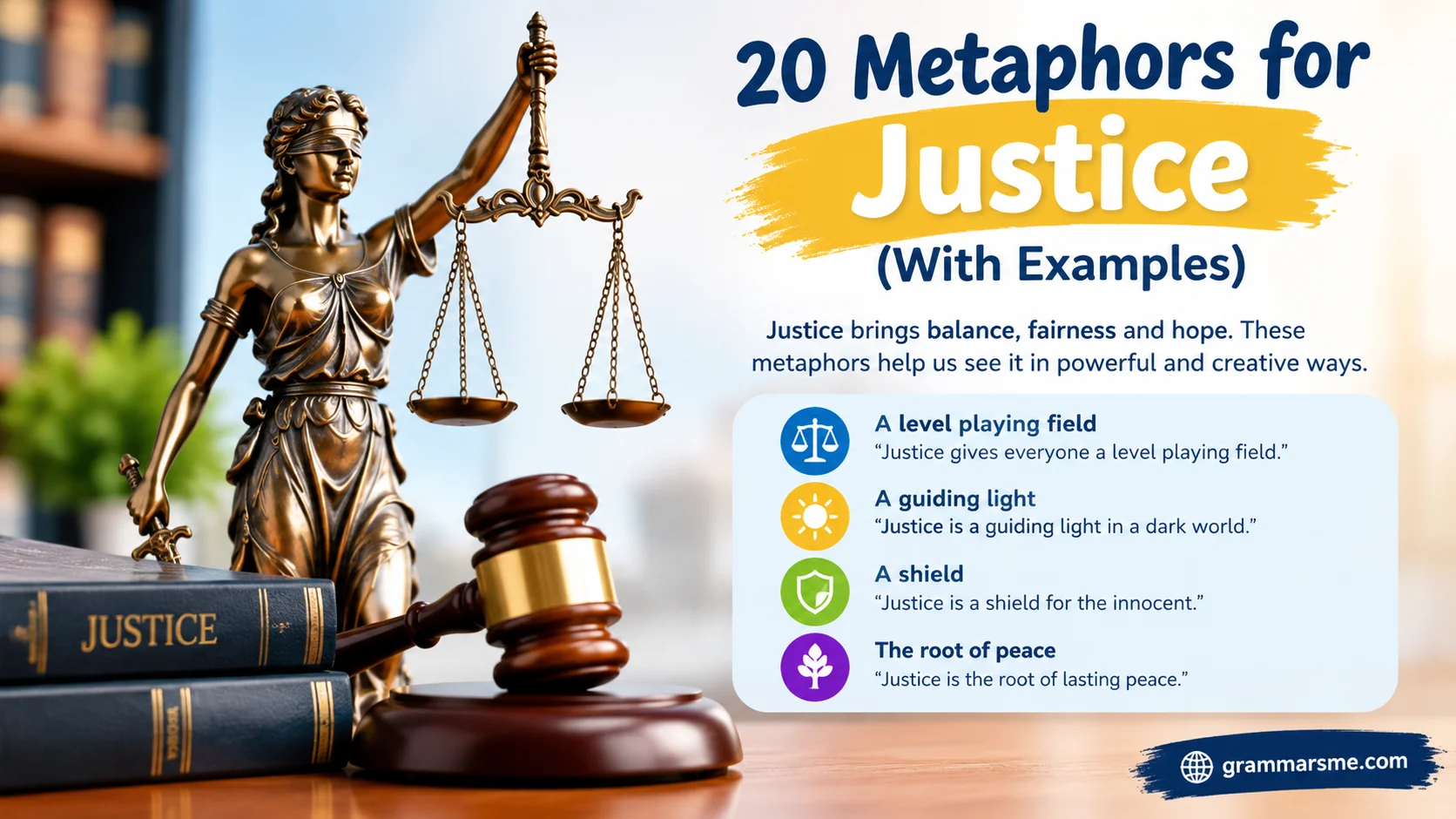

20 Metaphors for Justice (With Examples) uses justice, fairness, and accountability to make complex ideas clear, vivid, and memorable.
These metaphors for justice help writers, speakers, and storytellers explain equality, rights, responsibility, and doing what is right through figurative language and literary devices. Since justice is an abstract concept that can be difficult to explain, images such as a balanced scale, shield, bright light, guiding light, steady compass, bridge, and strong foundation make its true meaning easier to understand. These creative metaphors give readers a deeper level of clarity, power, and communication, while helping them connect with the message.
They can strengthen essays, stories, poems, speeches, creative writing, poetry, storytelling, persuasive writing, and everyday writing by using vivid images and vivid pictures. Each metaphor can offer a simple meaning, explanation, and example sentences, helping people recognize justice, understand its meanings, remember key ideas, and use naturally the right sentences. These original metaphors can also improve your writing and provide creative ways to describe fairness in a real and emotionally engaging manner.
1. Justice Is a Balanced Scale
Meaning: Justice is a balanced scale because it represents fairness and equal consideration.
Detailed explanation:
The image of a scale is one of the clearest ways to describe justice. A balanced scale suggests that every person, argument, or circumstance is being considered fairly rather than allowing personal preference to determine the outcome. The metaphor works especially well when discussing equal treatment, impartial decisions, and fairness. It reminds us that justice should seek balance rather than favoring one side without reason.
Example:
“Justice is a balanced scale, weighing every side before reaching a fair decision.”
3 other ways to say it:
- Justice is an evenly balanced scale.
- Fairness is a scale that weighs every side equally.
- Justice is the balance between competing rights.
2. Justice Is a Compass
Meaning: Justice is a compass because it guides people toward what is right.
Detailed explanation:
A compass helps travelers find direction when they are uncertain about which way to go. Justice can work in a similar way by providing a moral direction when people face difficult choices. This metaphor emphasizes that justice isn’t merely about punishment or rules. It can also help individuals and communities decide how to act with integrity, fairness, and responsibility.
Example:
“When emotions clouded their judgment, justice became their compass, pointing them toward a fair solution.”
3 other ways to say it:
- Justice is a guide toward fairness.
- Justice is a moral compass.
- Fairness is a directional light for difficult decisions.
3. Justice Is a Beacon of Light
Meaning: Justice is a beacon of light because it can illuminate truth and expose wrongdoing.
Detailed explanation:
A beacon shines through darkness and helps people see where they are going. As a metaphor, justice can represent the force that brings hidden facts into the open and gives people hope that unfairness can be confronted. This image is especially powerful when writing about truth, accountability, courage, and social change.
Example:
“After years of silence, the investigation became a beacon of justice, illuminating the truth.”
3 other ways to say it:
- Justice is a light in the darkness.
- Justice is a lamp revealing the truth.
- Justice is a guiding flame against injustice.
4. Justice Is a Bridge
Meaning: Justice is a bridge because it can connect divided people through fairness and understanding.
Detailed explanation:
A bridge connects places that would otherwise remain separated. Justice can similarly help communities move beyond conflict, discrimination, or resentment. When people believe that their rights are respected and their concerns are heard, justice can create a path toward reconciliation and trust.
Example:
“Fair laws can become a bridge between divided communities, giving everyone a shared path forward.”
3 other ways to say it:
- Justice is a path connecting people through fairness.
- Justice is a bridge between conflict and reconciliation.
- Fairness is a pathway toward unity.
5. Justice Is a Mirror
Meaning: Justice is a mirror because it reflects our actions and makes us face their consequences.
Detailed explanation:
A mirror shows us what is in front of it without changing the reflection. Justice can be viewed in the same way: it examines actions and reveals their consequences. This metaphor is particularly useful when discussing accountability and responsibility because it suggests that people must eventually confront what they have done.
Example:
“Justice held up a mirror to their actions, forcing everyone to confront the consequences.”
3 other ways to say it:
- Justice is a reflection of our actions.
- Justice is a mirror of accountability.
- Fairness makes society face its own reflection.
6. Justice Is a Shield
Meaning: Justice is a shield because it protects people from unfair treatment and abuse of power.
Detailed explanation:
A shield protects someone from harm. In a social or legal context, justice can serve a similar purpose by defending rights, dignity, equality, and freedom. The metaphor highlights the protective side of justice rather than focusing only on punishment.
Example:
“For those without power, the law can become a shield of justice, protecting their basic rights.”
3 other ways to say it:
- Justice is a protective shield.
- The law can be a defense against injustice.
- Fairness is a barrier against abuse.
7. Justice Is a Foundation
Meaning: Justice is a foundation because stable communities depend on fairness and equal treatment.
Detailed explanation:
Buildings require strong foundations to remain standing. Communities and institutions also need principles that support trust and stability. Justice can act as that foundation by encouraging equal rights, accountability, and consistent standards. Without a sense of fairness, social structures can become unstable.
Example:
“Justice is the foundation upon which a peaceful society is built.”
3 other ways to say it:
- Justice is the bedrock of society.
- Fairness is the foundation of social trust.
- Justice is the strong ground beneath a community.
8. Justice Is a River
Meaning: Justice is a river because it can continue moving forward despite obstacles.
Detailed explanation:
A river doesn’t always travel in a straight line. It moves around rocks, through narrow spaces, and across changing landscapes while continuing toward its destination. Justice can be described in the same way. Progress toward fairness may be slow or complicated, but the pursuit of justice can continue despite resistance, setbacks, and obstacles.
Example:
“The movement for equality flowed like a river of justice, finding a way forward despite resistance.”
3 other ways to say it:
- Justice is a flow that cannot easily be stopped.
- The pursuit of fairness is a stream moving toward equality.
- Justice is a current carrying society forward.
9. Justice Is a Scalesmith’s Craft
Meaning: Justice is a craft because achieving fairness often requires careful judgment and attention to detail.
Detailed explanation:
Justice isn’t always as simple as deciding who is right and who is wrong. Complex situations require careful examination of evidence, circumstances, rights, and consequences. Comparing justice to a craft emphasizes the patience, precision, and responsibility involved in making fair decisions.
Example:
“Seeking justice was like practicing a delicate craft, requiring patience and careful judgment.”
3 other ways to say it:
- Justice is the craft of careful judgment.
- Fairness requires the precision of a skilled artisan.
- Justice is a careful work of balancing competing interests.
10. Justice Is a Door
Meaning: Justice is a door because it can open access to rights, recognition, and a fairer future.
Detailed explanation:
A door separates one space from another but also provides a way through. Justice can represent the opportunity to move from unfair treatment toward recognition, protection, and equality. The metaphor works especially well when discussing access to courts, rights, opportunities, or social progress.
Example:
“Equal access to education can be a door to justice, giving every child a fairer opportunity.”
3 other ways to say it:
- Justice is an open door to equality.
- Fairness is a gateway to opportunity.
- Justice is an entrance to equal rights.
11. Justice Is a Seed
Meaning: Justice is a seed because small acts of fairness can grow into meaningful social change.
Detailed explanation:
A seed begins as something small, but with time and care it can develop into something much larger. A single fair decision, courageous statement, or act of compassion may similarly influence others and inspire broader change. This metaphor emphasizes patience, growth, hope, and long-term progress.
Example:
“That small act of fairness planted a seed of justice that eventually inspired the entire community.”
3 other ways to say it:
- Justice is a seed that grows through action.
- Fairness is a small beginning with lasting potential.
- One just act can become a seed of social change.
12. Justice Is an Anchor
Meaning: Justice is an anchor because it can keep society steady during periods of conflict and uncertainty.
Detailed explanation:
An anchor prevents a ship from drifting too far from its position. Justice can play a similar role by providing stable principles when emotions, fear, or political pressure might push people toward unfair decisions. This metaphor highlights stability, consistency, and principled action.
Example:
“During the crisis, the principle of equal treatment served as an anchor of justice.”
3 other ways to say it:
- Justice is a steadying force.
- Fairness is an anchor in turbulent times.
- Justice provides stability when society feels uncertain.
13. Justice Is a Sword
Meaning: Justice is a sword because it represents the power to confront wrongdoing and enforce accountability.
Detailed explanation:
A sword traditionally symbolizes strength and decisive action. As a metaphor, it can describe justice as a force that challenges wrongdoing rather than remaining passive. However, the metaphor should be used thoughtfully because justice isn’t simply about punishment. Its deeper purpose can include accountability, protection, and restoration of fairness.
Example:
“The law became a sword of justice, confronting those who had abused their power.”
3 other ways to say it:
- Justice is a weapon against wrongdoing.
- Accountability is the edge of justice.
- The law can act as a powerful instrument of fairness.
14. Justice Is a Scale in the Wind
Meaning: Justice is a scale in the wind because fairness can be difficult to maintain when outside pressures interfere.
Detailed explanation:
A scale can become unstable when affected by external forces. This metaphor captures the challenge of remaining impartial when decisions are influenced by fear, prejudice, money, authority, or public pressure. It reminds us that justice requires careful judgment and independence.
Example:
“Without impartial judgment, justice becomes a scale in the wind, easily pushed by outside pressure.”
3 other ways to say it:
- Justice can become a balance disturbed by pressure.
- Fairness is fragile when outside forces interfere.
- An impartial decision requires a steady hand.
15. Justice Is a Lighthouse
Meaning: Justice is a lighthouse because it guides people safely through moral and social uncertainty.
Detailed explanation:
A lighthouse helps ships navigate dangerous waters. Justice can provide similar guidance when individuals or societies face difficult choices. It represents direction, safety, truth, and hope, making it especially effective in writing about difficult periods or movements toward reform.
Example:
“In a divided society, the principle of equality stood like a lighthouse of justice, guiding people toward a safer future.”
3 other ways to say it:
- Justice is a guiding light.
- Fairness is a lighthouse through uncertainty.
- Justice is a signal pointing toward the right path.
16. Justice Is a Garden
Meaning: Justice is a garden because fairness requires continual care, attention, and protection.
Detailed explanation:
A garden doesn’t remain healthy without care. It needs watering, maintenance, and protection from harmful conditions. Justice can be understood similarly. Equal rights and fair institutions require people to protect them, improve them, and remain attentive to inequality. This metaphor emphasizes that justice is an ongoing responsibility rather than something achieved once and forgotten.
Example:
“Justice is a garden that must be tended, because fairness can weaken when people stop caring for it.”
3 other ways to say it:
- Justice is a garden requiring constant care.
- Fairness is something we must cultivate.
- Equality is a garden that grows through responsible action.
17. Justice Is a Fire
Meaning: Justice is a fire because it can ignite courage, determination, and collective action.
Detailed explanation:
Fire can symbolize energy, strength, and transformation. A desire for justice can similarly inspire people to speak up, challenge unfairness, and seek change. This metaphor is particularly powerful in creative writing and speeches where justice is presented as a force that motivates people.
Example:
“A fire for justice burned in their hearts, giving them the courage to speak against unfair treatment.”
3 other ways to say it:
- Justice is a flame of courage.
- Fairness is a spark that inspires change.
- The pursuit of justice is a fire that fuels determination.
18. Justice Is a Road
Meaning: Justice is a road because fairness is often a journey rather than a single destination.
Detailed explanation:
A road represents movement and progress. Justice can be viewed as a journey that requires continued effort, learning, correction, and cooperation. Societies may take wrong turns, encounter obstacles, or move slowly, but the goal remains greater fairness and equality.
Example:
“The fight for equal rights is a long road toward justice, requiring patience and continued effort.”
3 other ways to say it:
- Justice is a journey toward fairness.
- Equality is a path that society must continue walking.
- The pursuit of justice is a road built through collective effort.
19. Justice Is a Stitch in a Torn Fabric
Meaning: Justice is a stitch in torn fabric because it can help repair relationships and communities damaged by unfairness.
Detailed explanation:
Torn fabric cannot become whole with a single loose thread, but careful stitching can gradually repair it. Justice can work similarly after conflict, discrimination, or harm. Fair decisions, accountability, and recognition can help rebuild trust and social connection. The metaphor focuses on the restorative side of justice.
Example:
“Every fair decision became a stitch in the torn fabric of the community, slowly rebuilding trust.”
3 other ways to say it:
- Justice is a thread repairing damaged trust.
- Fairness is a stitch that helps mend social wounds.
- Justice can weave broken communities back together.
20. Justice Is a Rising Dawn
Meaning: Justice is a rising dawn because it represents hope, renewal, and the possibility of a fairer future.
Detailed explanation:
Dawn marks the transition from darkness to daylight. As a metaphor for justice, it can represent the moment when truth becomes visible and people begin moving toward greater fairness. It is especially useful for inspirational writing because it focuses on hope and positive change rather than only on past wrongdoing.
Example:
“After years of struggle, the new reforms felt like a rising dawn of justice.”
3 other ways to say it:
- Justice is the dawn of a fairer future.
- Equality is a new light after a long night.
- Justice is the sunrise of social change.
MCQs:
1. Which metaphor represents justice as fairness and equal consideration?
A. Justice is a river
B. Justice is a balanced scale
C. Justice is a seed
D. Justice is a garden
2. Which metaphor presents justice as a guide toward what is right?
A. Compass
B. Shield
C. Door
D. River
3. “Justice is a lighthouse” mainly suggests that justice:
A. Creates confusion
B. Provides direction and hope
C. Requires punishment
D. Moves quickly
4. Which metaphor emphasizes protecting people from unfair treatment?
A. Justice is a shield
B. Justice is a seed
C. Justice is a road
D. Justice is a mirror
5. What does “Justice is a foundation” suggest?
A. Justice is temporary
B. Justice supports a stable society
C. Justice is difficult to understand
D. Justice always involves punishment
6. Which metaphor describes justice as something that can grow from a small beginning?
A. Fire
B. Seed
C. Sword
D. Anchor
7. “Justice is an anchor” emphasizes:
A. Movement
B. Stability
C. Competition
D. Speed
8. Which metaphor represents justice as a force that confronts wrongdoing?
A. Justice is a sword
B. Justice is a garden
C. Justice is a bridge
D. Justice is a dawn
9. “Justice is a garden” suggests that fairness:
A. Requires ongoing care
B. Happens instantly
C. Is always easy
D. Depends only on laws
10. Which metaphor focuses on repairing damaged communities?
A. Justice is a mirror
B. Justice is a stitch in torn fabric
C. Justice is a compass
D. Justice is a sword
11. What does “Justice is a road” emphasize?
A. Justice is a journey
B. Justice is a punishment
C. Justice is a secret
D. Justice is a fixed object
12. Which metaphor is most closely connected with revealing truth?
A. Justice is a mirror
B. Justice is a bridge
C. Justice is an anchor
D. Justice is a seed
13. “Justice is a rising dawn” primarily represents:
A. Fear
B. Hope and renewal
C. Confusion
D. Conflict
14. Which metaphor describes justice as something that can connect divided people?
A. Justice is a bridge
B. Justice is a sword
C. Justice is a scale
D. Justice is a mirror
15. Which sentence uses a metaphor for justice correctly?
A. Justice is a blue chair in the courtroom.
B. Justice is a compass guiding society toward fairness.
C. Justice is exactly six feet tall.
D. Justice is a legal document with pages.
Answer Key:
1-B, 2-A, 3-B, 4-A, 5-B, 6-B, 7-B, 8-A, 9-A, 10-B, 11-A, 12-A, 13-B, 14-A, 15-B.
FAQs:
What is a metaphor for justice?
A metaphor for justice compares justice with something familiar to explain its meaning more vividly. Examples include “Justice is a balanced scale,” “Justice is a compass,” and “Justice is a lighthouse.”
What is a good metaphor for fairness?
A balanced scale is one of the clearest metaphors for fairness because it represents equal consideration and impartial judgment. A compass can also represent fairness by suggesting a commitment to the right principles.
What is a metaphor for justice and equality?
“Justice is a bridge” can represent justice and equality because a bridge connects people and creates a shared path. “Justice is a foundation” is another useful metaphor because equal treatment can support a stable society.
How can I use metaphors for justice in writing?
Use a metaphor when you want to make an abstract idea easier to visualize. For example, instead of writing “Justice guides people toward fairness,” you could write, “Justice is a compass pointing society toward fairness.”
Why are metaphors useful when talking about justice?
Justice can involve complicated ideas such as fairness, equality, accountability, rights, and social responsibility. Metaphors turn these abstract concepts into familiar images, making your writing more memorable, emotional, and accessible.
Conclusion:
These 20 metaphors for justice show that fairness can be understood through many different images. Justice can be a balanced scale when the focus is impartiality, a compass when it provides moral direction, a shield when it protects rights, or a bridge when it helps divided people reconnect. It can also be a seed that grows, a garden that needs care, a road that requires perseverance, or a rising dawn that offers hope. Choosing the right metaphor depends on the message you want to communicate. Whether you’re writing an essay, speech, story, poem, or everyday message, these comparisons can help you express justice with greater clarity, depth, and emotional meaning.