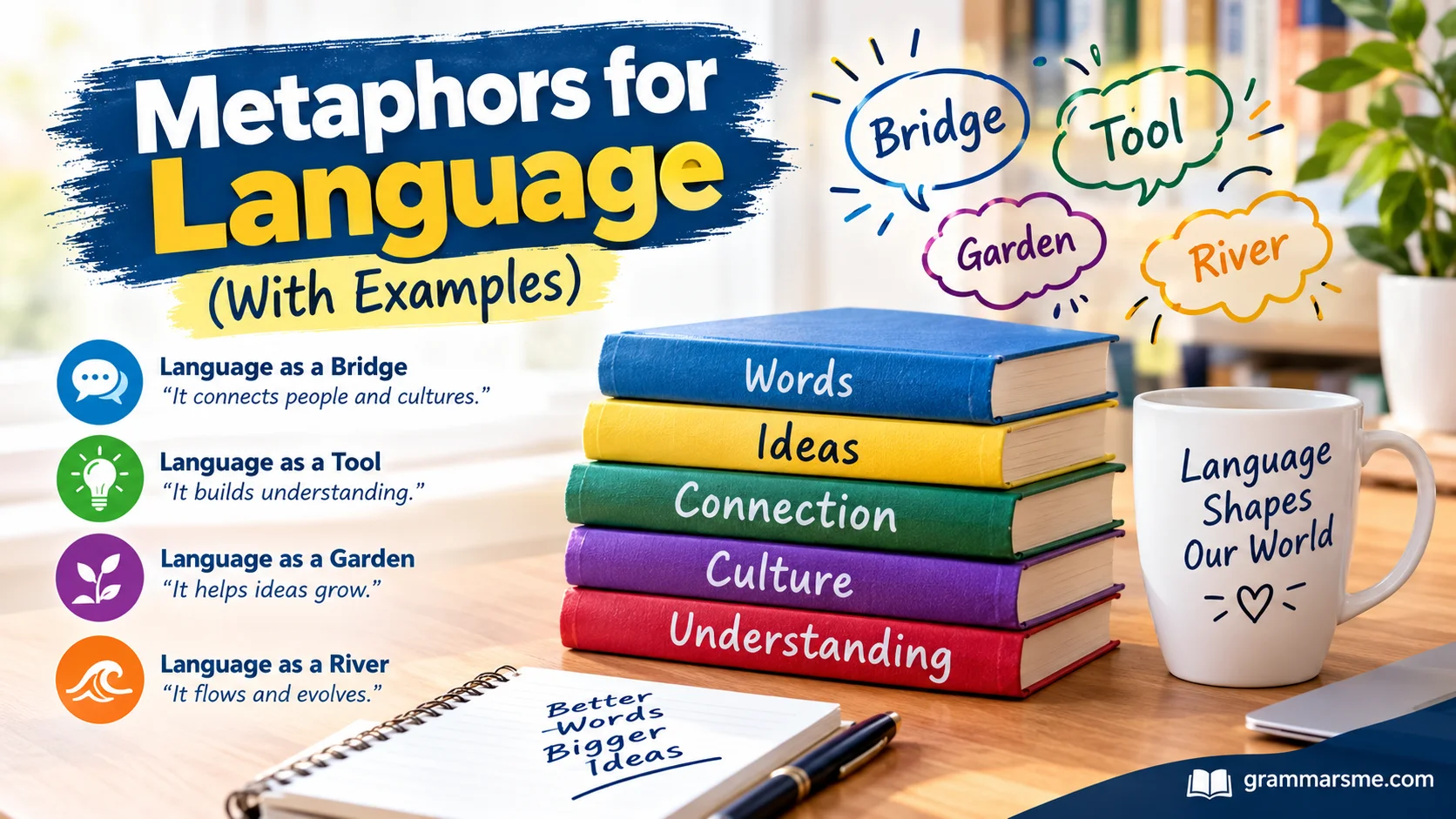

Learn how 20 Metaphors for Language (With Examples) use words and comparisons to make everyday ideas clearer, richer, and easier to understand.
Language often helps us encounter ideas in creative ways, and figurative language can paint a picture full of color and meaning. A metaphor is a fundamental pillar of literary technique, giving every writer, poet, or playwright useful tools to explain an idea through a direct comparison. It connects two things that may be generally not related but share a specific quality or characteristic. Metaphors are used efficiently and evocatively in poetry, literature, famous works, and everyday language to help artists make their meaning easier to understand.
For example, saying a classroom was a zoo does not mean animals were running around; it means the busy classroom felt noisy, chaotic, and difficult to control. Likewise, a heart of gold, heart of stone, or real firecracker can describe someone through different qualities or objects. Expressions such as turning a blind eye, blind spot, and blind rage also show how words can refer to meanings beyond their literal sense. These statements and examples highlight the many subtypes and uses of metaphors, allowing speakers and writers to explain an unlikely connection without using as or like.
1. Language Is a Bridge
Meaning:
Language is a bridge because it connects people who may have different experiences, backgrounds, emotions, or perspectives.
Detailed Explanation:
When two people communicate, language helps them cross the distance between their thoughts. Even when people disagree, carefully chosen words can create understanding. This metaphor highlights language as a tool for connection and mutual understanding.
Example:
“Her thoughtful words became a bridge between two people who had stopped understanding each other.”
Three Other Ways to Say It:
- Language connects people across differences.
- Words bring distant minds closer together.
- Communication creates a path toward understanding.
2. Language Is a Window
Meaning:
Language can be a window into someone’s thoughts, personality, feelings, and worldview.
Detailed Explanation:
The way people speak and write often reveals things they don’t directly explain. Their vocabulary, tone, stories, and expressions can give us a glimpse into their inner world. This metaphor presents language as a way to see beyond the surface.
Example:
“His stories were a window into the experiences that shaped his life.”
Three Other Ways to Say It:
- Language reveals what lies beneath the surface.
- Words offer a glimpse into the mind.
- Communication shows us how someone sees the world.
3. Language Is a Mirror
Meaning:
Language is a mirror because it can reflect our emotions, beliefs, identity, and experiences.
Detailed Explanation:
People often reveal themselves through the words they choose. A person’s language can reflect their confidence, fears, hopes, values, or personality. This metaphor works especially well when discussing self-expression.
Example:
“Her poetry was a mirror reflecting her hopes and hidden fears.”
Three Other Ways to Say It:
- Words reflect who we are.
- Language reveals our inner selves.
- Our speech shows pieces of our identity.
4. Language Is a Paintbrush
Meaning:
Language is a paintbrush because writers and speakers use words to create vivid mental pictures.
Detailed Explanation:
A skilled communicator can make readers imagine places, people, emotions, and events through carefully selected words. Just as a painter uses colors, a writer uses descriptive language to create an image.
Example:
“The author’s vivid descriptions used language like a paintbrush across the reader’s imagination.”
Three Other Ways to Say It:
- Words paint pictures in the mind.
- Language colors our imagination.
- Descriptions bring ideas to life.
5. Language Is a Key
Meaning:
Language is a key because it can unlock understanding, opportunities, knowledge, and relationships.
Detailed Explanation:
Knowing how to communicate effectively can open doors that might otherwise remain closed. Language helps people access education, build relationships, explain their needs, and participate in society. It can also unlock emotions that are difficult to express.
Example:
“Learning another language gave her a key to a culture she had never understood before.”
Three Other Ways to Say It:
- Language opens doors to understanding.
- Words unlock new possibilities.
- Communication gives us access to new worlds.
6. Language Is a River
Meaning:
Language is a river because it constantly moves, changes, develops, and carries ideas from one person or generation to another.
Detailed Explanation:
Languages are never completely still. New expressions appear, old words change meaning, and different communities influence vocabulary. Like a river, language flows through time and culture.
Example:
“Language is a river that carries the voices of generations into the future.”
Three Other Ways to Say It:
- Language flows from one generation to another.
- Words change as culture changes.
- Communication moves continuously through society.
7. Language Is a Thread
Meaning:
Language is a thread because it can connect people, memories, stories, and generations.
Detailed Explanation:
A single word or phrase can connect someone to a family tradition, childhood memory, cultural identity, or shared experience. Like a thread running through fabric, language can quietly hold different parts of life together.
Example:
“Our grandmother’s expressions were a thread connecting every generation of our family.”
Three Other Ways to Say It:
- Language ties people together.
- Words weave connections across generations.
- Communication links separate experiences.
8. Language Is a Compass
Meaning:
Language can be a compass because it helps people navigate difficult conversations, decisions, relationships, and ideas.
Detailed Explanation:
The right words can provide direction when emotions are confusing or situations are uncertain. Clear communication helps people understand what matters, where they stand, and what they should do next.
Example:
“Her calm explanation became a compass during a confusing conversation.”
Three Other Ways to Say It:
- Language guides us through uncertainty.
- Words help us find direction.
- Communication shows us a path forward.
9. Language Is a Seed
Meaning:
Language is a seed because a single word or idea can grow into a larger thought, feeling, relationship, or movement.
Detailed Explanation:
A small sentence can have a lasting effect. Encouraging words may build confidence, while a powerful idea can inspire people to make changes. Like a seed, language may begin small but develop over time.
Example:
“Her simple message planted a seed of hope in everyone who heard it.”
Three Other Ways to Say It:
- Words plant ideas in our minds.
- Language creates possibilities that can grow.
- A sentence can spark lasting change.
10. Language Is a Lantern
Meaning:
Language is a lantern because it can illuminate confusing ideas, hidden feelings, and difficult situations.
Detailed Explanation:
Clear words can bring understanding where uncertainty exists. When someone explains a complicated subject in simple language, they make the path easier to see. This metaphor emphasizes clarity and guidance.
Example:
“His explanation was a lantern that helped everyone understand the difficult subject.”
Three Other Ways to Say It:
- Words shed light on difficult ideas.
- Language makes confusion clearer.
- Communication illuminates what was previously hidden.
11. Language Is a Toolbox
Meaning:
Language is a toolbox because people have many different words and expressions for different situations.
Detailed Explanation:
A toolbox contains tools designed for specific jobs. Similarly, language gives us formal words, casual expressions, persuasive phrases, emotional vocabulary, humor, and descriptive language. Skilled communicators know which linguistic tool fits the moment.
Example:
“A strong vocabulary gives a writer a toolbox filled with different ways to express an idea.”
Three Other Ways to Say It:
- Language gives us tools for communication.
- Words help us handle different situations.
- Vocabulary provides options for expressing ideas.
12. Language Is Music
Meaning:
Language is music because rhythm, sound, repetition, pauses, and word choice can create an emotional experience.
Detailed Explanation:
Beautiful language isn’t only about meaning. The way words sound can influence how a message feels. Poetry, speeches, songs, and memorable prose often use rhythm and repetition to make language more powerful.
Example:
“The speaker’s carefully chosen words turned the speech into music for the audience’s ears.”
Three Other Ways to Say It:
- Language has its own rhythm and melody.
- Words create patterns that affect emotion.
- Communication can flow like a song.
13. Language Is a Map
Meaning:
Language is a map because it helps us organize and navigate ideas, experiences, cultures, and information.
Detailed Explanation:
A map helps travelers understand where they are and where they can go. Language performs a similar function for thought. It gives names to concepts and allows people to explain complicated experiences in an organized way.
Example:
“Words became a map that helped him make sense of his complicated emotions.”
Three Other Ways to Say It:
- Language helps us navigate our thoughts.
- Words give structure to experience.
- Communication shows us how ideas connect.
14. Language Is a Garden
Meaning:
Language is a garden because words can be cultivated, cared for, combined, and allowed to grow.
Detailed Explanation:
A rich vocabulary develops through reading, listening, writing, and conversation. Just as a garden becomes more beautiful with attention, language becomes more expressive when we continually learn and practice.
Example:
“Years of reading helped her cultivate a garden of words that enriched her writing.”
Three Other Ways to Say It:
- Vocabulary grows through practice and learning.
- Language flourishes when we nurture it.
- Words can bloom into beautiful expressions.
Read More: 20 Metaphors for Leadership (With Examples)
15. Language Is a Weapon
Meaning:
Language can be a weapon because words can hurt, attack, manipulate, or cause emotional damage.
Detailed Explanation:
Words can influence people deeply. Insults, cruel remarks, threats, and manipulative statements can leave lasting emotional wounds. This metaphor reminds us that communication carries responsibility and consequences.
Example:
“His cruel comments became weapons that damaged her confidence.”
Three Other Ways to Say It:
- Words can cause emotional wounds.
- Language can be used to hurt others.
- Harsh speech can leave lasting damage.
16. Language Is a Medicine
Meaning:
Language is a medicine when compassionate words provide comfort, encouragement, reassurance, or emotional support.
Detailed Explanation:
A thoughtful message cannot solve every problem, but it can make someone feel less alone. Kind words may provide comfort during grief, failure, fear, or uncertainty. This metaphor emphasizes the healing potential of communication.
Example:
“Her gentle words were medicine for a friend struggling through a difficult day.”
Three Other Ways to Say It:
- Words can bring emotional comfort.
- Kind language can soothe a troubled heart.
- Communication can provide reassurance during hardship.
17. Language Is an Anchor
Meaning:
Language is an anchor because familiar words can provide stability when emotions or circumstances feel uncertain.
Detailed Explanation:
During difficult moments, a reassuring sentence can help someone feel grounded. Familiar expressions, meaningful conversations, and honest communication can create a sense of emotional security.
Example:
“His father’s familiar advice became an anchor whenever life felt uncertain.”
Three Other Ways to Say It:
- Words can keep us grounded.
- Language provides stability during uncertainty.
- Reassuring communication helps us feel secure.
18. Language Is a Door
Meaning:
Language is a door because it can lead us into new relationships, cultures, knowledge, and experiences.
Detailed Explanation:
Learning how to communicate with others can create opportunities that were previously unavailable. A new language, for example, can introduce someone to different communities and ways of thinking.
Example:
“Learning Spanish opened a door into a culture she had always wanted to explore.”
Three Other Ways to Say It:
- Language opens access to new experiences.
- Words lead us into unfamiliar worlds.
- Communication creates opportunities for connection.
19. Language Is a Mirror of Culture
Meaning:
Language is a mirror of culture because it reflects a community’s history, values, traditions, relationships, and worldview.
Detailed Explanation:
Every language carries traces of the people who use it. Expressions, sayings, forms of politeness, and culturally specific words can reveal what a community considers important. Language therefore becomes a living record of cultural identity.
Example:
“Traditional sayings are a mirror reflecting the values and history of a community.”
Three Other Ways to Say It:
- Language reflects cultural identity.
- Words preserve traditions and history.
- Communication reveals what a society values.
20. Language Is a Fire
Meaning:
Language is a fire because powerful words can ignite emotions, ideas, motivation, creativity, or social change.
Detailed Explanation:
A single speech, phrase, or idea can inspire people to act. Language can create excitement, encourage courage, or start conversations that continue long after the original words were spoken. Like fire, language can spread quickly and create powerful effects.
Example:
“Her passionate speech became a fire that inspired the entire community to take action.”
Three Other Ways to Say It:
- Words ignite passion and motivation.
- Language sparks powerful ideas.
- Communication can inspire people to act.
MCQs:
1. Which metaphor describes language as a connection between people?
A. Language is a fire
B. Language is a bridge
C. Language is a garden
D. Language is an anchor
2. Which metaphor describes language as a reflection of identity?
A. Language is a mirror
B. Language is a river
C. Language is a door
D. Language is a toolbox
3. “Words paint pictures in the mind” refers to:
A. Language is a compass
B. Language is medicine
C. Language is a paintbrush
D. Language is a key
4. Which metaphor emphasizes language as a source of guidance?
A. Language is a compass
B. Language is a seed
C. Language is music
D. Language is a weapon
5. Which metaphor describes words that provide emotional comfort?
A. Language is a map
B. Language is medicine
C. Language is a window
D. Language is a river
6. Which metaphor represents language as something that can unlock opportunities?
A. Language is a key
B. Language is a mirror
C. Language is a thread
D. Language is a garden
7. “Language flows through generations” best represents:
A. Language is a lantern
B. Language is a river
C. Language is a weapon
D. Language is a door
8. Which metaphor describes vocabulary as a collection of communication tools?
A. Language is a toolbox
B. Language is a fire
C. Language is an anchor
D. Language is a window
9. Which metaphor emphasizes rhythm and sound?
A. Language is a map
B. Language is music
C. Language is a seed
D. Language is a bridge
10. “Words can plant ideas that grow” refers to:
A. Language is a seed
B. Language is a lantern
C. Language is a mirror
D. Language is a door
11. Which metaphor describes words that make confusing ideas clearer?
A. Language is a lantern
B. Language is a garden
C. Language is a thread
D. Language is a weapon
12. Which metaphor shows how language can connect generations?
A. Language is a thread
B. Language is a compass
C. Language is medicine
D. Language is music
13. Which metaphor highlights the harmful power of words?
A. Language is a window
B. Language is a weapon
C. Language is a key
D. Language is a river
14. Which metaphor represents language as a source of stability?
A. Language is an anchor
B. Language is a fire
C. Language is a paintbrush
D. Language is a garden
15. Which metaphor describes language as something that can inspire action?
A. Language is a map
B. Language is a door
C. Language is a fire
D. Language is a mirror
Answer Key:
1-B, 2-A, 3-C, 4-A, 5-B, 6-A, 7-B, 8-A, 9-B, 10-A, 11-A, 12-A, 13-B, 14-A, 15-C
FAQs:
What is a metaphor for language?
A metaphor for language compares language with something familiar to explain its power or purpose. For example, saying “language is a bridge” suggests that words connect people and create understanding.
Why use metaphors to describe language?
Metaphors make abstract ideas about communication easier to understand and more memorable. They can also make writing more vivid, emotional, and engaging.
What is the most common metaphor for language?
“Language is a bridge” is a widely useful metaphor because it captures the way communication connects people, cultures, ideas, and experiences.
Can language be both helpful and harmful?
Yes. Language can comfort, inspire, educate, and connect, but it can also hurt, manipulate, or divide people. The effect depends on the words, context, intention, and way they are delivered.
How can I create my own metaphors for language?
Think about what language does and compare that function with something familiar. If language guides people, you might call it a compass. If it reveals feelings, you could describe it as a mirror. Focus on the specific effect you want your metaphor to communicate.
Conclusion:
Language has the power to connect, reveal, guide, comfort, inspire, and transform. That is why metaphors can help us describe communication in ways that feel more vivid than literal definitions. Calling language a bridge emphasizes connection, while describing it as a lantern highlights clarity. Seeing it as a seed focuses on growth, and calling it a fire captures its ability to inspire action.
The best metaphor depends on the message you want to express. Whether you’re writing creatively, explaining an idea, or searching for a thoughtful way to describe communication, these 20 metaphors for language give you flexible ways to make your words more meaningful.



1 thought on “20 Metaphors for Language (With Examples)”