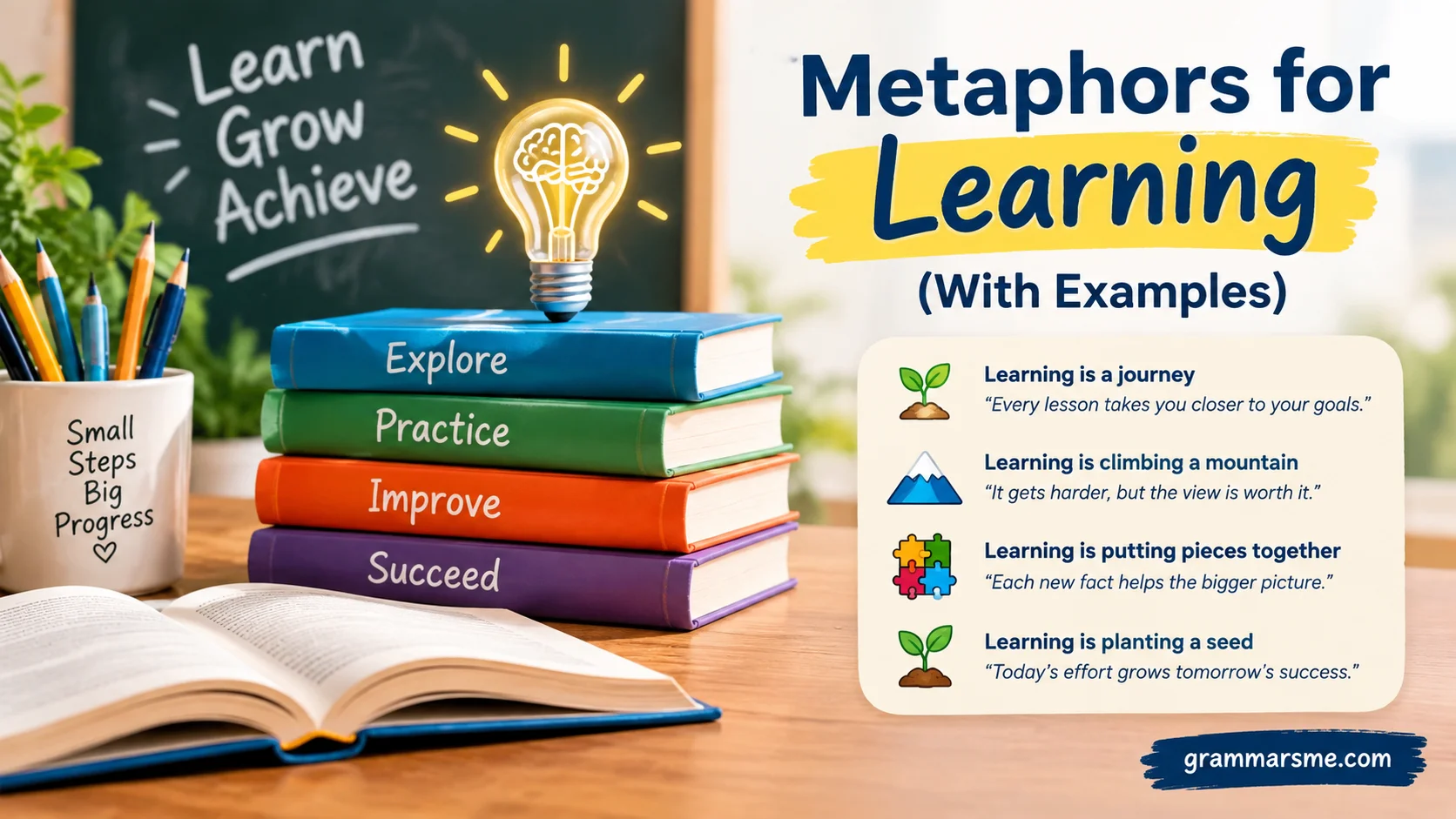

20 Metaphors for Learning (With Examples) shows how learning can be a key, seed, or light, making knowledge easier to understand and remember.
A key that opens doors shows how learning creates new opportunities, while a seed that grows with care explains how practice and patience support growth. A light helps us see ideas more clearly, and building a house represents how we develop skills step by step. These learning metaphors give an abstract idea a clear picture.
Students, teachers, writers, and speakers can use in essays, presentations, stories, speeches, and everyday conversations. Other comparisons, such as climbing a mountain, planting a seed, and opening a door, can describe mistakes, curiosity, motivation, and personal growth in a simple and relatable way.
1. Learning Is a Journey
Meaning: Learning is a journey because it involves progress, challenges, discoveries, and new destinations.
Detailed explanation:
When you learn something new, you rarely understand everything immediately. You move from one stage to another, sometimes taking wrong turns before finding the right path. This metaphor highlights the idea that learning takes time and that every step contributes to personal growth.
Example sentence:
“Learning is a journey, and every lesson takes me one step closer to understanding the world.”
Three other ways to say it:
- Learning is a path toward discovery.
- Education is a road filled with new experiences.
- Knowledge grows with every step we take.
2. Learning Is a Key
Meaning: Learning is a key because knowledge can unlock opportunities, ideas, and possibilities.
Detailed explanation:
A key opens a door that was previously closed. In the same way, learning can give you access to opportunities and perspectives you couldn’t reach before. This metaphor works especially well when talking about education and personal freedom.
Example sentence:
“Every new skill she learned became a key that opened another door in her future.”
Three other ways to say it:
- Knowledge unlocks new possibilities.
- Education opens doors to opportunity.
- Learning gives us access to new worlds.
3. Learning Is a Seed
Meaning: Learning is a seed because a small piece of knowledge can grow into something much larger.
Detailed explanation:
A seed starts small but can eventually become a strong plant. Similarly, one lesson, question, or idea can develop into deeper understanding over time. This metaphor emphasizes patience, potential, and growth.
Example sentence:
“The teacher planted a seed of curiosity that continued growing in her students long after the class ended.”
Three other ways to say it:
- Knowledge begins as a small seed of curiosity.
- Every lesson plants an idea that can grow.
- Education nurtures the seeds of understanding.
4. Learning Is a Garden
Meaning: Learning is a garden because knowledge needs attention, practice, patience, and care to flourish.
Detailed explanation:
A garden doesn’t become beautiful overnight. Plants need regular care, just as learners need practice and encouragement. This metaphor shows that consistent effort creates lasting growth.
Example sentence:
“Her mind became a garden where every book planted something new.”
Three other ways to say it:
- The mind is a garden of growing ideas.
- Learning cultivates the garden of knowledge.
- Education helps understanding bloom.
5. Learning Is a Light
Meaning: Learning is a light because knowledge can remove confusion and help us see things more clearly.
Detailed explanation:
Darkness often represents uncertainty, while light represents understanding. When you learn something, a confusing subject can suddenly become easier to understand. This metaphor is useful for describing clarity and discovery.
Example sentence:
“Learning was a light that helped him see possibilities he had never noticed before.”
Three other ways to say it:
- Knowledge shines through confusion.
- Education illuminates the unknown.
- Learning brings clarity to difficult ideas.
6. Learning Is Building a House
Meaning: Learning is like building a house because each lesson adds another part to a strong foundation.
Detailed explanation:
You cannot build a stable house without a foundation. In the same way, advanced knowledge often depends on basic concepts learned earlier. This metaphor emphasizes structure, patience, and gradual development.
Example sentence:
“Learning mathematics was like building a house, with every new concept resting on the foundation of earlier lessons.”
Three other ways to say it:
- Knowledge is built brick by brick.
- Each lesson strengthens the foundation of understanding.
- Education constructs a stronger mind.
7. Learning Is a Puzzle
Meaning: Learning is a puzzle because individual pieces of information eventually come together to form a complete understanding.
Detailed explanation:
At first, a new subject can seem like a collection of unrelated facts. As you continue studying, connections begin to appear. Eventually, those pieces create a clearer picture. This metaphor captures the problem-solving side of learning.
Example sentence:
“Understanding history felt like solving a puzzle as each new fact connected to the next.”
Three other ways to say it:
- Knowledge is a picture assembled piece by piece.
- Learning connects scattered pieces of information.
- Understanding emerges when the pieces fit together.
8. Learning Is a Bridge
Meaning: Learning is a bridge because it connects where you are now with where you want to be.
Detailed explanation:
A bridge helps people cross from one place to another. Learning performs a similar function by connecting ignorance with understanding, questions with answers, and goals with possibilities.
Example sentence:
“Education became a bridge between her childhood dreams and the career she eventually built.”
Three other ways to say it:
- Learning connects the present to the future.
- Knowledge bridges the gap between questions and answers.
- Education creates a path toward new possibilities.
9. Learning Is a Compass
Meaning: Learning is a compass because knowledge can help people make informed decisions and choose their direction.
Detailed explanation:
A compass doesn’t walk the journey for you, but it helps you understand which direction to take. Similarly, learning gives people tools for thinking, evaluating choices, and navigating unfamiliar situations.
Example sentence:
“Her education became a compass that helped her navigate difficult decisions.”
Three other ways to say it:
- Knowledge helps us find our direction.
- Education guides us through uncertainty.
- Learning provides a sense of direction.
10. Learning Is a Ladder
Meaning: Learning is a ladder because each new skill can help you reach a higher level of understanding.
Detailed explanation:
A ladder has separate steps, and you climb them one at a time. Learning often works the same way. You master basic ideas before moving toward more complex ones. The metaphor emphasizes progress and achievement.
Example sentence:
“Each book she read was another rung on the ladder of knowledge.”
Three other ways to say it:
- Every lesson raises us another level.
- Knowledge gives us steps toward greater understanding.
- Education helps us climb toward our goals.
11. Learning Is a Treasure Hunt
Meaning: Learning is a treasure hunt because discovering knowledge can feel exciting, rewarding, and unexpected.
Detailed explanation:
A treasure hunt encourages curiosity and exploration. Learning can create the same feeling when you search for answers and discover information that changes your perspective. This metaphor highlights curiosity and discovery.
Example sentence:
“For her, studying science was a treasure hunt filled with fascinating discoveries.”
Three other ways to say it:
- Learning is a search for hidden discoveries.
- Knowledge is treasure waiting to be uncovered.
- Education turns curiosity into discovery.
12. Learning Is a River
Meaning: Learning is a river because it keeps moving, changing, and carrying us toward new experiences.
Detailed explanation:
A river doesn’t remain still. It flows around obstacles and continues toward its destination. Lifelong learning can work in the same way. We encounter challenges, adapt, and continue moving forward.
Example sentence:
“Her curiosity was a river that kept flowing toward new subjects and ideas.”
Three other ways to say it:
- Knowledge flows throughout life.
- Learning keeps moving us toward discovery.
- Curiosity is a stream that never stops.
13. Learning Is a Toolbox
Meaning: Learning is a toolbox because every skill or piece of knowledge gives us another tool for solving problems.
Detailed explanation:
A toolbox contains different tools for different situations. Likewise, education provides people with skills they can apply when they face challenges. The metaphor works especially well when discussing practical knowledge and problem-solving.
Example sentence:
“Every new skill became another tool in his toolbox for handling difficult problems.”
Three other ways to say it:
- Knowledge equips us with useful tools.
- Education fills our toolbox with skills.
- Learning gives us resources for solving problems.
Read More: 20 Metaphors for Life (With Examples)
14. Learning Is a Map
Meaning: Learning is a map because knowledge helps us understand where we are and where we can go next.
Detailed explanation:
A map provides information about places, routes, and destinations. Learning can provide a similar sense of orientation. It helps us understand unfamiliar subjects and make better decisions about our next steps.
Example sentence:
“Learning a new language gave her a map for understanding another culture.”
Three other ways to say it:
- Knowledge maps out new possibilities.
- Education helps us navigate unfamiliar territory.
- Learning shows us routes toward understanding.
15. Learning Is a Staircase
Meaning: Learning is a staircase because progress happens through a series of manageable steps.
Detailed explanation:
You don’t need to reach the top of a staircase in one movement. You climb one step at a time. Learning also becomes easier when difficult goals are divided into smaller stages. This metaphor emphasizes steady progress rather than instant mastery.
Example sentence:
“Learning to write well was a staircase, with each writing exercise taking me one step higher.”
Three other ways to say it:
- Every lesson is another step forward.
- Progress happens one step at a time.
- Education takes us gradually toward mastery.
16. Learning Is a Lens
Meaning: Learning is a lens because knowledge changes how we view and interpret the world.
Detailed explanation:
A lens changes what we can see and how clearly we see it. Similarly, learning can introduce perspectives that help us understand people, events, and ideas differently. It emphasizes perspective and deeper understanding.
Example sentence:
“Studying literature gave her a new lens through which she could understand human emotions.”
Three other ways to say it:
- Knowledge changes the way we see the world.
- Education gives us new perspectives.
- Learning sharpens our view of life.
17. Learning Is a Spark
Meaning: Learning is a spark because one idea can ignite curiosity and inspire further exploration.
Detailed explanation:
A small spark can start something much larger. In learning, one interesting question can lead to another, creating a lasting desire to discover more. This metaphor captures the energy and excitement of curiosity.
Example sentence:
“That single question was a spark that started his lifelong interest in astronomy.”
Three other ways to say it:
- Curiosity begins with a spark of interest.
- One idea can ignite a passion for knowledge.
- Learning can set the mind alight with questions.
18. Learning Is a Tree
Meaning: Learning is a tree because knowledge develops roots, branches into different areas, and continues growing over time.
Detailed explanation:
A mature tree has deep roots and many branches. Similarly, basic knowledge creates roots, while advanced subjects branch into specialized areas. This metaphor beautifully represents depth, connection, and lifelong growth.
Example sentence:
“Her knowledge was a tree, with strong roots in basic education and branches reaching into many subjects.”
Three other ways to say it:
- Knowledge grows deep roots and wide branches.
- Education develops from foundations into many fields.
- Learning grows stronger as ideas connect.
19. Learning Is a Workout for the Mind
Meaning: Learning is a workout for the mind because mental practice strengthens thinking, memory, reasoning, and problem-solving abilities.
Detailed explanation:
Physical exercise challenges the body, while learning challenges the mind. Reading, practicing, questioning, and solving problems can all require mental effort. This metaphor reminds us that intellectual growth requires practice.
Example sentence:
“Solving challenging problems was a workout for the mind that strengthened her reasoning skills.”
Three other ways to say it:
- Learning exercises the mind.
- Education strengthens our mental abilities.
- Studying gives the brain a healthy challenge.
20. Learning Is an Open Door
Meaning: Learning is an open door because new knowledge can lead to opportunities, perspectives, experiences, and possibilities.
Detailed explanation:
An open door suggests possibility and invitation. Learning can introduce people to careers, cultures, ideas, and experiences they may never have encountered otherwise. This metaphor gives learning an optimistic and forward-looking meaning.
Example sentence:
“Learning a new skill was an open door to opportunities she had never considered before.”
Three other ways to say it:
- Knowledge opens the way to new possibilities.
- Education invites us into new worlds.
- Every new skill can open another door.
MCQs:
1. Which metaphor describes knowledge helping someone choose a direction?
A. Learning is a garden
B. Learning is a compass
C. Learning is a seed
D. Learning is a puzzle
2. Which metaphor focuses on knowledge growing from a small idea?
A. Learning is a seed
B. Learning is a bridge
C. Learning is a map
D. Learning is a lens
3. “Each lesson became another step toward mastery.” Which metaphor fits best?
A. Learning is a river
B. Learning is a staircase
C. Learning is a treasure hunt
D. Learning is a toolbox
4. Which metaphor describes learning as something that unlocks opportunities?
A. Learning is a key
B. Learning is a river
C. Learning is a workout
D. Learning is a tree
5. Which metaphor represents different pieces coming together to create understanding?
A. Learning is a garden
B. Learning is a puzzle
C. Learning is a ladder
D. Learning is a light
6. “Her education connected her current situation with her future career.” Which metaphor fits?
A. Learning is a bridge
B. Learning is a spark
C. Learning is a seed
D. Learning is a lens
7. Which metaphor emphasizes mental practice and effort?
A. Learning is an open door
B. Learning is a workout for the mind
C. Learning is a map
D. Learning is a river
8. Which metaphor describes knowledge changing how we see something?
A. Learning is a lens
B. Learning is a ladder
C. Learning is a toolbox
D. Learning is a garden
9. Which metaphor best represents lifelong growth and interconnected knowledge?
A. Learning is a tree
B. Learning is a key
C. Learning is a puzzle
D. Learning is a compass
10. “One fascinating question inspired her to explore an entire subject.” Which metaphor fits?
A. Learning is a staircase
B. Learning is a spark
C. Learning is a bridge
D. Learning is a map
11. Which metaphor describes learning as a gradual process with different stages?
A. Learning is a ladder
B. Learning is a light
C. Learning is a treasure hunt
D. Learning is an open door
12. Which metaphor emphasizes curiosity and discovery?
A. Learning is a treasure hunt
B. Learning is a house
C. Learning is a compass
D. Learning is a workout
13. “Every new skill gave him another resource for solving problems.” Which metaphor fits?
A. Learning is a toolbox
B. Learning is a river
C. Learning is a tree
D. Learning is a garden
14. Which metaphor suggests that knowledge can bring clarity to confusion?
A. Learning is a light
B. Learning is a staircase
C. Learning is a seed
D. Learning is a bridge
15. Which metaphor presents education as an opportunity to enter new experiences?
A. Learning is a puzzle
B. Learning is an open door
C. Learning is a river
D. Learning is a workout
Answer Key:
1-B, 2-A, 3-B, 4-A, 5-B, 6-A, 7-B, 8-A, 9-A, 10-B, 11-A, 12-A, 13-A, 14-A, 15-B.
FAQs:
What is a metaphor for learning?
A metaphor for learning compares education or gaining knowledge to something familiar. For example, “Learning is a journey” compares the process of gaining knowledge to traveling toward a destination.
What is a good metaphor for learning?
“Learning is a journey” is one of the most versatile metaphors because it captures progress, challenges, discovery, and personal growth. Other useful choices include “learning is a garden,” “learning is a key,” and “learning is a light.”
How can I use metaphors for learning in writing?
Choose a metaphor that matches the idea you want to communicate. For growth, use “learning is a seed.” For clarity, use “learning is a light.” For progress, use “learning is a staircase.” Then explain the comparison naturally in your sentence.
Why are metaphors useful when describing learning?
Metaphors make an abstract process easier to understand. Instead of simply saying that learning involves progress, you can say “Learning is a journey.” This gives readers a visual way to understand the experience.
What is a metaphor for lifelong learning?
“Learning is a river” works well for lifelong learning because a river keeps flowing. It suggests that learning continues throughout life, changing direction and carrying us toward new experiences and discoveries.
Conclusion:
The right metaphor can turn a simple statement about education into something memorable, vivid, and meaningful. These 20 metaphors for learning show that gaining knowledge can be compared with a journey, garden, key, light, bridge, puzzle, tree, staircase, and many other familiar ideas. Each comparison highlights a different part of the experience, from curiosity and discovery to patience, progress, and personal growth. Choose the metaphor that best matches the feeling or message you want to express, and let it make your writing more personal and engaging.



1 thought on “20 Metaphors for Learning (With Examples)”