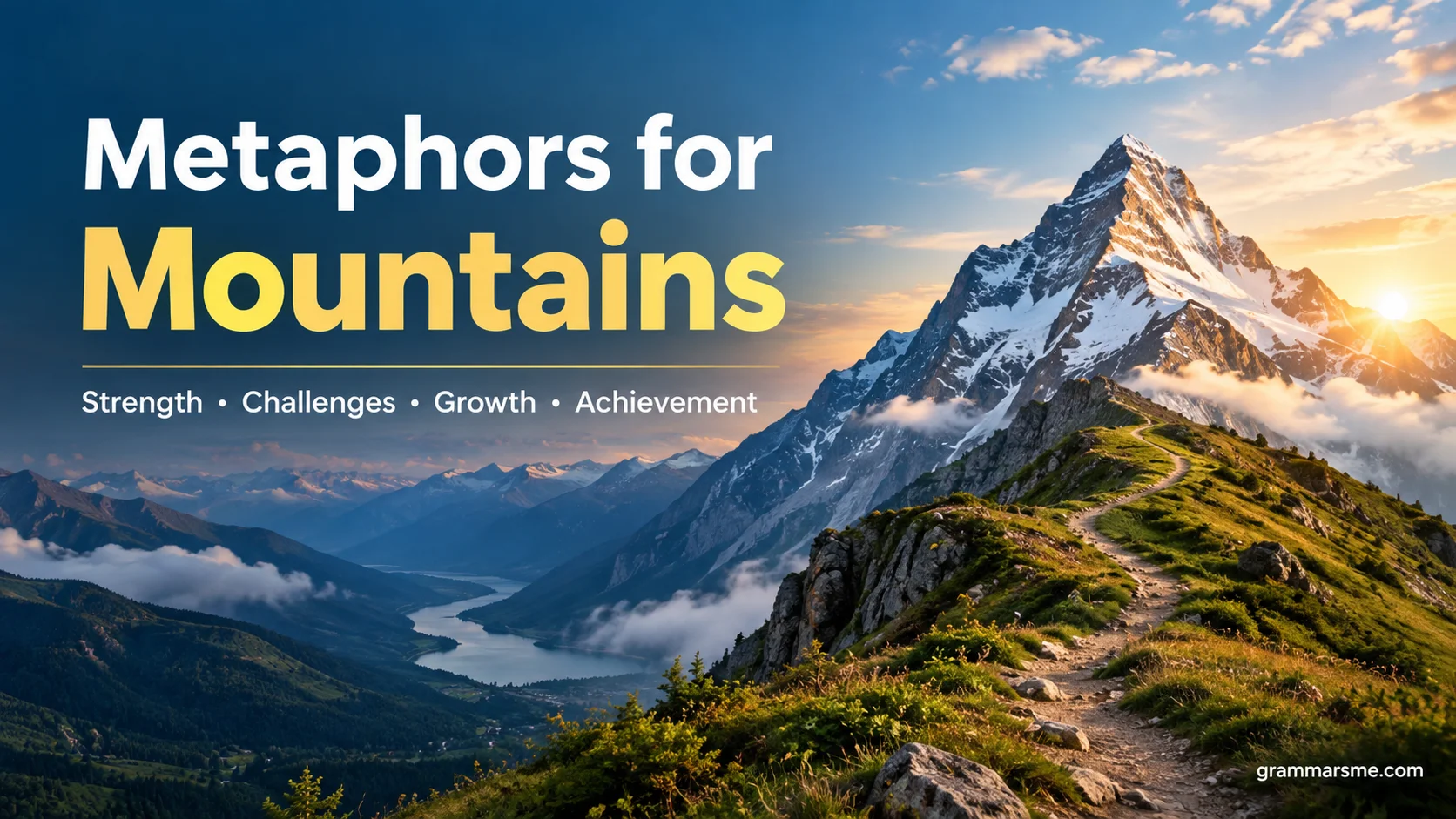

Finding the right words can make our thoughts more personal, vivid, and meaningful, and 20 Metaphors for Mountains (With Examples) shows how mountains can represent strength and hope.
Mountains can represent challenges, achievement, stability, and perspective, adding emotional depth to everyday writing and conversations about a difficult journey, major goal, or remarkable inner strength. A thoughtful metaphor turns a simple statement into an image readers can understand, especially when emotions are difficult to explain. In writing, a poem, speech, story, essay, or personal message, these expressions make words more memorable. The 20 metaphors for mountains explore growth, courage, and hope, with each metaphor offering meaning
Their bountiful beauty, grave silence, and rocky behemoths can stretch the human imagination. To look upon them feels humbling, while standing amongst them or choosing to climb them can become a supreme experience that makes us soar, irregardless of difficulty. Hiking beneath coniferous trees, mining through jagged rocks, and struggling toward a snowcapped summit reveal why mountains keep standing mightily and growing across millennia. Their rocky, natural connection to the world, geography, mountain, trees, rocks, summit, and climbing makes them powerful symbols.
1. Mountains Are Giants
Meaning: This metaphor compares mountains to giants because of their enormous size, strength, and commanding presence.
Detailed explanation:
A giant represents something powerful and difficult to ignore. When mountains are described as giants, the comparison emphasizes their massive scale and strength. It can also suggest that mountains seem like ancient beings standing silently above everything around them. This metaphor works especially well when describing a landscape that makes people feel small or humbled.
Example sentences:
- The mountains stood like giants guarding the valley.
- At sunrise, the rocky peaks looked like sleeping giants.
- We felt tiny beside those enormous stone giants.
3 other ways to say it:
- Mountains are towering guardians.
- Mountains are colossal sentinels.
- Mountains are massive stone beings.
2. Mountains Are Stepping Stones
Meaning: This metaphor presents mountains as stepping stones toward growth and achievement.
Detailed explanation:
A mountain may look like an obstacle, but climbing it can move you closer to your goal. Calling mountains stepping stones changes the focus from difficulty to progress. It suggests that every challenge can teach you something useful and help you reach a higher level of understanding or success.
Example sentences:
- Every difficult experience became a stepping stone toward her dreams.
- He treated each mountain in his career as a stepping stone, not a barrier.
- The challenges before us were only stepping stones to something greater.
3 other ways to say it:
- Mountains are steps toward success.
- Mountains are bridges to growth.
- Mountains are stages on the road to achievement.
3. Mountains Are Sleeping Giants
Meaning: This metaphor describes mountains as huge, powerful forms that appear peaceful and still.
Detailed explanation:
Mountains can seem completely motionless, almost as if they are sleeping. The phrase combines their enormous physical presence with a sense of quiet power. It can create an atmosphere of mystery, peace, and ancient strength.
Example sentences:
- The distant peaks looked like sleeping giants beneath the morning mist.
- Snow covered the slopes of the sleeping giants.
- The valley rested quietly beneath those enormous sleeping giants.
3 other ways to say it:
- Mountains are silent giants.
- Mountains are resting titans.
- Mountains are quiet colossi.
4. Mountains Are Life’s Obstacles
Meaning: This metaphor compares mountains with the difficult problems people encounter in life.
Detailed explanation:
A mountain requires effort to climb, just as many life challenges require patience and determination. This metaphor is useful when discussing hardship, personal struggles, setbacks, or difficult goals. It reminds readers that obstacles may be demanding without being impossible.
Example sentences:
- Losing his job felt like a mountain blocking his path.
- We all face mountains in life, but we can choose how to climb them.
- Her fear was a mountain standing between her and confidence.
3 other ways to say it:
- Mountains are barriers on life’s path.
- Mountains are challenges we must climb.
- Mountains are walls standing before us.
5. Mountains Are Pillars of the Earth
Meaning: This metaphor describes mountains as strong supports that seem to hold up the natural world.
Detailed explanation:
Pillars support buildings and structures. When mountains are called pillars of the Earth, the metaphor emphasizes their stability, permanence, and strength. It creates an image of mountains as foundational parts of the landscape that have witnessed generations come and go.
Example sentences:
- The ancient peaks looked like pillars of the Earth.
- Snow-covered mountains rose like great pillars beneath the sky.
- Those peaks have stood like pillars of the Earth for centuries.
3 other ways to say it:
- Mountains are foundations of the landscape.
- Mountains are columns of nature.
- Mountains are supports of the Earth.
6. Mountains Are Nature’s Staircase
Meaning: This metaphor presents a mountain as a natural staircase leading upward.
Detailed explanation:
A staircase takes you from a lower position to a higher one. Mountain slopes can symbolize the same movement, especially when discussing progress, ambition, learning, or personal growth. Each step represents another effort toward reaching a higher destination.
Example sentences:
- The winding trail felt like nature’s staircase to the clouds.
- Every rock beneath our feet became another step on nature’s staircase.
- Her journey toward success was like climbing nature’s staircase.
3 other ways to say it:
- Mountains are stairs to the sky.
- Mountains are nature’s upward path.
- Mountains are steps toward the summit.
7. Mountains Are Silent Teachers
Meaning: This metaphor describes mountains as quiet sources of wisdom and life lessons.
Detailed explanation:
Mountains don’t speak, yet they can inspire people to think about patience, endurance, humility, and resilience. Their stillness creates the impression that they have something important to teach anyone willing to observe them.
Example sentences:
- The mountains became silent teachers of patience.
- Sitting among the peaks, she learned from these silent teachers.
- The mountain taught him that strength doesn’t always need a voice.
3 other ways to say it:
- Mountains are quiet mentors.
- Mountains are teachers without words.
- Mountains are silent sources of wisdom.
8. Mountains Are Nature’s Fortresses
Meaning: This metaphor compares mountains to strong fortresses that protect and surround the land.
Detailed explanation:
Fortresses are built to withstand pressure and provide protection. Mountains can resemble them because of their steep cliffs, enormous walls of rock, and imposing appearance. The metaphor works particularly well when describing mountain ranges surrounding a town or valley.
Example sentences:
- The mountains formed nature’s fortress around the village.
- The valley was protected by a wall of rocky fortresses.
- We entered a landscape surrounded by nature’s towering fortresses.
3 other ways to say it:
- Mountains are natural castles.
- Mountains are stone strongholds.
- Mountains are rocky defenses.
9. Mountains Are Challenges to Conquer
Meaning: This metaphor presents mountains as major challenges that require determination to overcome.
Detailed explanation:
The word “conquer” creates a strong image of courage and persistence. This metaphor doesn’t necessarily mean physically defeating a mountain. Instead, it can represent personal goals, fears, difficult circumstances, or ambitious dreams.
Example sentences:
- Her fear was a mountain she was determined to conquer.
- Every major goal felt like another mountain to conquer.
- He faced his doubts as if they were mountains waiting to be conquered.
3 other ways to say it:
- Mountains are battles to overcome.
- Mountains are goals waiting to be reached.
- Mountains are challenges demanding courage.
10. Mountains Are Beacons of Hope
Meaning: This metaphor describes mountains as visible symbols that provide direction, inspiration, or hope.
Detailed explanation:
A beacon helps people find their way. Mountains are often visible from great distances, making them natural landmarks. In figurative language, they can represent a goal or source of encouragement that remains visible even when the journey becomes difficult.
Example sentences:
- The distant peak became a beacon of hope during the long journey.
- Her dream stood like a mountain beacon guiding her forward.
- The summit remained a symbol of hope when the climb became difficult.
3 other ways to say it:
- Mountains are guiding lights.
- Mountains are symbols of hope.
- Mountains are landmarks of possibility.
11. Mountains Are Nature’s Crowns
Meaning: This metaphor compares mountain peaks to crowns placed upon the landscape.
Detailed explanation:
A crown represents distinction, beauty, and importance. Snow-covered peaks can look especially crown-like when they rise above valleys and forests. This metaphor is ideal for poetic descriptions of natural beauty.
Example sentences:
- Snow rested on the peaks like nature’s crowns.
- The highest mountain wore a white crown above the valley.
- At sunset, the mountains looked like golden crowns against the sky.
3 other ways to say it:
- Mountains are crowns of the landscape.
- Mountains are jewels of the Earth.
- Mountains are royal peaks of nature.
12. Mountains Are Frozen Waves
Meaning: This metaphor compares mountain ranges to enormous ocean waves that have become still.
Detailed explanation:
Mountain ranges often rise and fall across the horizon in shapes that resemble waves. Calling them frozen waves combines the movement of the sea with the stillness of rock. It creates a vivid visual image, particularly for poetic or descriptive writing.
Example sentences:
- The distant range looked like frozen waves beneath the clouds.
- The mountains rolled across the horizon like waves turned to stone.
- We watched the landscape of frozen waves change color at sunset.
3 other ways to say it:
- Mountains are waves of stone.
- Mountains are solid ocean swells.
- Mountains are rocky waves beneath the sky.
13. Mountains Are Books of Time
Meaning: This metaphor presents mountains as ancient records that hold the history of the Earth.
Detailed explanation:
Mountains can exist for millions of years, carrying evidence of geological changes and natural events. Describing them as books of time suggests that their layers, rocks, and formations contain stories from the distant past.
Example sentences:
- The mountain was an open book of time, written in layers of rock.
- Scientists studied the cliffs like pages from Earth’s history.
- Every rock seemed to tell a chapter in the book of time.
3 other ways to say it:
- Mountains are pages of Earth’s history.
- Mountains are archives of nature.
- Mountains are ancient records of time.
Read More: 20 Metaphors for Music (With Examples)
14. Mountains Are Walls Against the Storm
Meaning: This metaphor compares mountains to protective walls that stand against harsh weather and adversity.
Detailed explanation:
Mountain ranges can influence winds, clouds, and weather patterns. Figuratively, they can also represent strength and protection. The metaphor works when describing someone or something that remains firm when faced with pressure.
Example sentences:
- The mountain range stood like a wall against the storm.
- Her courage was a mountain wall against fear.
- The peaks seemed to shield the valley like massive stone walls.
3 other ways to say it:
- Mountains are shields against adversity.
- Mountains are barriers against the storm.
- Mountains are strongholds against hardship.
15. Mountains Are Mirrors of Courage
Meaning: This metaphor suggests that mountains reflect the courage required to face difficult experiences.
Detailed explanation:
Looking at a mountain can remind people of the effort required to climb it. In this sense, the mountain becomes a mirror reflecting determination, bravery, endurance, and self-belief. It can also describe a person whose strength becomes visible through difficult circumstances.
Example sentences:
- The climb became a mirror of her courage.
- The mountain reflected the determination hidden inside him.
- Standing at the summit, she saw the journey as a reflection of her courage.
3 other ways to say it:
- Mountains are reflections of resilience.
- Mountains are symbols of bravery.
- Mountains are images of inner strength.
16. Mountains Are Goals on the Horizon
Meaning: This metaphor describes mountains as visible goals that encourage people to keep moving forward.
Detailed explanation:
A distant mountain gives travelers a recognizable destination. In everyday life, goals can work in the same way. They may seem far away, but having something visible to work toward can provide motivation and direction.
Example sentences:
- Her dreams stood like mountains on the horizon.
- The promotion was another mountain waiting on his horizon.
- We kept moving because our destination remained visible on the horizon.
3 other ways to say it:
- Mountains are distant goals.
- Mountains are targets in the distance.
- Mountains are destinations waiting ahead.
17. Mountains Are Guardians of the Valley
Meaning: This metaphor presents mountains as protective guardians watching over the land below.
Detailed explanation:
Because mountains surround and tower above valleys, they can appear protective and watchful. This metaphor gives the landscape a warm, almost human quality. It is useful when describing safety, belonging, or a strong connection between people and nature.
Example sentences:
- The mountains stood like guardians watching over the valley.
- Villagers had always viewed the peaks as protective guardians.
- Beneath the mountains, the town rested safely under nature’s watchful eyes.
3 other ways to say it:
- Mountains are protectors of the land.
- Mountains are watchful sentinels.
- Mountains are natural guardians.
18. Mountains Are Tests of Endurance
Meaning: This metaphor compares mountains with difficult experiences that test patience and persistence.
Detailed explanation:
A long climb requires physical and mental endurance. In figurative language, mountains can represent situations that reveal how long someone can continue despite fatigue, setbacks, or uncertainty. The metaphor emphasizes the value of persistence rather than speed.
Example sentences:
- The difficult project became a test of endurance.
- Every steep section of the climb tested our patience and strength.
- Life sometimes gives us mountains that reveal how strong we have become.
3 other ways to say it:
- Mountains are trials of resilience.
- Mountains are tests of persistence.
- Mountains are journeys that measure strength.
19. Mountains Are Bridges Between Earth and Sky
Meaning: This metaphor describes mountains as natural structures connecting the ground with the heavens.
Detailed explanation:
Mountains rise dramatically from the Earth toward the sky. This makes them powerful symbols of connection, aspiration, spirituality, and dreams. The metaphor is especially effective in poetic writing because it combines two contrasting spaces into one image.
Example sentences:
- The peaks looked like bridges between Earth and sky.
- From the summit, it felt as though we had crossed a bridge into the clouds.
- The mountain stood like a natural bridge connecting earth with heaven.
3 other ways to say it:
- Mountains are pathways to the sky.
- Mountains are links between earth and heaven.
- Mountains are ladders reaching toward the clouds.
20. Mountains Are Symbols of Resilience
Meaning: This metaphor presents mountains as powerful examples of strength that endure through changing conditions.
Detailed explanation:
Mountains experience wind, rain, snow, heat, erosion, and countless seasons while continuing to stand. Because of this, they are natural symbols of resilience and endurance. This metaphor works particularly well when encouraging someone who is facing a difficult period.
Example sentences:
- She stood like a mountain of resilience through every setback.
- His spirit was a mountain that refused to crumble.
- The old mountain became a symbol of strength through every season.
3 other ways to say it:
- Mountains are emblems of endurance.
- Mountains are monuments to strength.
- Mountains are symbols of unwavering courage.
MCQs:
1. What does “mountains are silent teachers” suggest?
A. Mountains make loud sounds
B. Mountains provide wisdom through their presence
C. Mountains are easy to climb
D. Mountains are artificial structures
2. Which metaphor best represents resilience?
A. Mountains are frozen waves
B. Mountains are nature’s crowns
C. Mountains are symbols of resilience
D. Mountains are books of time
3. “The mountains stood like giants” emphasizes their:
A. Small size
B. Enormous presence
C. Fragility
D. Speed
4. Which metaphor represents goals and ambition?
A. Mountains are goals on the horizon
B. Mountains are walls against storms
C. Mountains are silent teachers
D. Mountains are books of time
5. What does “mountains are stepping stones” communicate?
A. Challenges can help us move toward growth
B. Mountains are made of stairs
C. Mountains are dangerous animals
D. Mountains prevent all progress
6. Which metaphor describes mountains as protective?
A. Mountains are frozen waves
B. Mountains are guardians of the valley
C. Mountains are books of time
D. Mountains are goals on the horizon
7. “Mountains are nature’s crowns” mainly highlights:
A. Beauty and distinction
B. Fear and danger
C. Speed and movement
D. Silence and darkness
8. Which metaphor compares mountains with Earth’s history?
A. Mountains are mirrors of courage
B. Mountains are books of time
C. Mountains are stepping stones
D. Mountains are challenges to conquer
9. What does “mountains are nature’s staircase” suggest?
A. Mountains lead upward toward a higher place
B. Mountains are made by humans
C. Mountains disappear quickly
D. Mountains are underground
10. Which metaphor best describes overcoming a difficult problem?
A. Mountains are nature’s crowns
B. Mountains are frozen waves
C. Mountains are challenges to conquer
D. Mountains are bridges between Earth and sky
11. “Mountains are beacons of hope” focuses on:
A. Direction and encouragement
B. Geological age
C. Physical weakness
D. Darkness
12. Which metaphor presents mountains as ancient records?
A. Mountains are pillars of the Earth
B. Mountains are books of time
C. Mountains are walls against the storm
D. Mountains are silent teachers
13. What does “mountains are tests of endurance” mean?
A. Mountains test persistence and strength
B. Mountains are always easy to climb
C. Mountains have no obstacles
D. Mountains are symbols of wealth
14. Which metaphor emphasizes a connection between the Earth and sky?
A. Mountains are life’s obstacles
B. Mountains are frozen waves
C. Mountains are bridges between Earth and sky
D. Mountains are nature’s fortresses
15. Which metaphor best describes mountains as protective barriers?
A. Mountains are walls against the storm
B. Mountains are books of time
C. Mountains are stepping stones
D. Mountains are goals on the horizon
Answer Key:
1-B, 2-C, 3-B, 4-A, 5-A, 6-B, 7-A, 8-B, 9-A, 10-C, 11-A, 12-B, 13-A, 14-C, 15-A
FAQs:
What is a metaphor for a mountain?
A mountain can be a metaphor for strength, resilience, challenges, ambition, stability, or personal growth. For example, saying “Her determination was a mountain” suggests that her determination was powerful and difficult to overcome.
What do mountains symbolize in writing?
Mountains commonly symbolize challenges, achievement, endurance, wisdom, stability, and transformation. The meaning depends on the context in which the mountain metaphor is used.
What is a metaphor for climbing a mountain?
Climbing a mountain can represent overcoming difficulties, pursuing a goal, growing as a person, or moving toward success. For example, “Climbing the mountain of self-doubt” describes the process of overcoming insecurity.
What is a poetic metaphor for mountains?
A poetic metaphor could be “Mountains are frozen waves” or “Mountains are bridges between Earth and sky.” These comparisons create strong visual images while expressing deeper ideas about nature and human experience.
How can mountain metaphors describe life?
Mountain metaphors can describe life as a challenging climb, a journey toward a summit, or a landscape filled with obstacles and beautiful viewpoints. They help explain how difficult experiences can lead to growth and new perspectives.
Conclusion:
Mountain metaphors can give ordinary ideas greater emotional depth and stronger imagery. A mountain can represent a challenge, a dream, a source of strength, a protective presence, or a reminder of how far someone has come. Expressions such as “mountains are silent teachers,” “mountains are goals on the horizon,” and “mountains are symbols of resilience” allow you to communicate complex feelings in simple, memorable language. The most effective metaphor is the one that fits your message naturally. Whether you’re writing creatively, encouraging someone, or describing nature, these 20 metaphors for mountains can help your words feel more vivid, thoughtful, and meaningful.



1 thought on “20 Metaphors for Mountains (With Examples)”