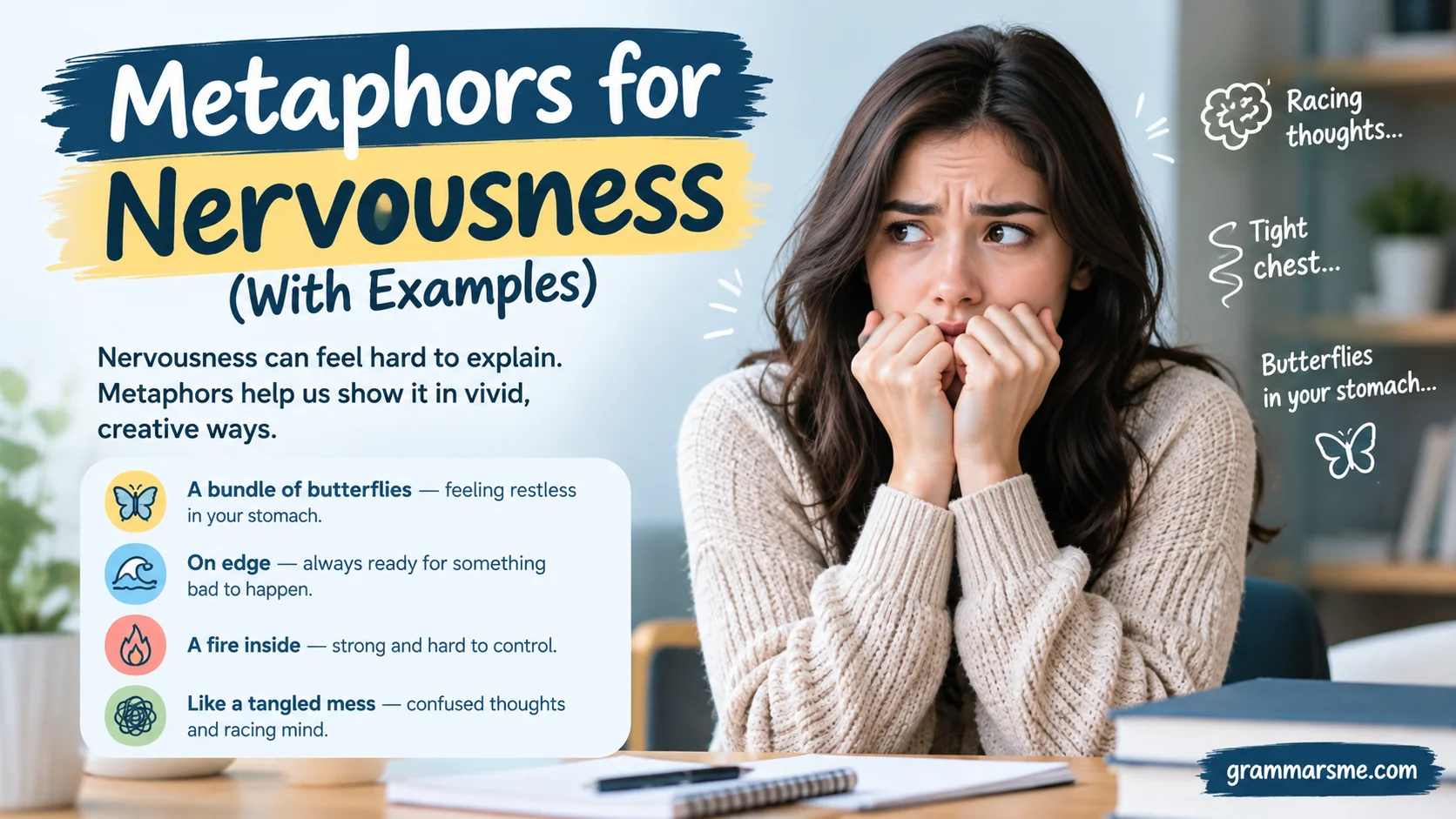

20 Metaphors for Nervousness (With Examples) can make anxiety easier to explain by turning nervous feelings into clear, vivid images.
Nervousness can affect the heart, heartbeat, palms, and thoughts, making them feel like startled birds. Nervousness metaphors such as butterflies trapped in a jar, tangled wires, racing horses, and emotional storms give an abstract emotion a physical shape. A Metaphor for Nervous can describe fluttering wildly in the stomach, restless energy, hands shake, mind race, and words stumble before a speech, interview, risky text, or confession.
A Metaphor for nervous can also show the unpredictable and uncontrollable side of nerves without simply saying “I’m nervous”. The phrase “My stomach is a fluttering bird” helps the reader feel the tension, unease, anticipation, worry, excitement, and fear behind nervousness. A storm before calm can represent how we care deeply about an outcome, while a good metaphor can name a pattern without treating a feeling as a fact. Anxiety itself involves the mind and body preparing for a possible threat, even when that threat is uncertain, distant, or not actually dangerous.
1. A Storm Brewing Inside
Meaning: This metaphor describes nervousness as an emotional storm that is building within you.
Detailed Explanation: When you’re nervous, your thoughts and emotions can become increasingly unsettled. You may feel calm on the outside while your mind is filled with worry, uncertainty, and anticipation. Comparing nervousness to a storm brewing inside captures that growing emotional pressure. It works especially well when you’re waiting for something important to happen.
Example Sentence: “Before walking into the interview, a storm was brewing inside me, even though I tried to look confident.”
3 Other Ways to Say It:
- A whirlwind of emotions
- A gathering cloud of worry
- A tempest in my mind
2. Butterflies in My Stomach
Meaning: This familiar metaphor describes the fluttering, unsettled feeling caused by nervousness.
Detailed Explanation: Nervousness often produces physical sensations in the stomach. Your stomach may feel light, jumpy, or unsettled, almost as though butterflies are moving around inside it. This metaphor is particularly useful for mild or excited nervousness, such as before meeting someone, performing, or attending an important event.
Example Sentence: “I had butterflies in my stomach before stepping onto the stage.”
3 Other Ways to Say It:
- A flutter in my stomach
- A swarm in my belly
- A nervous flutter inside
3. A Knot in My Stomach
Meaning: This metaphor represents the tight, uncomfortable feeling that nervousness can create in your stomach.
Detailed Explanation: Anxiety and nervousness can make your stomach feel physically tense. Saying you have a knot in your stomach communicates both the emotional and physical side of nervousness. It is especially appropriate when you’re worried about an unpleasant outcome or difficult situation.
Example Sentence: “I felt a knot in my stomach as I waited for the results.”
3 Other Ways to Say It:
- A twist in my stomach
- A tightness in my gut
- A tangled feeling inside
4. A Shaking Leaf
Meaning: This metaphor compares a nervous person to a leaf trembling in the wind.
Detailed Explanation: A leaf can shake gently when exposed to even a small breeze. In the same way, nervousness can make your hands, voice, or entire body tremble. A shaking leaf creates a gentle and visual image of vulnerability without making the emotion sound overwhelming.
Example Sentence: “Standing in front of the audience, I felt like a shaking leaf in the wind.”
3 Other Ways to Say It:
- A trembling branch
- A leaf caught in the breeze
- A fragile thing in the wind
5. A Buzzing Wire
Meaning: This metaphor compares nervous energy to an electrical wire that is constantly buzzing.
Detailed Explanation: Nervousness can make your body feel full of restless energy. Your mind may race, your fingers may move constantly, and you may find it difficult to sit still. Describing yourself as a buzzing wire highlights that feeling of internal energy that refuses to settle.
Example Sentence: “Before my presentation, I felt like a buzzing wire, unable to sit still.”
3 Other Ways to Say It:
- A live current
- A charged wire
- An electric pulse of worry
6. A Racing Engine
Meaning: This metaphor compares nervousness to an engine running faster than it should.
Detailed Explanation: When you’re nervous, your heart may beat faster and your thoughts can move rapidly from one concern to another. A racing engine captures this sense of acceleration and difficulty slowing down. It is especially effective when describing nervous energy before an important event.
Example Sentence: “My heart felt like a racing engine as I waited for my name to be called.”
3 Other Ways to Say It:
- A revving motor
- An engine running too fast
- A machine that won’t slow down
7. A Cage of Thoughts
Meaning: This metaphor describes nervousness as being trapped inside repetitive and worrying thoughts.
Detailed Explanation: Nervousness isn’t always physical. Sometimes the mind becomes the main source of discomfort. You may repeatedly imagine what could go wrong or replay possible conversations. A cage of thoughts expresses the feeling of being mentally trapped by your own worries.
Example Sentence: “Before the conversation, I felt trapped inside a cage of thoughts.”
3 Other Ways to Say It:
- A prison of worries
- A maze of thoughts
- A trap of uncertainty
8. A Tightrope Over the Unknown
Meaning: This metaphor compares nervousness to carefully balancing while facing an uncertain outcome.
Detailed Explanation: Walking across a tightrope requires concentration because one wrong step can create danger. Nervousness can feel similar when you’re entering unfamiliar territory or making an important decision. A tightrope over the unknown communicates uncertainty, pressure, and vulnerability.
Example Sentence: “Starting my new job felt like walking a tightrope over the unknown.”
3 Other Ways to Say It:
- Balancing on uncertainty
- Walking a narrow path
- Stepping carefully into the unknown
9. A Drumbeat in My Chest
Meaning: This metaphor describes the rapid heartbeat that often accompanies nervousness.
Detailed Explanation: One of the clearest physical signs of nervousness is a pounding or racing heart. Comparing that sensation to a drumbeat in the chest makes the feeling vivid and easy to imagine. It can work particularly well in storytelling and emotional writing.
Example Sentence: “As I approached the microphone, a drumbeat echoed in my chest.”
3 Other Ways to Say It:
- A pounding rhythm inside
- A heartbeat like a drum
- A thunderous pulse
10. A Cloud Hanging Over Me
Meaning: This metaphor represents a persistent feeling of worry or nervous anticipation.
Detailed Explanation: A cloud can block sunlight and make the atmosphere feel heavy. Similarly, nervousness can cast a shadow over an otherwise ordinary moment. A cloud hanging over me is useful when nervousness remains in the background for a long period rather than appearing suddenly.
Example Sentence: “The upcoming exam felt like a cloud hanging over me all week.”
3 Other Ways to Say It:
- A shadow over my mind
- A dark cloud of worry
- A weight in the air
11. A Cage of Butterflies
Meaning: This metaphor combines excitement and nervousness by imagining butterflies trapped inside you.
Detailed Explanation: Butterflies traditionally represent nervous excitement, while a cage suggests something difficult to contain. Together, a cage of butterflies creates a vivid image of emotions fluttering wildly inside you. It is ideal for situations involving excitement mixed with uncertainty.
Example Sentence: “Before meeting my favorite author, I had a cage of butterflies fluttering inside me.”
3 Other Ways to Say It:
- A swarm of restless butterflies
- A fluttering storm inside
- Trapped wings in my stomach
12. A Volcano Ready to Erupt
Meaning: This metaphor describes nervousness as intense internal pressure that feels close to bursting.
Detailed Explanation: A volcano stores enormous pressure beneath its surface before erupting. Nervousness can sometimes feel similar when emotions, worries, and anticipation build until they become difficult to contain. A volcano ready to erupt is stronger than gentle metaphors such as butterflies and works best for intense nervousness.
Example Sentence: “I tried to stay calm, but inside I felt like a volcano ready to erupt.”
3 Other Ways to Say It:
- A pressure cooker
- A mountain of pent-up emotion
- A storm about to break
13. A Ticking Clock
Meaning: This metaphor represents nervousness caused by waiting for an important moment or deadline.
Detailed Explanation: The sound of a ticking clock can make people increasingly aware that time is passing. When you’re nervous about an approaching event, every second may seem significant. A ticking clock captures the pressure created by anticipation and limited time.
Example Sentence: “As the deadline approached, every minute felt like a ticking clock inside my head.”
3 Other Ways to Say It:
- A countdown in my mind
- Time pressing against me
- A clock racing toward the moment
Read More:20 Metaphors for Nervousness (With Examples)
14. A Wave About to Break
Meaning: This metaphor compares nervousness to a wave building before crashing onto the shore.
Detailed Explanation: A wave gathers strength before it finally breaks. Nervousness can develop in much the same way, beginning as a small feeling and gradually becoming stronger. A wave about to break works particularly well when you feel that your emotions are reaching their limit.
Example Sentence: “My nervousness rose like a wave about to break as the ceremony began.”
3 Other Ways to Say It:
- A rising tide of worry
- A wave of anticipation
- A swell of emotion
15. A Rabbit in a Spotlight
Meaning: This metaphor describes feeling exposed, watched, and unsure of what to do.
Detailed Explanation: A rabbit caught in bright light may freeze because it feels vulnerable and uncertain. People can experience something similar when everyone suddenly focuses on them. A rabbit in a spotlight is especially effective for describing stage fright, public speaking, interviews, or unexpected attention.
Example Sentence: “When everyone turned toward me, I felt like a rabbit in a spotlight.”
3 Other Ways to Say It:
- A deer caught in headlights
- A startled animal under observation
- A frightened creature in the open
16. A Storm of Static
Meaning: This metaphor describes nervousness as mental noise that makes it difficult to think clearly.
Detailed Explanation: Static interferes with a clear signal, making communication difficult. Nervousness can have a similar effect on your thoughts. You may know what you want to say but struggle to organize your words. A storm of static captures that confusion and mental interference.
Example Sentence: “When the interviewer asked the question, a storm of static filled my mind.”
3 Other Ways to Say It:
- Noise in my thoughts
- Mental static
- A scrambled signal
17. A Boat Rocking on Rough Water
Meaning: This metaphor compares nervousness to the instability of a boat moving through rough water.
Detailed Explanation: A boat becomes difficult to control when the water is turbulent. Nervousness can create a similar sense of instability, especially when you don’t know what will happen next. A boat rocking on rough water communicates uncertainty while emphasizing the desire to regain balance.
Example Sentence: “Waiting for the doctor’s call made me feel like a boat rocking on rough water.”
3 Other Ways to Say It:
- A ship in a restless sea
- A boat caught in a swell
- A vessel struggling for balance
18. A Fist Clenched Inside
Meaning: This metaphor represents the physical tension and emotional pressure caused by nervousness.
Detailed Explanation: Nervousness can cause muscles to tighten without you realizing it. Your shoulders may stiffen, your hands may clench, and your stomach may tighten. Describing the feeling as a fist clenched inside gives readers a strong sense of internal tension.
Example Sentence: “Before I opened the email, I felt a fist clenched inside my chest.”
3 Other Ways to Say It:
- A tight grip inside
- An invisible hand squeezing me
- A knot of tension
19. Walking Through Fog
Meaning: This metaphor describes nervousness that makes the future feel unclear and uncertain.
Detailed Explanation: Fog makes it difficult to see what lies ahead. Similarly, nervousness often grows when you don’t know what to expect. Walking through fog communicates uncertainty without suggesting that something will necessarily go wrong.
Example Sentence: “Starting the new chapter felt like walking through fog without knowing what was ahead.”
3 Other Ways to Say It:
- Stepping into the unknown
- Moving through uncertainty
- Finding my way through haze
20. A String Pulled Too Tight
Meaning: This metaphor compares nervousness to a string stretched so tightly that it feels ready to snap.
Detailed Explanation: A string can tolerate only so much tension before it breaks. Likewise, prolonged nervousness can make you feel emotionally stretched. A string pulled too tight is a powerful metaphor for pressure, anticipation, and emotional strain.
Example Sentence: “After waiting for hours, I felt like a string pulled too tight.”
3 Other Ways to Say It:
- A wire stretched to its limit
- A thread under pressure
- A spring wound too tightly
MCQs:
1. Which metaphor describes nervousness as a growing emotional disturbance?
A. A shaking leaf
B. A storm brewing inside
C. A ticking clock
D. A walking fog
2. What does “butterflies in my stomach” usually describe?
A. Hunger
B. Anger
C. Nervous excitement
D. Sleepiness
3. Which metaphor focuses on mental worry and feeling trapped?
A. A cage of thoughts
B. A racing engine
C. A shaking leaf
D. A drumbeat
4. “A drumbeat in my chest” refers mainly to what physical reaction?
A. Sweating
B. Fast heartbeat
C. Headache
D. Shaking hands
5. Which metaphor best describes nervousness caused by uncertainty?
A. A tightrope over the unknown
B. A buzzing wire
C. A cage of butterflies
D. A shaking leaf
6. What does “a cloud hanging over me” suggest?
A. Happiness
B. Persistent worry
C. Physical tiredness
D. Anger
7. Which metaphor suggests intense nervous pressure?
A. A volcano ready to erupt
B. A gentle breeze
C. A quiet garden
D. A warm blanket
8. “A ticking clock” is especially useful for nervousness caused by:
A. Silence
B. Waiting or an approaching deadline
C. Friendship
D. Celebration
9. Which metaphor describes feeling exposed when everyone is watching you?
A. A boat on rough water
B. A rabbit in a spotlight
C. A ticking clock
D. A cloud hanging overhead
10. What does “a storm of static” represent?
A. Clear thinking
B. Mental confusion
C. Physical strength
D. Confidence
11. Which metaphor compares nervousness with instability?
A. A boat rocking on rough water
B. A ticking clock
C. A cage of butterflies
D. A buzzing wire
12. “A fist clenched inside” mainly represents:
A. Relaxation
B. Internal tension
C. Excitement
D. Sleep
13. Which metaphor describes uncertainty about what lies ahead?
A. Walking through fog
B. A drumbeat in my chest
C. A shaking leaf
D. A racing engine
14. What does “a string pulled too tight” suggest?
A. Emotional pressure
B. Happiness
C. Curiosity
D. Peace
15. Which metaphor combines nervousness with excitement?
A. A cage of butterflies
B. A fist clenched inside
C. A cloud hanging over me
D. A cage of thoughts
Answer Key:
1. B | 2. C | 3. A | 4. B | 5. A | 6. B | 7. A | 8. B | 9. B | 10. B | 11. A | 12. B | 13. A | 14. A | 15. A
FAQs:
1. What is a metaphor for nervousness?
A metaphor for nervousness describes the feeling by comparing it to something more visual or familiar. For example, saying “I felt like a leaf trembling in the wind” compares nervousness to something physically unsteady.
2. What is a creative way to say “I am nervous”?
You could say, “I have butterflies in my stomach,” “My thoughts are racing,” or “I feel like a string pulled too tight.” These expressions communicate nervousness in a more vivid and personal way.
3. What metaphor describes extreme nervousness?
For intense nervousness, metaphors such as “a volcano ready to erupt,” “a string pulled too tight,” and “a storm brewing inside” work particularly well because they suggest pressure and emotional intensity.
4. Can metaphors for nervousness be used in everyday conversation?
Yes. Many nervousness metaphors sound natural in everyday speech. Expressions such as “I have butterflies in my stomach” and “I feel like I’m walking through fog” can be used in conversations, texts, speeches, and personal writing.
5. Why use metaphors to describe nervousness?
Metaphors make an invisible emotion easier to visualize. Instead of simply saying “I’m nervous,” you can show what the feeling is like. This makes your communication more expressive, memorable, and emotionally engaging.
Conclusion:
Nervousness can be difficult to explain because it’s both emotional and physical. Your heart may race, your stomach may tighten, and your thoughts may become difficult to organize. The right metaphor gives those sensations a clear image that other people can understand. Whether you describe nervousness as a storm brewing inside, butterflies in your stomach, a racing engine, a boat on rough water, or a string pulled too tight, each expression adds personality to your words. Use these 20 metaphors for nervousness when you want your writing or conversation to sound more vivid, thoughtful, and emotionally honest.




1 thought on “20 Metaphors for Nervousness (With Examples)”