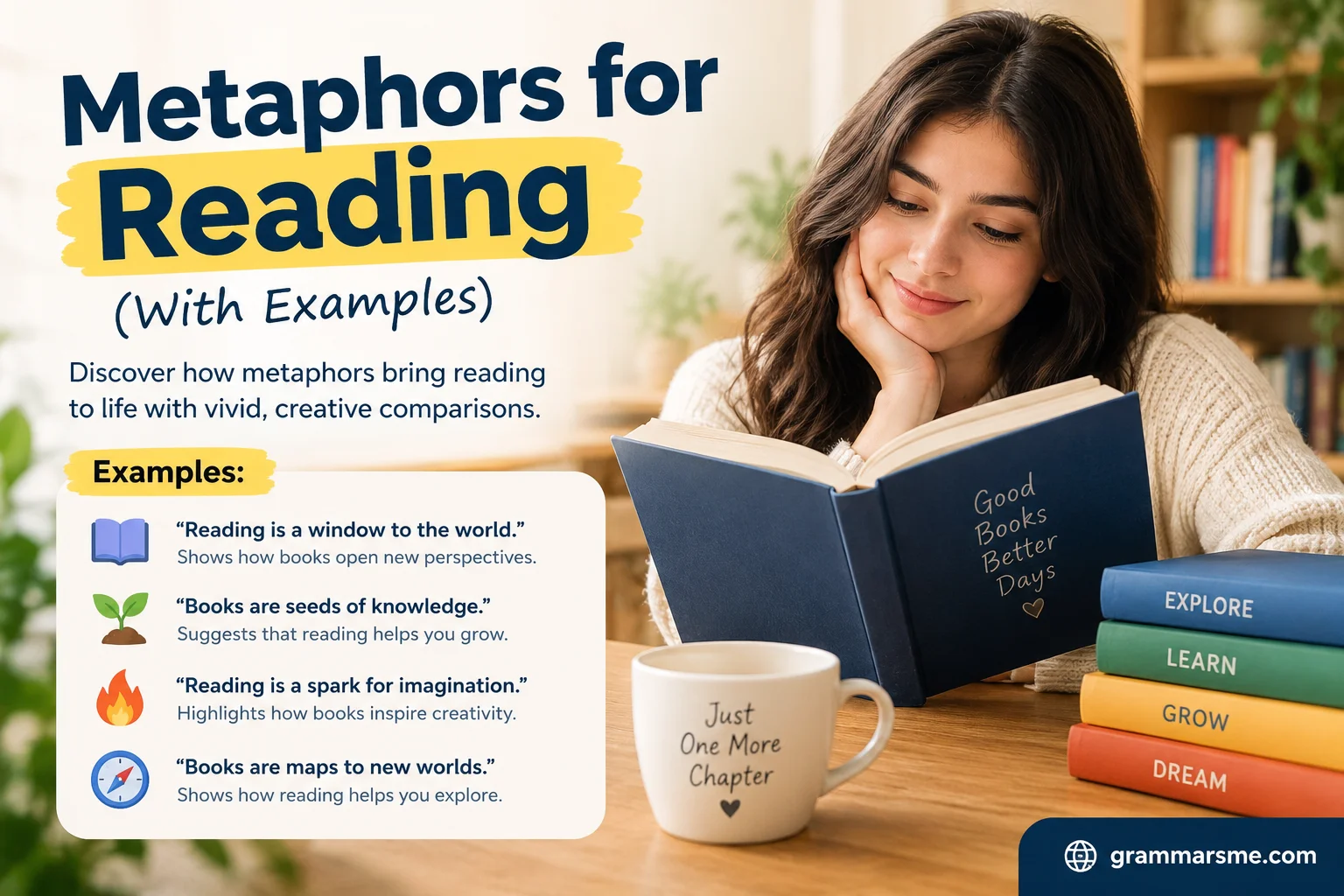

20 Metaphors for Reading (With Examples) show how reading is more than looking at words; it can open doors, build imagination, and create new experiences.
In my experience, reading becomes more vivid, emotional, and meaningful when metaphors compare it with journeys, adventures, keys, windows, treasure hunts, a secret door, a forest of ideas, or a train of voices. These images help readers imagine entering worlds, gathering meaning, and crossing thresholds.
A lantern, voyage, garden, key, home, window, or doorway can explain how books connect us with stories, knowledge, and new ideas. Even a quiet room, chair, fan, cup of tea, and table can become part of this invisible magic, as the mind and heart travel far beyond the outside world. Good metaphors also add depth to writing, language, and everyday writing. Instead of decoding words, readers can discover meaning through a sentence that leaves them changed. This makes reading engaging and memorable for students, writers, teachers, and book lovers.
1. Reading Is a Journey
Meaning: Reading is like traveling through unfamiliar places, experiences, and ideas.
Detailed explanation:
When you read a book, you move from one point to another just as you would during a journey. A story can take you across countries, through different periods of history, or into another person’s imagination. Every chapter becomes another step on the path, while the ending becomes a destination. This metaphor works especially well when talking about novels, biographies, travel books, or stories that change your perspective.
Example:
“Every chapter was another mile on my journey through the author’s imagination.”
3 other ways to say it:
- Reading is a voyage through ideas.
- A book is a road leading to new discoveries.
- Every chapter is another step into the unknown.
2. Reading Is a Window
Meaning: Reading gives you a view into worlds, cultures, lives, and perspectives beyond your own.
Detailed explanation:
A window lets you see something that exists beyond the room you’re standing in. Books work similarly. Through reading, you can observe different cultures, emotions, lifestyles, beliefs, and experiences without physically being there. This metaphor is particularly useful when describing books that broaden understanding or introduce readers to unfamiliar perspectives.
Example:
“Books are windows into lives I may never experience myself.”
3 other ways to say it:
- Reading gives us a view of another world.
- A book opens a window into another life.
- Stories let us look beyond our own experience.
3. Reading Is a Key
Meaning: Reading unlocks knowledge, understanding, opportunities, and new possibilities.
Detailed explanation:
A key gives access to something that was previously closed. In the same way, reading can unlock information and ideas that were once unfamiliar. Learning a new subject, understanding another culture, or discovering a solution can feel like opening a locked door. This metaphor is especially appropriate for educational and academic writing.
Example:
“Reading became the key that unlocked my curiosity about science.”
3 other ways to say it:
- Books unlock hidden knowledge.
- Reading opens doors to understanding.
- A book can give you access to new possibilities.
4. Reading Is a Treasure Hunt
Meaning: Reading involves searching for valuable ideas, lessons, discoveries, and insights.
Detailed explanation:
A treasure hunt requires curiosity and patience. You follow clues until you discover something valuable. Reading can feel exactly the same. A meaningful sentence may become the treasure, while clues can appear through characters, descriptions, arguments, or carefully chosen words. The metaphor works well when describing books that contain important lessons or hidden meanings.
Example:
“Reading the old novel felt like a treasure hunt for forgotten wisdom.”
3 other ways to say it:
- Every page hides a possible discovery.
- Books are maps to buried ideas.
- Reading is a search for hidden treasures of knowledge.
5. Reading Is a Lantern
Meaning: Reading provides light when you are trying to understand something confusing or unfamiliar.
Detailed explanation:
A lantern helps people see when darkness surrounds them. Reading can provide a similar kind of intellectual and emotional light. A book may clarify a difficult subject, explain an unfamiliar experience, or help someone understand their own feelings. This metaphor emphasizes the illuminating power of words.
Example:
“During a difficult period, that book became a lantern in the darkness of my thoughts.”
3 other ways to say it:
- Reading shines light on difficult ideas.
- Books illuminate paths we cannot yet see.
- A story can brighten an uncertain mind.
6. Reading Is a Conversation
Meaning: Reading creates an imagined dialogue between the reader and the writer.
Detailed explanation:
Although an author isn’t physically present, their ideas can speak directly to you through the page. You may agree, disagree, question, or challenge what you read. In this sense, reading becomes a silent conversation. This metaphor is useful for essays and discussions about literature because it highlights the active role of the reader.
Example:
“Reading her essays felt like having a thoughtful conversation with someone I’d never met.”
3 other ways to say it:
- A book speaks to the reader.
- Reading is a dialogue across time.
- Every page invites a response from the mind.
7. Reading Is a Bridge
Meaning: Reading connects people, cultures, generations, and ideas.
Detailed explanation:
A bridge connects two places that might otherwise remain separated. Books can do the same by bringing different people and perspectives together. A reader can connect with someone from another country, century, or social background through a story. This metaphor emphasizes empathy and shared understanding.
Example:
“Literature became a bridge between my world and cultures I knew very little about.”
3 other ways to say it:
- Books connect distant minds.
- Reading builds bridges between cultures.
- Stories bring different experiences closer together.
8. Reading Is a Mirror
Meaning: Reading can reflect your own thoughts, emotions, experiences, and personality.
Detailed explanation:
A mirror shows you something about yourself. Certain books do the same emotionally. A character may experience something that reminds you of your own life, or a sentence may describe a feeling you couldn’t explain before. Reading can help you recognize yourself more clearly.
Example:
“That novel was a mirror reflecting feelings I had never been able to name.”
3 other ways to say it:
- Some stories reflect our inner world.
- Books can show us parts of ourselves.
- A character can become a reflection of the reader.
9. Reading Is a Seed
Meaning: Reading plants ideas that can grow in your mind over time.
Detailed explanation:
A seed starts small but can eventually become something much larger. A single sentence or idea can work the same way. You may read something today and continue thinking about it weeks or years later. Books plant thoughts that can grow into questions, beliefs, creativity, or wisdom.
Example:
“That short story planted a seed of curiosity that eventually grew into my passion for history.”
3 other ways to say it:
- Books plant ideas in the mind.
- A sentence can grow into a powerful thought.
- Reading plants the beginnings of new understanding.
10. Reading Is a Compass
Meaning: Reading can help guide your thoughts, decisions, values, and understanding.
Detailed explanation:
A compass helps travelers determine which direction to take. Reading can provide a similar sense of direction. Advice, biographies, philosophy, and personal stories can help people think through choices and understand possible paths. The metaphor doesn’t mean every book gives direct answers; instead, it suggests that reading can help you navigate uncertainty.
Example:
“Her memoir became a compass while I was trying to decide what direction to take in life.”
3 other ways to say it:
- Books can guide us through uncertainty.
- Reading can point the mind toward new directions.
- Stories can help us navigate difficult choices.
11. Reading Is a Passport
Meaning: Reading gives you access to places, cultures, periods, and experiences without physically traveling.
Detailed explanation:
A passport allows someone to cross borders and enter new places. Books can provide a similar kind of access. You can visit ancient civilizations, distant countries, imaginary kingdoms, or unfamiliar communities simply by turning pages. This metaphor highlights the freedom and range that reading provides.
Example:
“Every novel on my shelf felt like a passport to somewhere I had never visited.”
3 other ways to say it:
- Books let the imagination cross borders.
- Reading is a ticket to distant experiences.
- A story can transport you beyond your surroundings.
12. Reading Is a Garden
Meaning: Reading is a space where ideas, imagination, and knowledge can grow.
Detailed explanation:
A garden needs attention, patience, and time. Reading can develop in a similar way. The more you read, the more your vocabulary, imagination, knowledge, and critical thinking can grow. Different books can also introduce different ideas, much like different plants creating variety in a garden.
Example:
“My bookshelf is a garden where new ideas grow every day.”
3 other ways to say it:
- Reading cultivates the mind.
- Books are gardens filled with ideas.
- A reading habit allows curiosity to grow.
13. Reading Is a River
Meaning: Reading carries your thoughts continuously from one idea to another.
Detailed explanation:
A river keeps moving, changing direction, and passing through different landscapes. Reading can create a similar flow in the mind. One idea leads naturally to another, and one chapter can change how you understand the next. This metaphor works especially well for describing immersive reading experiences.
Example:
“I lost track of time as the story carried me along like a river flowing through the pages.”
3 other ways to say it:
- The story carried my thoughts forward.
- Ideas flowed from one page to the next.
- Reading swept me into a continuous stream of thought.
Read More: Metaphors for Relationships (With Examples)
14. Reading Is a Doorway
Meaning: Reading provides entry into new worlds, ideas, and possibilities.
Detailed explanation:
A doorway marks the entrance to somewhere new. When you open a book, you may enter another world, another person’s mind, or an unfamiliar field of knowledge. The metaphor emphasizes the moment of discovery that happens when reading begins.
Example:
“Opening that novel was a doorway into a world I had never imagined.”
3 other ways to say it:
- Every book opens an entrance to somewhere new.
- Reading takes us through doors of possibility.
- A story is an invitation to enter another world.
15. Reading Is a Map
Meaning: Reading provides information that helps you understand a subject, place, experience, or idea.
Detailed explanation:
A map helps travelers understand where they are and where they might go. Similarly, books can give readers a framework for understanding complicated subjects. A history book can map out the past, while a guidebook can map a physical location. Even fiction can provide a map of human emotions and relationships.
Example:
“The novel became a map that helped me understand the character’s complicated emotions.”
3 other ways to say it:
- Books chart unfamiliar territory.
- Reading gives shape to complicated ideas.
- A story can guide us through emotional landscapes.
16. Reading Is a Time Machine
Meaning: Reading allows you to experience different periods of history or imagine future possibilities.
Detailed explanation:
A time machine would allow someone to travel beyond their own era. Books offer a symbolic version of that experience. Through diaries, historical fiction, biographies, and classic literature, readers can encounter voices from the past. Science fiction can also carry readers toward imagined futures.
Example:
“Reading the diary was like stepping into a time machine and visiting another century.”
3 other ways to say it:
- Books let us travel through time.
- Reading brings distant eras into the present.
- A story can transport us beyond our own generation.
17. Reading Is a Fire
Meaning: Reading can ignite curiosity, passion, imagination, and a desire to learn.
Detailed explanation:
Fire begins with a spark and can grow when it receives fuel. Reading can create the same effect in the mind. One fascinating book can spark a lifelong interest in science, history, art, philosophy, or storytelling. This metaphor focuses on enthusiasm and intellectual energy.
Example:
“That first science book lit a fire of curiosity that never disappeared.”
3 other ways to say it:
- Reading sparks curiosity.
- A powerful story can ignite the imagination.
- Books can fuel a lifelong passion for learning.
18. Reading Is an Ocean
Meaning: Reading offers an enormous depth and variety of knowledge, stories, and perspectives.
Detailed explanation:
An ocean is vast, deep, and filled with things waiting to be discovered. The world of books has the same qualities. There are endless subjects, genres, authors, cultures, and ideas to explore. You can skim the surface with a short article or dive deeply into a complex subject through extensive reading.
Example:
“The world of literature is an ocean of stories, and I could spend a lifetime exploring it.”
3 other ways to say it:
- Books form a vast sea of knowledge.
- Reading lets us dive into deep ideas.
- Literature stretches farther than the imagination can measure.
19. Reading Is a Keyhole
Meaning: Reading offers a small but meaningful glimpse into another person’s world.
Detailed explanation:
A keyhole gives you only a limited view, but even that small opening can reveal something beyond a closed door. Reading can work similarly. A memoir, poem, or short story may offer a glimpse into another person’s emotions, experiences, or worldview. This metaphor is especially effective when discussing empathy.
Example:
“Her poem was a keyhole through which I glimpsed a world very different from mine.”
3 other ways to say it:
- A story gives us a glimpse behind another person’s experience.
- Reading offers a small opening into unfamiliar lives.
- A book lets us peek into another perspective.
20. Reading Is a Lighthouse
Meaning: Reading can provide guidance, perspective, and reassurance during uncertain moments.
Detailed explanation:
A lighthouse helps ships navigate safely when visibility is limited. Books can provide a similar form of guidance when life feels confusing or uncertain. A meaningful passage can offer perspective, while a familiar story can provide comfort. This metaphor captures the emotional and intellectual support that reading can provide.
Example:
“During a confusing season of my life, that book became a lighthouse guiding me toward clearer thoughts.”
3 other ways to say it:
- Books can guide us through uncertain waters.
- Reading offers light when the path feels unclear.
- A meaningful story can become a steady source of direction.
MCQs:
1. Which metaphor suggests that reading connects different cultures?
A. Reading is a fire
B. Reading is a bridge
C. Reading is a garden
D. Reading is a river
2. Which metaphor describes reading as a source of guidance?
A. Reading is a compass
B. Reading is an ocean
C. Reading is a seed
D. Reading is a passport
3. “Every chapter was another mile” represents which metaphor?
A. Reading is a mirror
B. Reading is a keyhole
C. Reading is a journey
D. Reading is a lantern
4. Which metaphor suggests that books reveal unfamiliar perspectives?
A. Reading is a window
B. Reading is a fire
C. Reading is a river
D. Reading is a garden
5. Which metaphor describes reading as something that plants ideas?
A. Reading is an ocean
B. Reading is a seed
C. Reading is a doorway
D. Reading is a compass
6. Which metaphor suggests that reading can illuminate confusing ideas?
A. Reading is a lantern
B. Reading is a passport
C. Reading is a bridge
D. Reading is a mirror
7. “Books unlock knowledge” refers to which metaphor?
A. Reading is a river
B. Reading is a key
C. Reading is an ocean
D. Reading is a time machine
8. Which metaphor describes reading as an imagined conversation?
A. Reading is a conversation
B. Reading is a garden
C. Reading is a map
D. Reading is a lighthouse
9. Which metaphor focuses on seeing yourself through stories?
A. Reading is a passport
B. Reading is a mirror
C. Reading is a doorway
D. Reading is an ocean
10. Which metaphor compares reading to traveling through history?
A. Reading is a time machine
B. Reading is a seed
C. Reading is a bridge
D. Reading is a window
11. Which metaphor emphasizes the huge depth and variety of literature?
A. Reading is a keyhole
B. Reading is an ocean
C. Reading is a lantern
D. Reading is a compass
12. Which metaphor suggests that reading can ignite curiosity?
A. Reading is a fire
B. Reading is a map
C. Reading is a passport
D. Reading is a mirror
13. Which metaphor describes books as an entrance into another world?
A. Reading is a doorway
B. Reading is a river
C. Reading is a garden
D. Reading is a bridge
14. Which metaphor suggests that reading provides a glimpse into another person’s life?
A. Reading is a keyhole
B. Reading is a fire
C. Reading is a compass
D. Reading is a journey
15. Which metaphor compares reading with something that helps ships navigate?
A. Reading is a seed
B. Reading is a lighthouse
C. Reading is a window
D. Reading is a passport
Answer Key:
1-B, 2-A, 3-C, 4-A, 5-B, 6-A, 7-B, 8-A, 9-B, 10-A, 11-B, 12-A, 13-A, 14-A, 15-B.
FAQs:
1. What is a metaphor for reading?
A metaphor for reading describes reading by comparing it directly to something else. For example, “Reading is a journey” suggests that readers move through different ideas, experiences, and discoveries as they progress through a book.
2. What is a creative metaphor for reading?
“Reading is a passport” is a creative metaphor because it suggests that books give readers access to different cultures, places, time periods, and experiences without requiring physical travel.
3. How can metaphors improve writing about reading?
Metaphors make descriptions more vivid and memorable. Instead of simply saying that reading provides knowledge, you might say, “Reading is a lantern that illuminates unfamiliar ideas.” This creates a stronger mental image.
4. What metaphor describes books as sources of knowledge?
“Reading is a key” works especially well because it suggests that books unlock information, understanding, opportunities, and new perspectives.
5. What is a metaphor for reading that focuses on imagination?
“Reading is a doorway” is an effective choice. It suggests that opening a book allows the imagination to enter a new world filled with characters, places, ideas, and possibilities.
Conclusion:
The best metaphors for reading turn a simple activity into something vivid and emotionally meaningful. Reading can be a journey, a window, a key, a bridge, a mirror, or a lighthouse, depending on what you want to express. These comparisons help readers communicate how books influence their thoughts, emotions, imagination, and understanding.
Whether you’re writing an essay, creating a poem, preparing a speech, or simply describing your love of books, choose a metaphor that matches the feeling you want to convey. A carefully chosen comparison can make ordinary words feel more memorable and personal.


1 thought on “20 Metaphors for Reading (With Examples)”