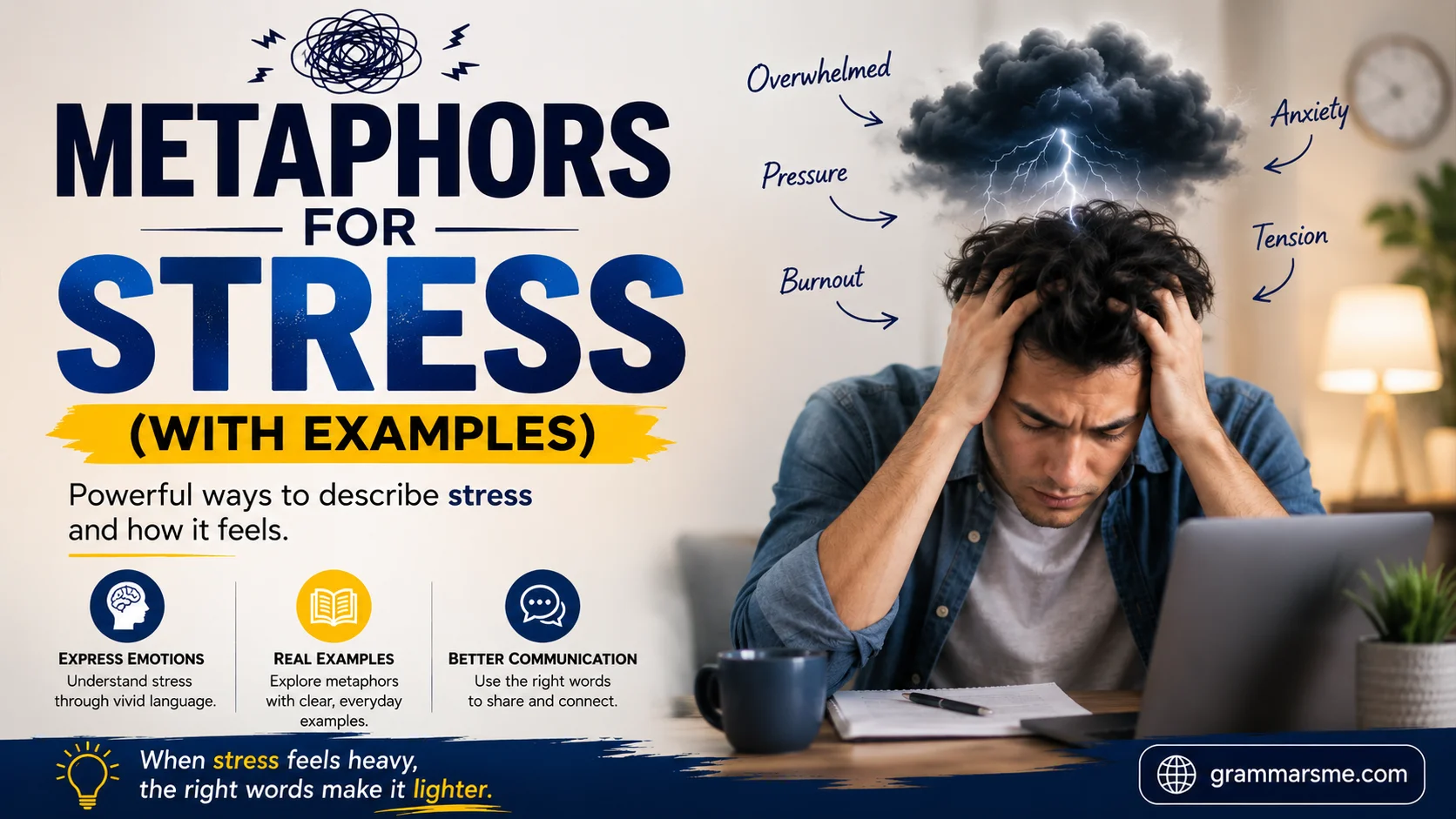

In everyday life, stress can make an ordinary day feel harder, and this is where 20 Metaphors for Stress (With Examples) can help readers understand the mental side of tiredness.
When someone is mentally tired, a chest that tightens, a heavy body, and shallow breathing may reflect daily responsibilities, pressure, tension, anxiety, exhaustion, and overwhelm. Metaphors, metaphorical language, metaphors about stress, and stress metaphors make these feelings clearer: an invisible weight can represent a powerful burden, while a storm or eye of a storm can show emotions raging inside.
These images help explain an internal experience, internal struggle, emotional state, and mental state. When thoughts race and the world feels like it is closing in, stress can seem crushingly physical instead of abstract. This physical sensation, emotional pressure, and mental pressure can support people who want to manage stress through stress management and understanding stress. The feeling becomes an experience that readers can see, touch, and recognize as real.
1. Stress Is a Heavy Backpack
Meaning
The metaphor “stress is a heavy backpack” compares emotional pressure to carrying a bag that becomes heavier over time.
Detailed Explanation
A backpack may begin with only a few things inside, but as more items are added, carrying it becomes increasingly difficult. Stress can work in the same way. Small responsibilities, worries, deadlines, and personal problems can accumulate until they feel too heavy to manage. The metaphor also suggests that someone may continue carrying their burden even when others cannot see how difficult it has become.
Example
“I’ve been carrying stress like a heavy backpack all week, and I really need a chance to put it down.”
3 Other Ways to Say It
- Stress feels like carrying a heavy load.
- My worries are weighing me down.
- I’m carrying more pressure than I can handle.
2. Stress Is a Storm
Meaning
“Stress is a storm” compares overwhelming emotions and difficult circumstances to powerful, unpredictable weather.
Detailed Explanation
A storm can arrive suddenly, create chaos, and make it difficult to see clearly. Stress can have a similar effect on our thoughts and emotions. When several problems happen at once, everything may feel noisy and uncertain. Like a storm, stress can eventually pass, reminding us that difficult emotional periods are not always permanent.
Example
“My mind feels like a storm right now because everything seems to be happening at once.”
3 Other Ways to Say It
- My thoughts are caught in a storm.
- I’m going through an emotional storm.
- Everything feels chaotic right now.
3. Stress Is a Pressure Cooker
Meaning
“Stress is a pressure cooker” suggests that unexpressed worries and responsibilities continue building pressure inside a person.
Detailed Explanation
A pressure cooker contains intense pressure until the cooking process is complete. Similarly, people sometimes keep their worries to themselves while continuing to work, study, or care for others. When pressure keeps increasing without relief, a person may eventually feel emotionally overwhelmed. This metaphor highlights the importance of rest, communication, and healthy emotional release.
Example
“I’ve been keeping everything inside, and now I feel like a pressure cooker ready to explode.”
3 Other Ways to Say It
- The pressure is building inside me.
- I feel close to my breaking point.
- I’ve been holding in too much.
4. Stress Is a Ticking Clock
Meaning
“Stress is a ticking clock” compares stress to the feeling that time is constantly running out.
Detailed Explanation
A ticking clock can create urgency, especially when someone has a deadline or limited time to finish something. This metaphor captures the anxiety that comes from constantly thinking about time, unfinished tasks, and approaching deadlines. Even when nothing dangerous is happening, the constant awareness of time can make the mind feel restless.
Example
“Every unfinished task feels like a ticking clock in the back of my mind.”
3 Other Ways to Say It
- I feel like I’m racing against time.
- The deadline is constantly hanging over me.
- Time pressure is making me anxious.
5. Stress Is a Mountain
Meaning
“Stress is a mountain” compares a large collection of problems to a huge obstacle that seems difficult to climb.
Detailed Explanation
A mountain can look intimidating from the bottom, especially when its peak seems far away. Stress can feel similar when someone faces many responsibilities at the same time. One task may seem manageable, but dozens of tasks together can create the impression of an enormous challenge. Breaking the mountain into smaller steps can make the situation feel more manageable.
Example
“My workload looks like a mountain, and I don’t know which part to tackle first.”
3 Other Ways to Say It
- My responsibilities feel enormous.
- I’m facing a mountain of pressure.
- Everything feels like a huge obstacle.
6. Stress Is a Knot
Meaning
“Stress is a knot” compares emotional tension to a physical knot that is difficult to untangle.
Detailed Explanation
When a rope becomes tangled, pulling at it randomly may make the knot tighter. Stress can feel similar. Conflicting thoughts, worries, and unresolved problems can become tangled together until it is difficult to identify the original source of anxiety. The metaphor works especially well when describing mental confusion.
Example
“There’s a knot of worry in my mind that I can’t seem to untangle.”
3 Other Ways to Say It
- My thoughts feel tangled.
- I’m caught in a web of worries.
- My mind feels complicated and confused.
7. Stress Is a Weight on Your Shoulders
Meaning
This metaphor compares stress to a physical weight resting heavily on someone’s shoulders.
Detailed Explanation
The shoulders are commonly associated with carrying burdens. When someone has too many responsibilities, worries, or expectations, they may describe the experience as something physically weighing them down. The metaphor communicates both emotional exhaustion and responsibility in a simple way.
Example
“The uncertainty about my future feels like a weight on my shoulders.”
3 Other Ways to Say It
- I feel weighed down by worry.
- My responsibilities are heavy right now.
- I’m carrying a lot emotionally.
8. Stress Is a Leaking Faucet
Meaning
“Stress is a leaking faucet” suggests that small worries continuously drip into a person’s mind.
Detailed Explanation
A single drop of water may seem insignificant, but constant dripping eventually becomes irritating and can cause problems. Stress can develop similarly. Small concerns may not seem serious individually, yet repeated worries can gradually drain someone’s energy. This metaphor is particularly useful for describing low-level stress that never completely disappears.
Example
“The little worries in my life are like a leaking faucet, constantly draining my energy.”
3 Other Ways to Say It
- Small worries keep wearing me down.
- Stress is slowly draining my energy.
- Minor problems keep piling up.
9. Stress Is a Cage
Meaning
“Stress is a cage” compares overwhelming pressure to feeling trapped without an easy way out.
Detailed Explanation
A cage limits movement and freedom. Stress can create a similar emotional experience when someone feels surrounded by deadlines, expectations, responsibilities, or difficult circumstances. The person may technically have choices, yet their stress makes those choices difficult to see.
Example
“My constant worries have turned my routine into a cage.”
3 Other Ways to Say It
- I feel trapped by my responsibilities.
- Stress is limiting my freedom.
- I can’t seem to find a way out of this pressure.
10. Stress Is a Fire
Meaning
“Stress is a fire” compares growing pressure to flames that become stronger when they are continually fed.
Detailed Explanation
A small fire can become much larger when more fuel is added. Stress can grow in the same way when new responsibilities, conflicts, worries, or deadlines continue appearing. The metaphor suggests that removing some sources of pressure may prevent stress from becoming overwhelming.
Example
“Every new problem feels like another piece of wood thrown onto the fire.”
3 Other Ways to Say It
- My stress keeps growing.
- New problems are fueling my anxiety.
- The pressure is getting hotter and harder to control.
11. Stress Is an Overloaded Computer
Meaning
“Stress is an overloaded computer” compares an overwhelmed mind to a computer trying to process too much information.
Detailed Explanation
A computer may slow down or stop responding when too many programs are running simultaneously. Human attention can feel the same way. When someone is juggling work, relationships, decisions, deadlines, and worries, their ability to focus may become weaker. This metaphor makes mental overload easy to understand.
Example
“My brain feels like an overloaded computer with too many programs running at once.”
3 Other Ways to Say It
- My mind is overloaded.
- I’m trying to process too much at once.
- My thoughts are running in too many directions.
12. Stress Is a Wave
Meaning
“Stress is a wave” compares emotional pressure to a wave that rises, peaks, and eventually moves away.
Detailed Explanation
Waves vary in size and strength. Some are gentle, while others can feel powerful. Stress can also come in waves. A person may feel fine for a while and then suddenly experience a period of intense worry or pressure. The metaphor is comforting because it suggests that even a powerful emotional wave can eventually pass.
Example
“A wave of stress hit me when I realized how much work I still had to finish.”
3 Other Ways to Say It
- A rush of stress came over me.
- The pressure suddenly overwhelmed me.
- I’m going through a stressful period.
13. Stress Is a Tightrope
Meaning
“Stress is a tightrope” describes the difficult balance between responsibilities and personal well-being.
Detailed Explanation
Walking on a tightrope requires careful balance. Too much movement in one direction can cause a person to lose stability. Stress can feel similar when someone is trying to balance work, family, relationships, finances, personal goals, and rest. The metaphor highlights how exhausting it can be to maintain balance for too long.
Example
“Balancing work and family feels like walking a tightrope every day.”
3 Other Ways to Say It
- I’m struggling to keep everything balanced.
- My life feels difficult to manage right now.
- I’m constantly trying to maintain balance.
14. Stress Is a Fog
Meaning
“Stress is a fog” compares mental pressure to thick fog that makes it difficult to see clearly.
Detailed Explanation
Fog reduces visibility and makes familiar surroundings appear uncertain. Stress can affect thinking in a similar way. When someone is overwhelmed, decision-making, concentration, and emotional clarity can become more difficult. This metaphor describes the confusing side of stress rather than simply its intensity.
Example
“Stress has created a fog in my mind, and I’m struggling to think clearly.”
3 Other Ways to Say It
- My thoughts feel unclear.
- I’m struggling to see things clearly.
- Stress is clouding my judgment.
Read More: Metaphors for Strong (With Examples)
15. Stress Is a Storm Cloud
Meaning
“Stress is a storm cloud” represents a persistent worry that seems to hang over someone’s life.
Detailed Explanation
A storm cloud can remain overhead even when the rest of the sky is clear. In the same way, a person may continue with everyday activities while carrying an underlying sense of worry or pressure. The metaphor is useful for describing stress that is always present in the background.
Example
“The upcoming deadline has been a storm cloud hanging over my entire week.”
3 Other Ways to Say It
- The worry is hanging over me.
- I have a constant concern in the back of my mind.
- The pressure has followed me everywhere.
16. Stress Is a Broken Alarm
Meaning
“Stress is a broken alarm” compares constant anxiety to an alarm that keeps sounding even when there is no immediate danger.
Detailed Explanation
An alarm is designed to alert us when something requires attention. But when it continues ringing without stopping, it becomes exhausting. Stress can create a similar experience when the mind remains in a state of constant alertness. Even during quiet moments, the person may struggle to relax.
Example
“My mind feels like a broken alarm that refuses to switch off.”
3 Other Ways to Say It
- I can’t seem to turn off my worries.
- My mind is constantly on alert.
- I’m finding it hard to relax.
17. Stress Is a Traffic Jam
Meaning
“Stress is a traffic jam” compares mental overload to roads filled with vehicles moving slowly or not at all.
Detailed Explanation
A traffic jam creates frustration because everything takes longer than expected. Stress can produce the same feeling when too many tasks compete for attention. You may want to move forward, but your thoughts feel blocked by unfinished work and competing priorities.
Example
“My thoughts are like a traffic jam; everything is crowded, and nothing seems to move forward.”
3 Other Ways to Say It
- My mind feels completely congested.
- Too many thoughts are blocking my progress.
- I feel mentally stuck.
18. Stress Is a Loaded Spring
Meaning
“Stress is a loaded spring” describes tension that continues building until it feels ready to release.
Detailed Explanation
A compressed spring stores energy under pressure. The longer it remains compressed, the stronger the potential release can become. Similarly, unresolved stress can build emotional tension when someone continually pushes their feelings aside. The metaphor emphasizes accumulated pressure.
Example
“I’ve been holding everything together, but I feel like a loaded spring.”
3 Other Ways to Say It
- I’m carrying a lot of built-up tension.
- The pressure has been accumulating.
- I feel ready to let everything out.
19. Stress Is a Ceiling Closing In
Meaning
“Stress is a ceiling closing in” represents the feeling that pressure is reducing someone’s emotional or mental space.
Detailed Explanation
A low or descending ceiling can create a sense of confinement. Stress can feel similar when responsibilities become so intense that there seems to be no room to breathe, think, or rest. This metaphor is especially powerful when describing overwhelming situations.
Example
“With every new deadline, it feels like the ceiling is closing in on me.”
3 Other Ways to Say It
- I feel increasingly overwhelmed.
- There’s barely any room to breathe.
- The pressure is closing in around me.
20. Stress Is a Backpack Full of Bricks
Meaning
“Stress is a backpack full of bricks” presents an especially strong image of accumulated emotional and mental pressure.
Detailed Explanation
A backpack full of bricks would become extremely difficult to carry for a long distance. The metaphor shows how multiple worries can become heavier when carried together. One brick might represent a deadline, another a financial concern, another a difficult conversation, and another an unresolved personal issue. The more bricks someone carries, the more exhausting the journey becomes.
Example
“Every responsibility feels like another brick in the backpack I’ve been carrying.”
3 Other Ways to Say It
- My worries feel incredibly heavy.
- I’m carrying too many burdens at once.
- The pressure is becoming difficult to bear.
MCQs:
1. Which metaphor suggests that stress comes from carrying many responsibilities?
A. Stress is a storm
B. Stress is a heavy backpack
C. Stress is a wave
D. Stress is fog
2. Which metaphor best represents approaching deadlines?
A. A ticking clock
B. A cage
C. A knot
D. A mountain
3. “My mind feels like a traffic jam” suggests:
A. Peace and relaxation
B. Physical exhaustion only
C. Too many thoughts competing for attention
D. Excitement about travel
4. Which metaphor describes stress as something that builds pressure internally?
A. A wave
B. A pressure cooker
C. A storm cloud
D. A mountain
5. “Stress is a fog” mainly represents:
A. Mental confusion
B. Physical strength
C. Happiness
D. Time management
6. Which metaphor represents feeling trapped by stress?
A. A cage
B. A wave
C. A leaking faucet
D. A ticking clock
7. “Stress is a storm” suggests:
A. Emotional calmness
B. Emotional chaos or difficult circumstances
C. A predictable routine
D. Complete relaxation
8. Which metaphor describes small worries that gradually drain energy?
A. A leaking faucet
B. A mountain
C. A tightrope
D. A fire
9. Which metaphor compares stress to balancing several areas of life?
A. A broken alarm
B. A tightrope
C. A storm
D. A knot
10. “Stress is a broken alarm” means:
A. Someone is constantly alert or worried
B. Someone has excellent time management
C. Someone is sleeping peacefully
D. Someone is avoiding responsibility
11. Which metaphor represents accumulated emotional tension?
A. Loaded spring
B. Wave
C. Fog
D. Traffic jam
12. What does “stress is a mountain” emphasize?
A. A small inconvenience
B. A large and intimidating challenge
C. A relaxing experience
D. A sudden celebration
13. Which metaphor suggests that stress can come and go in powerful periods?
A. A cage
B. A wave
C. A backpack
D. A ceiling
14. What does “stress is a fire” suggest?
A. Pressure can grow when more problems are added
B. Stress always disappears immediately
C. Stress is completely harmless
D. Stress makes people physically stronger
15. Which metaphor best describes having many worries that become increasingly heavy?
A. Stress is a backpack full of bricks
B. Stress is a ticking clock
C. Stress is a broken alarm
D. Stress is a wave
Answer Key:
1-B, 2-A, 3-C, 4-B, 5-A, 6-A, 7-B, 8-A, 9-B, 10-A, 11-A, 12-B, 13-B, 14-A, 15-A
FAQs:
1. What is a metaphor for stress?
A metaphor for stress compares stress to something familiar, such as a storm, mountain, backpack, or pressure cooker. It helps communicate an invisible emotional experience through a clear mental image.
2. What is the best metaphor for feeling overwhelmed?
“Stress is a heavy backpack” is a useful metaphor for feeling overwhelmed because it shows how multiple responsibilities can become increasingly difficult to carry.
3. What metaphor describes mental stress?
“Stress is an overloaded computer” is an effective metaphor for mental stress because it compares an overwhelmed mind to a system trying to process too much information at once.
4. What is a metaphor for emotional pressure?
“Stress is a pressure cooker” works well for emotional pressure because it suggests that feelings and responsibilities can build until someone needs relief.
5. Why are metaphors useful for describing stress?
Metaphors make complex emotions easier to explain and remember. They give readers a visual way to understand feelings such as anxiety, pressure, exhaustion, confusion, and emotional overload.
Conclusion:
The right metaphor for stress can transform a simple statement into something much more expressive. Instead of saying only “I’m stressed,” you can describe stress as a heavy backpack, a storm, a ticking clock, a mountain, or an overloaded computer.
Each comparison communicates a slightly different experience. Some show emotional heaviness, while others describe mental confusion, time pressure, constant worry, or accumulated tension.
The most meaningful metaphor is the one that feels closest to your actual experience. When chosen carefully, these expressions can help you communicate with greater clarity, empathy, and emotional depth.
If you’d like, I can also turn this into a 2,500+ word SEO article with an optimized meta description, title tag, FAQs schema-style answers, and NLP/LSI keywords for your blog.




1 thought on “20 Metaphors for Stress (With Examples)”