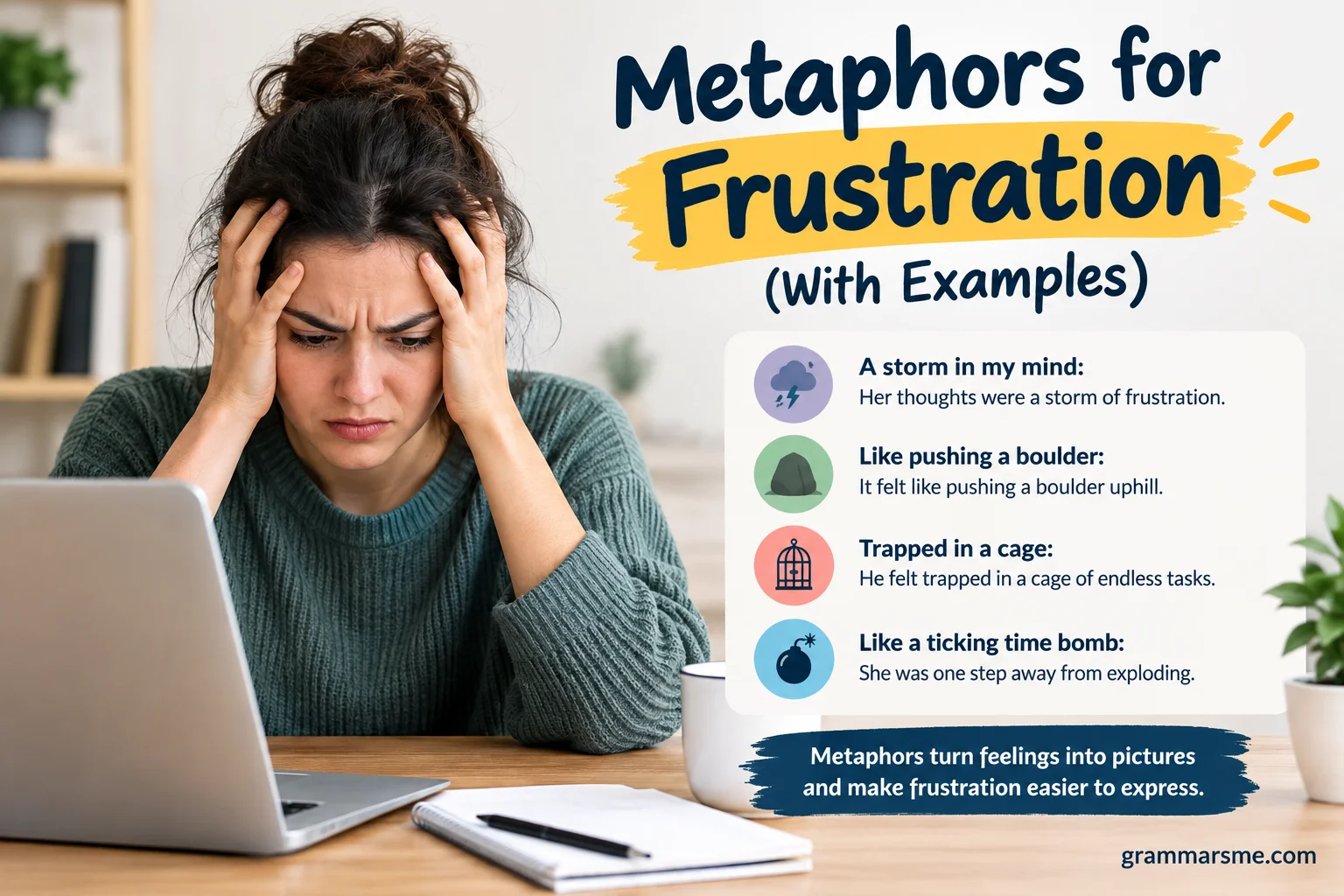

Explore Metaphors for Frustration (With Examples) to express an emotional state through clear, relatable, and memorable creative comparisons.
Frustration is an emotional state that may feel overwhelming, restless, and filled with inner tension, especially when it is hard to put into words. Metaphors, similes, and creative comparisons can bring this emotion to life through vivid imagery, such as a storm, pressure cooker, or tangled knot, representing trapped energy, breaking pressure, feeling stuck, irritated, or mentally exhausted. This expressive language allows writers and readers to instantly relate to the feeling through storytelling, poetry, and personal writing, while powerful images make an emotion more clear, relatable, and memorable without sounding harsh.
These comparisons can also help people communicate difficult experiences in personal messages, work, and relationships. Hayakawa described metaphors as more than ornaments of discourse, connecting them with direct expressions, evaluation, and strong feelings. In intractable conflicts, extraordinary events may create extraordinary human responses, making the increased use of metaphor useful for disputants and observers who want to understand what is occurring, its meaning, and its worldview. Through framing, a conflict may appear positive or negative, constructive or destructive.
1. Frustration Is a Pressure Cooker
Meaning: This metaphor compares frustration to a pressure cooker that becomes increasingly tense until something eventually gives way.
Explanation: When problems keep piling up, emotions can build quietly. You may remain calm for a while, but every new inconvenience adds more pressure. Like a pressure cooker, frustration can eventually reach a point where release becomes unavoidable.
Example: “After dealing with one problem after another all morning, my frustration felt like a pressure cooker.”
3 other ways to say it:
- My frustration is building pressure.
- I feel like I’m reaching my breaking point.
- Everything is becoming too much.
2. Frustration Is a Boiling Pot
Meaning: A boiling pot represents emotions that are becoming increasingly intense.
Explanation: A pot doesn’t boil immediately. It gradually heats until the liquid begins bubbling. Frustration can work the same way. Small annoyances may seem manageable individually, but when they continue, they can create an emotional boiling point.
Example: “Every unanswered message added another degree to the boiling pot of my frustration.”
3 other ways to say it:
- My irritation is boiling over.
- I’m becoming increasingly frustrated.
- My patience is running thin.
3. Frustration Is a Storm
Meaning: This metaphor describes frustration as a storm that brings emotional turbulence.
Explanation: Storms can arrive suddenly or develop gradually. Likewise, frustration may begin as a small irritation before becoming emotionally overwhelming. The storm image captures the confusion, intensity, and temporary turbulence that frustration can create.
Example: “A storm of frustration swept through me when the project failed again.”
3 other ways to say it:
- I feel emotionally overwhelmed.
- My emotions are unsettled.
- I’m caught in a wave of irritation.
4. Frustration Is a Tangled Knot
Meaning: A tangled knot represents problems and emotions that feel difficult to untangle.
Explanation: Sometimes frustration isn’t caused by one obvious problem. Several concerns become connected, making it difficult to know where to begin. Comparing frustration to a tangled knot shows how complicated and mentally exhausting that feeling can become.
Example: “My thoughts had become a tangled knot of frustration and uncertainty.”
3 other ways to say it:
- My thoughts feel tangled.
- I’m struggling to sort everything out.
- Everything feels complicated right now.
5. Frustration Is a Wall
Meaning: A wall represents an obstacle that prevents progress.
Explanation: Frustration often appears when you know what you want to accomplish but something repeatedly blocks your path. The wall metaphor emphasizes stagnation, helplessness, and difficulty moving forward.
Example: “Every attempt to fix the issue felt like running into the same wall of frustration.”
3 other ways to say it:
- I keep hitting the same obstacle.
- Something is blocking my progress.
- I feel stuck.
6. Frustration Is a Locked Door
Meaning: A locked door symbolizes an opportunity or solution that seems inaccessible.
Explanation: Imagine knowing where you want to go but being unable to open the door. This captures the feeling of wanting progress while repeatedly encountering resistance.
Example: “The lack of communication felt like a locked door between us.”
3 other ways to say it:
- I can’t seem to find a way forward.
- The solution feels out of reach.
- I keep meeting resistance.
7. Frustration Is a Traffic Jam
Meaning: A traffic jam represents delays, interruptions, and slow progress.
Explanation: Traffic jams are particularly frustrating because movement is possible in theory, yet you remain stuck. This metaphor works well when describing delayed plans, slow processes, or repeated obstacles.
Example: “My thoughts were a traffic jam of unfinished tasks and unanswered questions.”
3 other ways to say it:
- Everything feels backed up.
- Progress has completely stalled.
- I’m stuck waiting for things to move.
8. Frustration Is a Leaking Faucet
Meaning: A leaking faucet represents a small irritation that continues until it becomes difficult to ignore.
Explanation: One drop may not matter, but constant dripping can gradually wear down your patience. This metaphor is useful for describing small, repeated annoyances that accumulate over time.
Example: “Those constant interruptions were a leaking faucet of frustration throughout the afternoon.”
3 other ways to say it:
- The little annoyances keep adding up.
- It’s slowly wearing down my patience.
- The repeated interruptions are getting to me.
9. Frustration Is a Cage
Meaning: A cage symbolizes feeling trapped without an obvious way to escape.
Explanation: Frustration can make people feel as though their choices have disappeared. They may want to change something but feel restricted by circumstances. The cage metaphor highlights emotional confinement and helplessness.
Example: “Being unable to change the situation made my frustration feel like a cage.”
3 other ways to say it:
- I feel trapped by the situation.
- I don’t see an easy way out.
- I feel restricted by what’s happening.
10. Frustration Is a Thorn
Meaning: A thorn represents a persistent irritation that keeps causing discomfort.
Explanation: A thorn may be small, but its sharpness makes it difficult to ignore. Similarly, one unresolved issue can remain in your mind and continue causing irritation. This metaphor works especially well for persistent frustrations.
Example: “That unresolved disagreement remained a thorn in the back of my mind.”
3 other ways to say it:
- The issue keeps bothering me.
- It’s a persistent irritation.
- I can’t seem to let it go.
11. Frustration Is a Heavy Backpack
Meaning: A heavy backpack represents the emotional weight created by ongoing difficulties.
Explanation: Carrying a heavy backpack becomes increasingly tiring the longer you carry it. Frustration can feel similar when unresolved problems accumulate. The metaphor emphasizes emotional exhaustion and mental burden.
Example: “After weeks of setbacks, frustration felt like a heavy backpack on my shoulders.”
3 other ways to say it:
- I’m carrying a lot of emotional weight.
- The situation is exhausting me.
- I feel weighed down by everything.
12. Frustration Is a Fog
Meaning: Fog represents confusion that makes it difficult to see the way forward.
Explanation: When frustration becomes intense, clear thinking can become harder. You may know something needs to change but cannot immediately identify the solution. Calling frustration a fog captures this mental uncertainty.
Example: “The constant setbacks left me walking through a fog of frustration.”
3 other ways to say it:
- I’m struggling to think clearly.
- The situation feels confusing.
- I can’t see the next step clearly.
13. Frustration Is a Rubber Band Stretched Tight
Meaning: A tightly stretched rubber band represents emotional tension nearing its limit.
Explanation: A rubber band can stretch only so far before it snaps or returns suddenly to its original shape. Likewise, people can tolerate difficulties for a while, but prolonged pressure can create intense emotional tension.
Example: “After hours of setbacks, my patience felt like a rubber band stretched to its limit.”
3 other ways to say it:
- My patience is being stretched.
- I’m under a lot of pressure.
- I’m close to reaching my limit.
14. Frustration Is a Broken Record
Meaning: A broken record represents the same problem repeating again and again.
Explanation: Repetition can be one of the strongest sources of frustration. When the same mistake, conversation, or obstacle keeps returning, it can feel as though you’re stuck in an endless loop.
Example: “Having the same argument every week felt like living with a broken record of frustration.”
3 other ways to say it:
- The same problem keeps repeating.
- We’re stuck in a cycle.
- Nothing seems to change.
Read More: 20 Metaphors for Grass (With Examples)
15. Frustration Is a Dead End
Meaning: A dead end represents reaching a point where further progress seems impossible.
Explanation: You can spend considerable time trying different approaches and still arrive nowhere. The dead-end metaphor communicates the feeling of effort without progress.
Example: “After trying every solution I could think of, the situation felt like a dead end.”
3 other ways to say it:
- I don’t know where to go from here.
- My efforts aren’t getting results.
- I feel like I’ve run out of options.
16. Frustration Is a Fire Under the Skin
Meaning: This metaphor describes frustration as an intense internal irritation that is difficult to ignore.
Explanation: Unlike a visible fire, this emotional fire burns internally. It represents the restlessness, irritation, and urgency that can accompany unresolved frustration.
Example: “His repeated excuses left a fire of frustration burning under my skin.”
3 other ways to say it:
- I feel intensely irritated.
- The situation is getting under my skin.
- I can’t shake this irritation.
17. Frustration Is a Cracked Dam
Meaning: A cracked dam represents emotions being held back while pressure continues to increase.
Explanation: A dam is designed to contain enormous amounts of water. When cracks appear, pressure can eventually force the water through. This metaphor captures how suppressed frustration can eventually spill out.
Example: “I had stayed quiet for weeks, but my frustration felt like water pushing through a cracked dam.”
3 other ways to say it:
- I’ve been holding too much inside.
- My emotions are starting to spill over.
- I need to release some of this pressure.
18. Frustration Is a Maze
Meaning: A maze represents confusion, repeated attempts, and difficulty finding a solution.
Explanation: In a maze, you can keep moving without knowing whether you’re getting closer to the exit. Frustration often feels similar when every attempt seems to lead to another problem.
Example: “Trying to resolve the issue became a maze of frustrating choices.”
3 other ways to say it:
- I feel lost in the problem.
- I keep going in circles.
- Finding the answer has been difficult.
19. Frustration Is a Weight on the Heart
Meaning: This metaphor describes frustration as an emotional burden that affects your inner sense of peace.
Explanation: Some frustrations go beyond temporary irritation. They can affect your mood and make it harder to relax. Describing frustration as a weight on the heart gives the feeling a softer, more emotional quality.
Example: “The unresolved situation had become a weight on my heart.”
3 other ways to say it:
- The situation is emotionally heavy.
- I’m carrying this feeling with me.
- It’s affecting my peace of mind.
20. Frustration Is a Door That Won’t Open
Meaning: A door that won’t open symbolizes repeated attempts to make progress without success.
Explanation: You may try again and again, but nothing changes. This metaphor expresses frustration without blaming anyone directly. It works especially well when you want to communicate disappointment and persistence at the same time.
Example: “No matter how carefully I explained myself, the conversation felt like a door that simply wouldn’t open.”
3 other ways to say it:
- I keep trying without getting through.
- I’m having trouble making progress.
- I feel like my efforts aren’t reaching the other side.
MCQs:
1. Which metaphor describes frustration building toward an emotional release?
A. A fog
B. A pressure cooker
C. A maze
D. A thorn
2. Which metaphor best represents repeated irritation?
A. A leaking faucet
B. A locked door
C. A heavy backpack
D. A storm
3. “My thoughts are a tangled knot” suggests:
A. Happiness
B. Confidence
C. Confusion and frustration
D. Excitement
4. Which metaphor represents feeling trapped?
A. A traffic jam
B. A cage
C. A broken record
D. A thorn
5. “My patience is like a rubber band stretched tight” means:
A. Patience is increasing
B. Patience is close to its limit
C. Everything is peaceful
D. The problem has disappeared
6. Which metaphor describes repeated problems?
A. A broken record
B. A heavy backpack
C. A storm
D. A fog
7. A “dead end” metaphor suggests:
A. Easy progress
B. A new opportunity
C. No obvious way forward
D. Celebration
8. Which metaphor describes emotional confusion?
A. A fog
B. A thorn
C. A cage
D. A wall
9. “A weight on the heart” mainly represents:
A. Physical strength
B. Emotional burden
C. Excitement
D. Humor
10. Which metaphor represents an obstacle preventing progress?
A. A wall
B. A fire
C. A backpack
D. A record
11. “Frustration is a traffic jam” emphasizes:
A. Speed
B. Delays and stalled progress
C. Freedom
D. Celebration
12. Which metaphor suggests that emotions have been held back under pressure?
A. A cracked dam
B. A fog
C. A maze
D. A locked door
13. “A fire under the skin” suggests:
A. Calmness
B. Intense internal irritation
C. Sleepiness
D. Curiosity
14. Which metaphor best describes feeling unable to find a solution?
A. A maze
B. A boiling pot
C. A thorn
D. A backpack
15. Which metaphor represents an opportunity that seems inaccessible?
A. A locked door
B. A storm
C. A broken record
D. A traffic jam
Answer Key:
1. B | 2. A | 3. C | 4. B | 5. B | 6. A | 7. C | 8. A | 9. B | 10. A | 11. B | 12. A | 13. B | 14. A | 15. A
FAQs:
1. What is a metaphor for frustration?
A metaphor for frustration compares the emotion to something familiar, such as a pressure cooker, storm, wall, maze, or tangled knot. These comparisons make difficult feelings easier to visualize and communicate.
2. What is a good metaphor for feeling frustrated and stuck?
“Frustration is a wall” or “frustration is a dead end” works well when you feel unable to move forward. Both metaphors communicate blocked progress and emotional difficulty.
3. What metaphor describes frustration building up?
“Frustration is a pressure cooker” is a strong metaphor for emotions that gradually build until they become difficult to contain. It highlights increasing emotional pressure.
4. How can metaphors help express frustration?
Metaphors make emotional communication more vivid and personal. Instead of simply saying you’re frustrated, you can explain what that frustration feels like, helping others understand your experience more clearly.
5. Can these frustration metaphors be used in everyday writing?
Yes. These metaphors can work in personal messages, conversations, essays, creative writing, journal entries, speeches, and social media posts. Choose an image that matches the intensity and situation you’re describing.
Conclusion:
Frustration can be difficult to explain because it often combines irritation, disappointment, pressure, confusion, and helplessness. A thoughtful metaphor gives that complicated feeling a recognizable shape. Whether your frustration feels like a boiling pot, a tangled knot, a traffic jam, a storm, or a locked door, the right comparison can help others understand what you’re experiencing. Most importantly, expressive language doesn’t have to sound harsh. With the right metaphor, you can communicate honestly, calmly, and thoughtfully while still making your feelings clear.




1 thought on “20 Metaphors for Frustration (With Examples)”