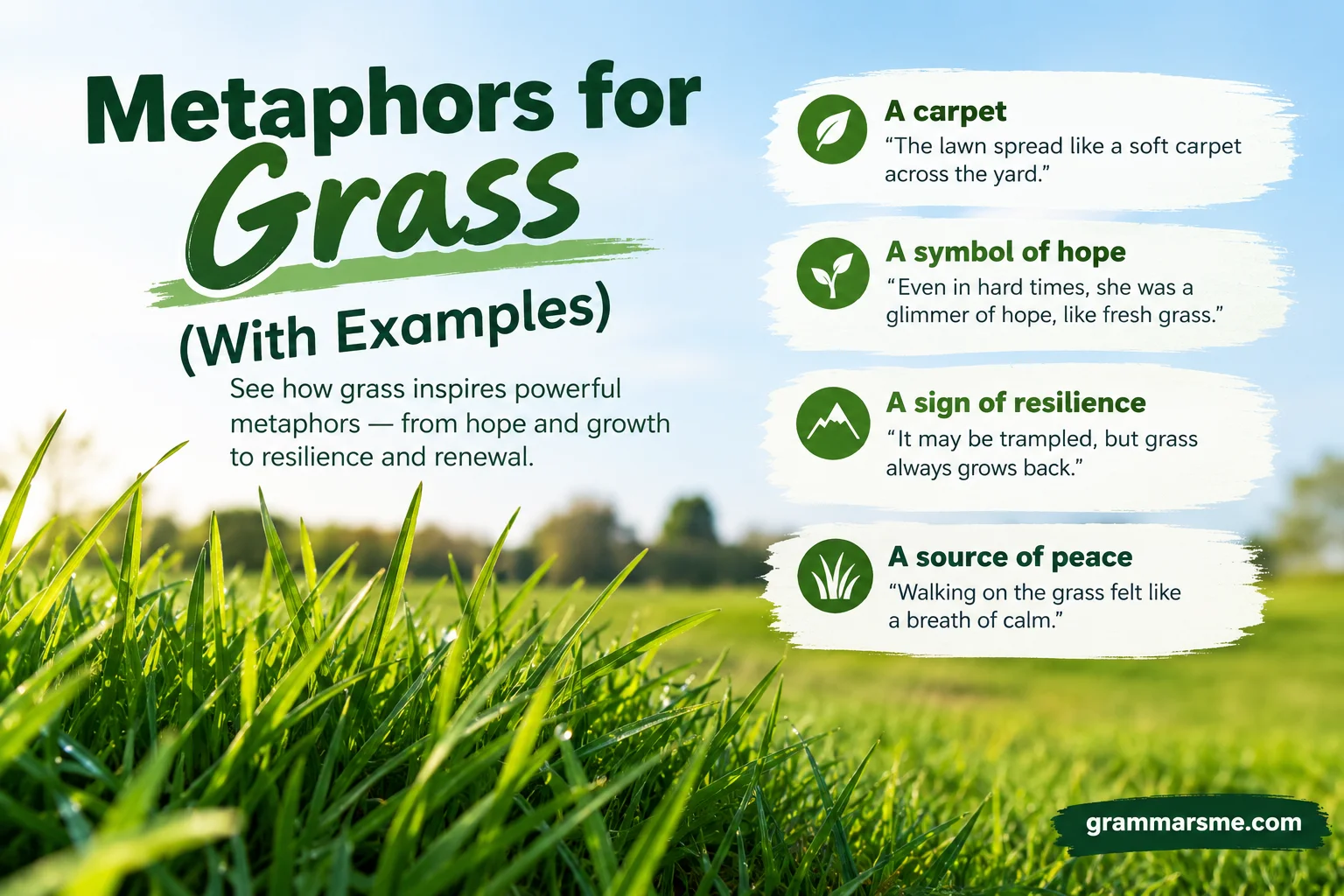

Metaphors for Grass (With Examples) show how a familiar image can make grass easier to understand through clear, vivid, and memorable language.
A metaphor is a linguistic form and a cognitive way that human beings use to think about the world and human daily life. In English, it is a kind of figure of speech where a phrase or word describes an action or object through similarity or resemblance, rather than literally. For example, “I’m feeling blue” describes a person feeling sad, while “He is the black sheep of the family” describes someone different from others. These expressions equate a situation with a real thing that it is not actually.
The relationship between metaphor and utilization is also useful in therapy and hypnosis, where metaphor has a role in structuring experience. The work of Gregory Bateson shows how metaphor functions through a comparison of two forms of syllogistic logic, creating a background for distinguishing the experiential effects of metaphor from the categorical thinking found in simile and analogy. Clinical examples demonstrate how utilization can be structured by metaphor, particularly through Bateson’s analysis of Syllogism in Grass. More broadly, metaphor exists universally.
1. Grass Is a Green Carpet
Meaning: Grass is compared to a soft green carpet spread naturally across the ground.
Detailed explanation: This metaphor emphasizes how grass covers the earth smoothly and creates a welcoming surface. It can suggest comfort, beauty, and natural elegance. Unlike an ordinary carpet, this one grows, changes with the seasons, and belongs to the landscape.
Example: The fresh grass stretched across the garden like a green carpet beneath our feet.
3 other ways to say it:
- A natural green carpet
- Nature’s living carpet
- A carpet of emerald
2. Grass Is a Sea of Emerald
Meaning: Grass is described as an emerald sea because its wide green surface resembles water.
Detailed explanation: This metaphor works especially well when grass moves in the wind. The shifting blades can look like waves traveling across a green landscape, creating a sense of movement and peaceful beauty.
Example: The meadow became a sea of emerald as the morning breeze moved through the grass.
3 other ways to say it:
- An emerald ocean
- A green tide
- A rolling green sea
3. Grass Is Nature’s Green Blanket
Meaning: Grass is compared to a blanket covering the earth.
Detailed explanation: A blanket represents warmth, protection, and comfort. When grass is called nature’s blanket, it suggests that the earth is gently covered by a soft layer of green. This metaphor is particularly effective in descriptions of peaceful parks and meadows.
Example: A green blanket of grass covered the hillside beneath the old trees.
3 other ways to say it:
- Earth’s green covering
- Nature’s soft blanket
- A blanket of green
4. Grass Is a Living Carpet
Meaning: Grass is a carpet that is alive and constantly growing.
Detailed explanation: This metaphor highlights the difference between natural grass and something manufactured. Grass changes with sunlight, rain, seasons, and care, making it a living part of the landscape rather than a static decoration.
Example: The children ran across the living carpet of grass, laughing beneath the afternoon sun.
3 other ways to say it:
- A growing green carpet
- A living layer of green
- Nature’s growing floor
5. Grass Is a Green Ocean
Meaning: A large field of grass is compared to an ocean of green.
Detailed explanation: This metaphor is powerful when describing expansive fields. When wind moves through tall grass, the blades rise and fall like waves. The comparison creates an image of vastness, rhythm, and freedom.
Example: The golden sunlight swept across the green ocean as the wind passed through the meadow.
3 other ways to say it:
- An ocean of green
- A green expanse
- A wave-filled meadow
6. Grass Is Earth’s Hair
Meaning: Grass is compared to hair growing from the surface of the earth.
Detailed explanation: Like hair, grass grows from a surface and can become long, short, thick, or sparse. This metaphor gives the earth a human-like quality, making nature feel more alive and relatable.
Example: After the rain, the meadow looked as if Earth had grown a fresh head of green hair.
3 other ways to say it:
- The earth’s green hair
- Nature’s green strands
- The planet’s living hair
7. Grass Is Nature’s Smile
Meaning: Grass represents the joyful and welcoming side of nature.
Detailed explanation: Green grass can make a place feel fresh, lively, and inviting. Calling it nature’s smile gives the landscape an emotional quality and works especially well in warm, positive writing.
Example: The bright lawn looked like nature’s smile after a long season of rain.
3 other ways to say it:
- Nature’s cheerful grin
- Earth’s green smile
- A smile across the landscape
8. Grass Is a Green River
Meaning: Grass is compared to a river flowing across the land.
Detailed explanation: This metaphor focuses on the way grass appears to move when wind passes through it. From a distance, a large field can seem like a river whose waves are made of green blades instead of water.
Example: The wind sent ripples through the meadow like a green river flowing toward the hills.
3 other ways to say it:
- A river of green
- A flowing meadow
- A stream of grass
9. Grass Is a Natural Pillow
Meaning: Soft grass is compared to a pillow provided by nature.
Detailed explanation: This metaphor emphasizes grass’s softness and the comfort it can provide. It works well when describing someone lying down, resting, reading, or relaxing outdoors.
Example: He rested his head on the natural pillow of grass and watched the clouds drift overhead.
3 other ways to say it:
- Nature’s soft cushion
- A green pillow
- The earth’s cushion
10. Grass Is a Green Flame
Meaning: Grass is compared to a flame, not because it burns, but because its blades can rise and move with energy.
Detailed explanation: This metaphor is especially effective for tall grass moving dramatically in the wind. It gives the landscape a feeling of energy, motion, and intensity.
Example: The tall meadow grass flickered like a green flame beneath the restless wind.
3 other ways to say it:
- A flame of green
- Nature’s green fire
- A flickering green blaze
11. Grass Is a Carpet of Life
Meaning: Grass represents a living layer that supports and surrounds other forms of life.
Detailed explanation: This metaphor goes beyond appearance. Grass provides habitat, food, shelter, and part of the foundation for many ecosystems. Calling it a carpet of life emphasizes its vital role in nature.
Example: Beneath the trees, the carpet of life sheltered tiny insects and wildflowers.
3 other ways to say it:
- A living foundation
- Nature’s green support
- A floor of life
12. Grass Is a Green Symphony
Meaning: Grass is compared to a symphony performed by nature.
Detailed explanation: This metaphor focuses on movement, sound, and harmony. Wind moving through grass can create a gentle rustling sound, while the surrounding landscape adds birdsong, insects, and other natural sounds.
Example: The breeze turned the meadow into a green symphony, with every blade moving to its rhythm.
3 other ways to say it:
- Nature’s green music
- A meadow melody
- A symphony of blades
13. Grass Is a Soldier
Meaning: Grass is compared to a soldier because of its resilience and persistence.
Detailed explanation: Grass can survive cutting, trampling, drought, and changing weather before growing again under suitable conditions. The metaphor therefore represents strength, endurance, and persistence.
Example: Even after weeks of harsh weather, the grass stood like a quiet soldier ready to grow again.
3 other ways to say it:
- A resilient warrior
- A quiet fighter
- Nature’s little survivor
14. Grass Is a Green Blanket for the Earth
Meaning: Grass is portrayed as a protective covering spread across the ground.
Detailed explanation: This metaphor gives grass a nurturing role. It creates an image of the earth being wrapped in green, which can communicate comfort, protection, and natural beauty.
Example: Spring wrapped the valley in a green blanket, covering the bare soil with new life.
3 other ways to say it:
- Earth’s green quilt
- A protective green covering
- Nature’s earth blanket
Read More: 20 Metaphors for Halloween (With Examples)
15. Grass Is a Sea of Tiny Waves
Meaning: Moving grass is compared to small waves traveling across a sea.
Detailed explanation: This metaphor is ideal for tall grass on a windy day. Each blade bends and rises, creating patterns that resemble waves. It helps readers visualize movement immediately.
Example: The breeze created a sea of tiny waves across the tall meadow grass.
3 other ways to say it:
- Waves of green
- Ripples of grass
- A meadow of waves
16. Grass Is a Green Canvas
Meaning: Grass becomes a canvas on which nature creates a picture.
Detailed explanation: A green field can provide the background for flowers, trees, shadows, sunlight, and wildlife. This metaphor presents the landscape as an artistic creation that is constantly changing.
Example: The wildflowers painted themselves across the green canvas of the meadow.
3 other ways to say it:
- Nature’s canvas
- A living green painting
- Earth’s natural artwork
17. Grass Is a Symbol of Renewal
Meaning: Grass represents fresh beginnings and the ability to grow again.
Detailed explanation: New grass often appears after rain, winter, or periods of dryness. Because of this cycle, it can symbolize hope, recovery, renewal, and starting over.
Example: The first green shoots were a symbol of renewal after the long winter.
3 other ways to say it:
- A sign of new beginnings
- A symbol of rebirth
- Nature’s reminder to begin again
18. Grass Is a Green Whisper
Meaning: Grass is compared to a quiet whisper from nature.
Detailed explanation: When wind passes gently through grass, it produces a soft rustling sound. This metaphor creates a peaceful emotional atmosphere and works beautifully in poetry and reflective writing.
Example: The evening breeze moved through the grass like a green whisper beneath the fading sunlight.
3 other ways to say it:
- Nature’s soft whisper
- A whispering meadow
- A quiet voice of green
19. Grass Is a Gentle Sea
Meaning: A field of grass is compared to a calm sea.
Detailed explanation: This metaphor emphasizes tranquility rather than vastness. When grass moves slowly under a light breeze, its gentle motion can create a calming scene similar to quiet water.
Example: She walked beside the gentle sea of grass, listening to the soft rhythm of the wind.
3 other ways to say it:
- A peaceful green sea
- A calm meadow ocean
- A quiet tide of green
20. Grass Is a Green Thread Through the Earth
Meaning: Grass is compared to a thread that connects different parts of the landscape.
Detailed explanation: This metaphor suggests connection and continuity. Grass can stretch through gardens, fields, hills, and open spaces, visually tying different parts of nature together like a thread woven through fabric.
Example: A green thread of grass followed the trail between the forest and the distant meadow.
3 other ways to say it:
- A thread of green
- Nature’s connecting thread
- A green line across the earth
MCQs:
1. Which metaphor compares grass to something soft and comforting?
A. Green flame
B. Natural pillow
C. Green river
D. Green thread
2. What does “grass is a green carpet” emphasize?
A. Its ability to make noise
B. Its softness and coverage
C. Its resistance to fire
D. Its connection to rivers
3. Which metaphor best represents grass as a sign of new beginnings?
A. Symbol of renewal
B. Green ocean
C. Earth’s hair
D. Green canvas
4. “The meadow became a sea of emerald” mainly suggests:
A. A large area of rich green grass
B. A dry landscape
C. A dangerous storm
D. A garden without plants
5. Which metaphor focuses on grass moving in the wind?
A. Green river
B. Natural pillow
C. Green canvas
D. Carpet of life
6. “Grass is nature’s smile” suggests:
A. Joy and freshness
B. Sadness and loneliness
C. Darkness and fear
D. Anger and conflict
7. Which metaphor describes grass as resilient?
A. Green whisper
B. Green canvas
C. Soldier
D. Gentle sea
8. What does “grass is a green canvas” suggest?
A. Grass is artificial
B. Nature creates a picture across it
C. Grass grows underwater
D. Grass makes music
9. Which metaphor is most suitable for peaceful writing?
A. Green flame
B. Green whisper
C. Resilient warrior
D. Green fire
10. “Grass is Earth’s hair” is based mainly on:
A. Growth from the earth’s surface
B. Grass making loud sounds
C. Grass being used as clothing
D. Grass behaving like water
11. Which metaphor compares grass to music?
A. Green carpet
B. Green symphony
C. Natural pillow
D. Green thread
12. What does “carpet of life” highlight?
A. Grass’s role as part of a living ecosystem
B. Grass’s color only
C. Grass’s ability to swim
D. Grass’s use as furniture
13. Which metaphor best describes grass connecting parts of a landscape?
A. Green flame
B. Gentle sea
C. Green thread
D. Natural pillow
14. “A sea of tiny waves” refers to:
A. Grass growing underwater
B. Grass moving in the wind
C. Grass being covered by snow
D. Grass being cut
15. Which metaphor best communicates calmness?
A. Green flame
B. Green soldier
C. Gentle sea
D. Green fire
Answer Key:
1. B | 2. B | 3. A | 4. A | 5. A | 6. A | 7. C | 8. B | 9. B | 10. A | 11. B | 12. A | 13. C | 14. B | 15. C
FAQs:
1. What is a metaphor for grass?
A metaphor for grass compares grass directly with something else to communicate an idea or image. Examples include “grass is a green carpet,” “grass is a sea of emerald,” and “grass is nature’s smile.”
2. What is the best metaphor for green grass?
A strong metaphor for green grass is “a sea of emerald.” It highlights the grass’s rich green color while also suggesting a broad, flowing landscape.
3. What does grass symbolize metaphorically?
Grass can symbolize growth, resilience, renewal, peace, hope, life, and connection. The meaning depends on the context in which the metaphor is used.
4. What is a poetic metaphor for grass?
“Grass is a green whisper” is a poetic metaphor that connects grass with the soft sound and peaceful feeling created when wind moves through it.
5. How can I use grass metaphors in writing?
Use a grass metaphor when you want to make a description more vivid or emotional. For example, instead of saying “The field was covered with grass,” you could write, “The field became a sea of emerald beneath the morning sun.”
Conclusion:
Grass may look simple, but it can carry rich emotional and symbolic meaning when described through metaphor. It can become a green carpet of comfort, a sea of emerald, a symbol of renewal, or a quiet whisper from nature. The best metaphor depends on the feeling you want your reader to experience. If you’re writing poetry, storytelling, a personal message, or descriptive prose, these comparisons can help your words feel warmer, clearer, and more memorable. When you choose an image that naturally fits your message, even something as familiar as grass can express hope, peace, resilience, beauty, and new beginnings.


1 thought on “20 Metaphors for Grass (With Examples)”