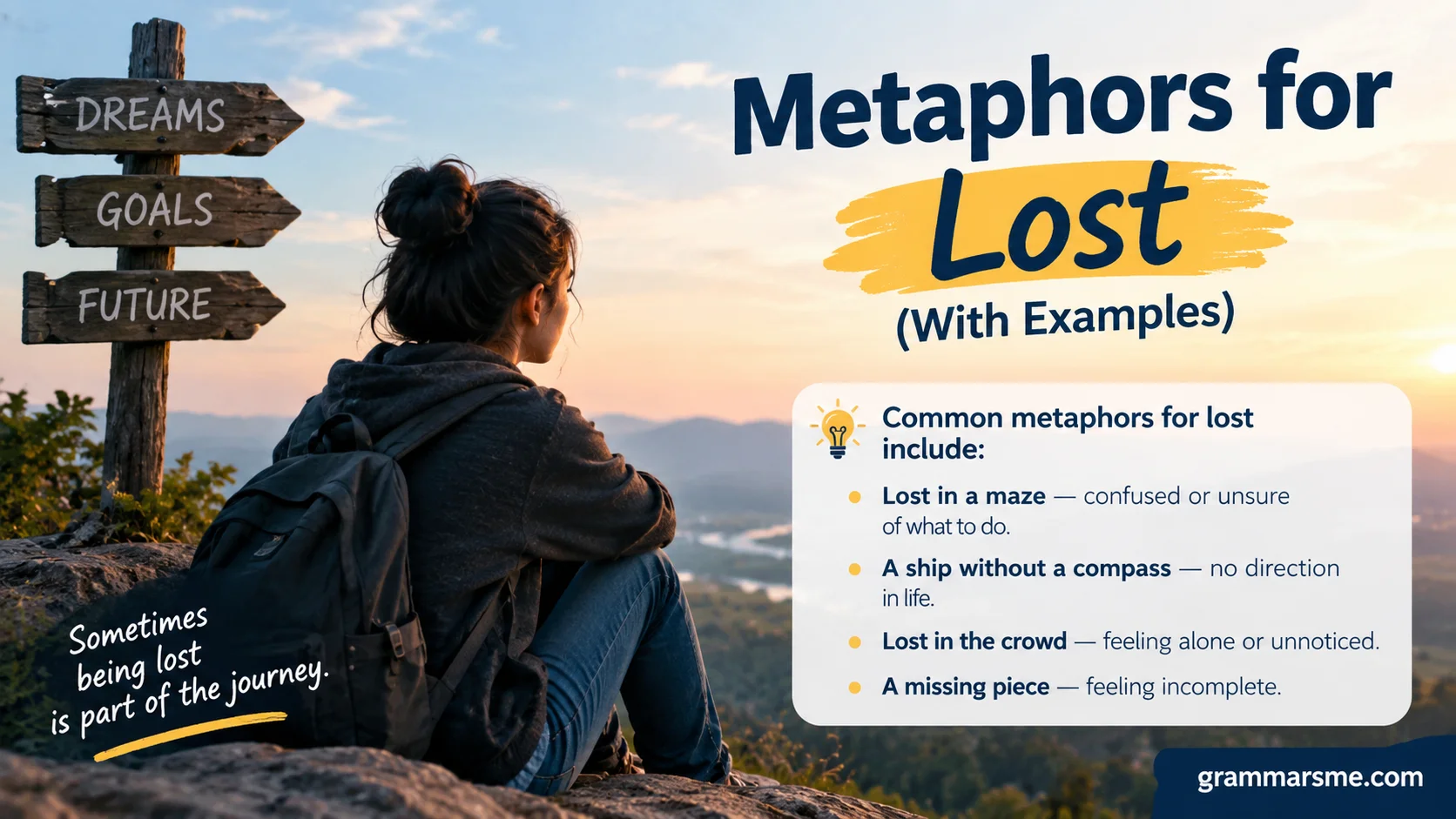

20 Metaphors for Lost (With Examples) can turn confusion, loneliness, and uncertainty into clear images that readers can easily understand well.
When some people feel lost, they may be emotionally confused, disconnected, or unsure about what comes next. The experience can feel like losing a direction after a major change, while family, loss, grief, and mourning can make that feeling stronger. In my personal experience, finding the right words helps express these emotions without making them harder to explain. A strong metaphor can communicate a feeling of absence, separation, or connection through vivid images, making an emotional idea easier to understand and describe.
For writing, a story, poem, personal message, or thoughtful reflection, metaphors can give shape and meaning to something difficult to explain. A person may describe themselves as a traveler without a map, a ship without a compass, or someone standing at a crossroads, using imagery to show feeling directionless, loneliness, and uncertainty. Communication, expression, and careful words are especially important in sensitive and emotional situations, whether the purpose is remembrance, sympathy, or simply to say “I’m lost.”
1. Lost in a Maze
Meaning:
Being lost in a maze means feeling confused and unable to find the right direction or solution.
Detailed explanation:
A maze has many paths, turns, and dead ends. You may keep moving without knowing whether you’re getting closer to the exit. This makes it a powerful metaphor for confusion, uncertainty, and difficult decisions. It works especially well when someone feels trapped in complicated circumstances.
Example sentence:
“I feel like I’m lost in a maze, trying to figure out which path will finally lead me forward.”
3 other ways to say it:
- Wandering through endless confusion
- Trapped among uncertain choices
- Searching for a way out
2. A Ship Without a Compass
Meaning:
A ship without a compass represents someone who has no clear direction or sense of purpose.
Detailed explanation:
A ship can travel across a huge ocean, but without a compass, the crew may not know where they’re going. This metaphor describes people who are moving through life but don’t have a clear goal or destination. It can express uncertainty about relationships, careers, decisions, or the future.
Example sentence:
“After leaving my old career, I felt like a ship without a compass, drifting toward an unknown future.”
3 other ways to say it:
- Drifting without direction
- Traveling without a destination
- Moving without knowing where to go
3. A Leaf in the Wind
Meaning:
A leaf in the wind represents someone being carried from one situation to another without control over where they end up.
Detailed explanation:
A leaf has little power against a strong wind. It moves wherever the air takes it. This metaphor can describe feeling helpless, uncertain, or directionless. It is especially useful when circumstances seem to control your life more than your own choices do.
Example sentence:
“After everything changed so quickly, I felt like a leaf in the wind, carried wherever circumstances took me.”
3 other ways to say it:
- Drifting with the current
- Carried by circumstances
- Floating without control
4. Wandering Through a Fog
Meaning:
Wandering through a fog means moving forward without being able to see clearly what lies ahead.
Detailed explanation:
Fog makes familiar surroundings difficult to recognize. You may know you’re moving, but you can’t clearly see your destination. As a metaphor, it captures uncertainty, confusion, and emotional disorientation. It works particularly well when the future feels unclear.
Example sentence:
“Since the decision was made, I’ve been wandering through a fog, unsure of what I should do next.”
3 other ways to say it:
- Walking through uncertainty
- Moving through unclear circumstances
- Trying to see through confusion
5. A Wanderer Without a Home
Meaning:
A wanderer without a home represents someone who feels disconnected, unsettled, or unable to find where they truly belong.
Detailed explanation:
Home often symbolizes comfort, belonging, and security. A wanderer without one is constantly searching for somewhere to feel settled. This metaphor can describe physical displacement as well as emotional or social disconnection.
Example sentence:
“After losing touch with the people I trusted, I felt like a wanderer without a home.”
3 other ways to say it:
- Searching for somewhere to belong
- Drifting without a place to settle
- Looking for a sense of home
6. A Starless Night
Meaning:
A starless night represents a period when someone feels unable to find hope, guidance, or direction.
Detailed explanation:
Stars have traditionally helped travelers navigate the night. When the sky is completely dark, that natural guidance disappears. This makes the metaphor useful for describing moments of emotional uncertainty, loneliness, and lack of direction.
Example sentence:
“Without any idea what the future held, my life felt like a starless night.”
3 other ways to say it:
- A night without guidance
- A dark road ahead
- A sky without direction
7. A Broken Map
Meaning:
A broken map represents having plans or guidance that no longer help you reach your intended destination.
Detailed explanation:
A map is supposed to show where you are and how to reach somewhere else. If the map is inaccurate or damaged, following it can leave you even more confused. This metaphor works well when old plans no longer fit your current situation.
Example sentence:
“My carefully planned future suddenly felt like a broken map, pointing me toward places that no longer existed.”
3 other ways to say it:
- A plan that no longer works
- Guidance that has lost its meaning
- A path that no longer leads anywhere
8. A Compass Spinning in Circles
Meaning:
A compass spinning in circles represents uncertainty and an inability to identify the right direction.
Detailed explanation:
A compass should provide a reliable sense of direction. If its needle keeps spinning, it becomes useless to someone trying to navigate. The metaphor captures the feeling of changing your mind repeatedly or being unable to choose a path.
Example sentence:
“My thoughts were like a compass spinning in circles, pointing toward a different answer every day.”
3 other ways to say it:
- Unable to find a direction
- Caught between choices
- Searching for a clear answer
9. A Traveler at a Crossroads
Meaning:
A traveler at a crossroads represents someone who must choose between different paths but doesn’t know which one is right.
Detailed explanation:
A crossroads gives travelers several possible directions. Each path may lead to a completely different destination. This metaphor is ideal for describing major life decisions, relationship choices, career changes, or moments of uncertainty.
Example sentence:
“After graduation, I stood like a traveler at a crossroads, wondering which road would shape my future.”
3 other ways to say it:
- Standing between different paths
- Facing an uncertain choice
- Choosing between possible futures
10. A Boat Drifting at Sea
Meaning:
A boat drifting at sea represents someone moving through life without a clear destination or control over their direction.
Detailed explanation:
The ocean is vast, and a drifting boat can travel far without reaching a meaningful destination. This metaphor expresses aimlessness, uncertainty, and emotional isolation. It can be gentle rather than dramatic, making it useful for personal writing.
Example sentence:
“Since I stopped chasing my old dreams, I have felt like a boat drifting at sea.”
3 other ways to say it:
- Floating without a destination
- Drifting through life
- Moving without a clear course
11. A Puzzle With Missing Pieces
Meaning:
A puzzle with missing pieces represents a situation that doesn’t make sense because important information or understanding is missing.
Detailed explanation:
A puzzle becomes difficult to complete when essential pieces are gone. Similarly, people can feel lost when they don’t understand what happened or what they should do next. This metaphor is especially effective for describing confusion and unanswered questions.
Example sentence:
“My memories felt like a puzzle with missing pieces, leaving me unable to understand the whole story.”
3 other ways to say it:
- A story with unanswered questions
- A picture missing important pieces
- A mystery without enough clues
12. A Road With No Signs
Meaning:
A road with no signs represents moving forward without guidance or information about where the path leads.
Detailed explanation:
Road signs help travelers understand where they are and what destinations lie ahead. Without them, even a straight road can feel uncertain. This metaphor expresses lack of guidance and uncertainty about the future.
Example sentence:
“Starting over felt like walking down a road with no signs, because I had no idea where I was headed.”
3 other ways to say it:
- A path without guidance
- A journey without directions
- A road toward an unknown destination
13. A Voice Lost in the Crowd
Meaning:
A voice lost in the crowd represents someone who feels unheard, overlooked, or disconnected from others.
Detailed explanation:
A person can speak loudly in a crowded place and still struggle to be heard. This metaphor shifts the meaning of being lost from physical direction to emotional and social disconnection. It works well when someone feels invisible or misunderstood.
Example sentence:
“Among so many opinions, I felt like a voice lost in the crowd, unsure whether anyone understood me.”
3 other ways to say it:
- Feeling unheard among others
- A presence overlooked
- Speaking without being understood
Read More: 20 Metaphors for Loud (With Examples)
14. A Shadow Searching for Light
Meaning:
A shadow searching for light represents someone looking for hope, clarity, or a way forward.
Detailed explanation:
A shadow exists where light is blocked. Imagining a shadow searching for light creates a powerful contrast between confusion and hope. Unlike some metaphors for being lost, this one suggests that the person is still searching for something better.
Example sentence:
“I was a shadow searching for light, looking for one small reason to believe things could improve.”
3 other ways to say it:
- Searching for a ray of hope
- Looking for clarity in darkness
- Reaching toward something brighter
15. A Traveler Walking in Circles
Meaning:
A traveler walking in circles represents someone who keeps making choices or repeating patterns without making progress.
Detailed explanation:
Walking for hours without realizing you’ve returned to the same place can feel frustrating. This metaphor describes repeated mistakes, indecision, or emotional patterns that keep someone from moving forward.
Example sentence:
“I kept returning to the same worries, like a traveler walking in circles.”
3 other ways to say it:
- Repeating the same path
- Going nowhere despite moving
- Caught in a cycle of uncertainty
16. A Feather Floating on Water
Meaning:
A feather floating on water represents someone who feels carried along by circumstances without knowing where they will end up.
Detailed explanation:
A feather is light and easily moved by water. It doesn’t decide its destination; the current determines where it travels. This metaphor can describe a softer form of feeling lost, especially when someone feels passive, uncertain, or emotionally adrift.
Example sentence:
“After so many unexpected changes, I felt like a feather floating on water, simply following the current.”
3 other ways to say it:
- Floating with the current
- Drifting wherever life carries you
- Moving without a fixed destination
17. An Untitled Book
Meaning:
An untitled book represents a life or situation whose purpose and direction have not yet been defined.
Detailed explanation:
A book without a title doesn’t necessarily have a bad story. It simply hasn’t been given a clear identity yet. This makes the metaphor useful when someone feels uncertain about who they are or what comes next, while leaving room for hope and possibility.
Example sentence:
“After changing my plans, I felt like an untitled book, waiting to discover what the next chapter would be.”
3 other ways to say it:
- A story still being written
- A future without a title
- A blank chapter waiting to unfold
18. A Train Between Stations
Meaning:
A train between stations represents someone caught between one stage of life and another.
Detailed explanation:
A train traveling between stations has already left one destination but hasn’t reached the next. This metaphor captures the uncomfortable middle period when the past is behind you and the future hasn’t arrived yet.
Example sentence:
“After leaving my old life behind, I felt like a train between stations, unsure where I would finally stop.”
3 other ways to say it:
- Caught between two stages
- Moving between past and future
- Waiting to reach the next destination
19. A Lantern With No Path
Meaning:
A lantern with no path represents having some hope or awareness but still not knowing where to go.
Detailed explanation:
A lantern can illuminate the area around you, but it cannot necessarily tell you which road to choose. This metaphor shows that sometimes a person can understand their situation yet still feel uncertain about their next step.
Example sentence:
“I had hope, but I still felt like a lantern with no path, shining without knowing where to lead myself.”
3 other ways to say it:
- Having light without direction
- Seeing clearly but not knowing where to go
- Holding hope without a destination
20. A Traveler Beneath an Unknown Sky
Meaning:
A traveler beneath an unknown sky represents someone entering unfamiliar territory without knowing what lies ahead.
Detailed explanation:
The sky is enormous, and an unfamiliar sky can symbolize a completely new environment or stage of life. This metaphor works especially well when being lost isn’t only frightening but also connected to growth, change, and discovering something new.
Example sentence:
“As I began this new chapter, I felt like a traveler beneath an unknown sky, unsure of where the journey would lead.”
3 other ways to say it:
- Exploring an unfamiliar future
- Walking into the unknown
- Beginning a journey without a clear destination
MCQs:
1.After losing his sense of purpose, he felt like ______.
A. a ship without a compass
B. a bright sunrise
C. a locked door
D. a strong mountain
2.She couldn’t decide which career path to choose, so she felt like ______.
A. a leaf in the wind
B. a traveler at a crossroads
C. a finished book
D. a shining star
3.He kept repeating the same mistakes and making no progress. He was like ______.
A. a traveler walking in circles
B. a lantern with no path
C. a calm ocean
D. a clear road
4.After moving somewhere completely unfamiliar, she felt like ______.
A. an untitled book
B. a traveler beneath an unknown sky
C. a completed puzzle
D. a compass pointing north
5.His thoughts were confused and unclear, like ______.
A. a wandering fog
B. a broken map
C. a perfect road
D. a bright lantern
6.She felt unheard despite being surrounded by people, like ______.
A. a boat at sea
B. a voice lost in the crowd
C. a traveler at a crossroads
D. an untitled book
7.His plans no longer matched reality, so his future felt like ______.
A. a broken map
B. a starry sky
C. a finished journey
D. a clear compass
8.After leaving his old life behind but before starting his new one, he felt like ______.
A. a train between stations
B. a starless night
C. a leaf on a tree
D. a completed puzzle
9.She had hope but didn’t know what direction to take, like ______.
A. a lantern with no path
B. a road with signs
C. a compass working perfectly
D. a traveler at home
10.After everything changed suddenly, he felt powerless and carried along by events like ______.
A. a leaf in the wind
B. a mountain
C. a compass
D. a road sign
11.His life felt dark and directionless, like ______.
A. a starless night
B. a clear morning
C. a marked road
D. a complete map
12.She couldn’t understand what had happened because important information was missing, like ______.
A. a puzzle with missing pieces
B. a finished book
C. a straight road
D. a working compass
13.He was looking for hope during a difficult period, like ______.
A. a shadow searching for light
B. a boat at harbor
C. a completed puzzle
D. a road with signs
14.After losing his sense of belonging, he felt like ______.
A. a wanderer without a home
B. a traveler with a destination
C. a ship with a compass
D. a book with a title
15.She was entering a completely unfamiliar stage of life, like ______.
A. a traveler beneath an unknown sky
B. a road with clear signs
C. a completed journey
D. a compass pointing home
Answer Key:
1-A, 2-B, 3-A, 4-B, 5-A, 6-B, 7-A, 8-A, 9-A, 10-A, 11-A, 12-A, 13-A, 14-A, 15-A
FAQs:
What is a metaphor for feeling lost?
A metaphor for feeling lost compares confusion or uncertainty to a familiar image. Examples include “lost in a maze,” “a ship without a compass,” and “wandering through a fog.”
What is a metaphor for being lost in life?
“A ship without a compass” is a strong metaphor for feeling lost in life because it suggests movement without a clear destination or direction.
What is a metaphor for feeling emotionally lost?
“A voice lost in the crowd” can describe emotional disconnection, while “a shadow searching for light” suggests someone looking for hope and clarity.
What is a positive metaphor for being lost?
“An untitled book” is a positive metaphor because it suggests that uncertainty doesn’t mean the story is over. The future can still be written.
How can I use these metaphors in writing?
Choose a metaphor that matches the specific emotion you’re expressing. For example, use “a traveler at a crossroads” for difficult decisions and “a boat drifting at sea” for aimlessness. Add the metaphor naturally to a sentence rather than forcing it into your writing.
Conclusion:
Feeling lost doesn’t always mean you’re failing or moving in the wrong direction. Sometimes, it simply means you’re standing between what you knew and what you haven’t discovered yet. The right metaphor can make that complicated feeling easier to express. Whether you describe yourself as a traveler at a crossroads, a ship without a compass, a shadow searching for light, or an untitled book, each image communicates a different shade of uncertainty. Choose the metaphor that feels closest to your experience, and let it give your words the clarity, emotion, and meaning they need.



1 thought on “20 Metaphors for Lost (With Examples)”