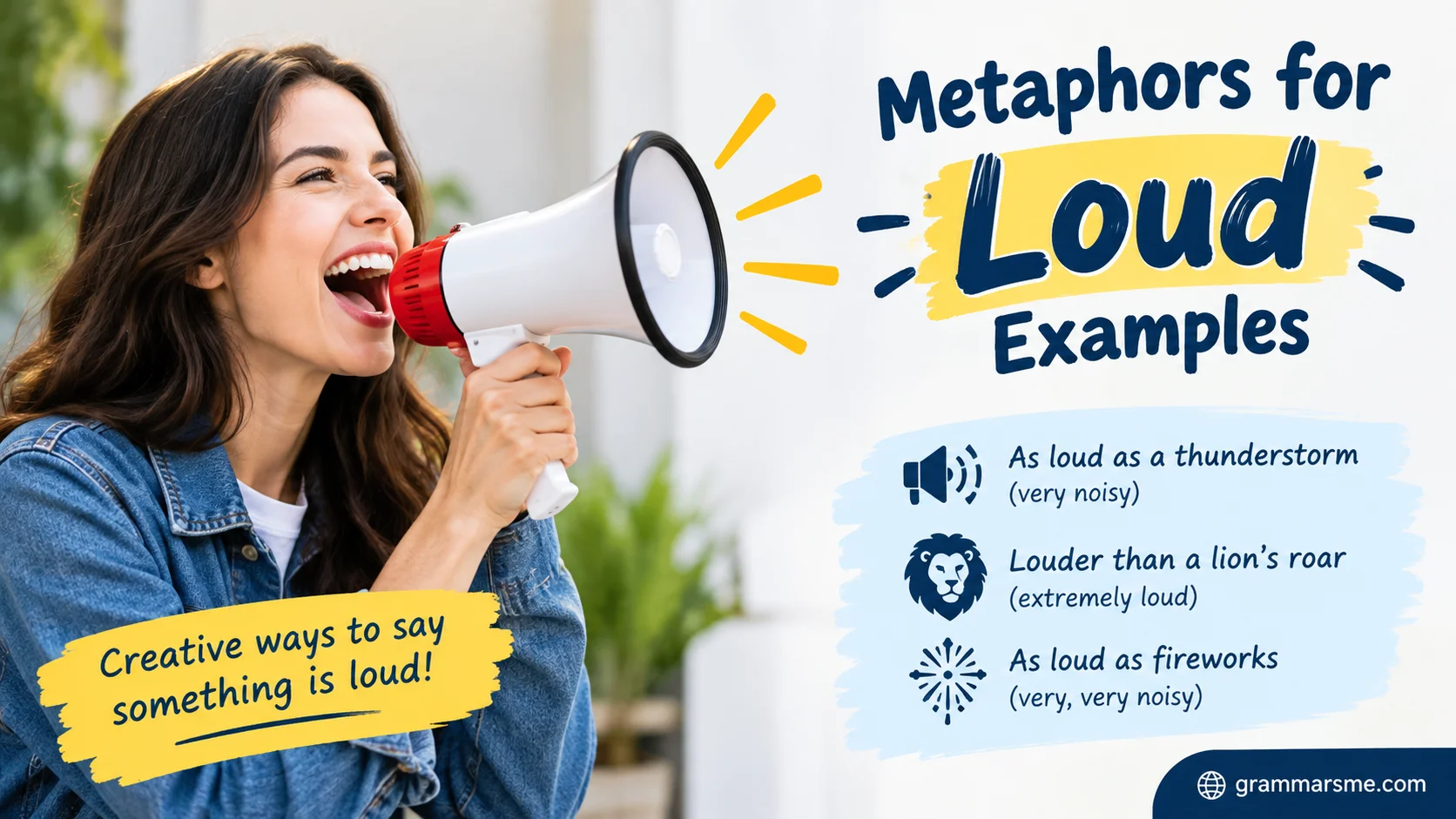

Using 20 Metaphors for Loud (With Examples) can transform ordinary language into vivid images that help readers understand powerful sounds more clearly and naturally.
Metaphors act like secret engines of language, helping us move beyond simply describing something directly. They transform ordinary words so readers can feel and understand a voice, sound, or loud moment more clearly. We can compare a voice with thunder and use weather as an imaginative reference, allowing the comparison to shape perception and stretch meaning beyond dictionary definitions. From my experience, this can infuse a sentence with sensation, mood, and depth.
Some sounds are soft, while loud sounds may feel exciting or create surprise. We notice these things through our ears and bodies, whether it is a dog barking, a fire truck siren, a drum at a parade, or music that resembles a lion’s roar. These fun word pictures give us an easy way to talk about one thing as something else, instead of merely saying that a sound is loud. This lesson uses different metaphors to make loud things more fun and clear. Figurative expressions can describe intense sounds in a creative way when you have struggled to express a roaring noise or a crowded scene.
1. A Thunderclap
Meaning: A sound that is extremely loud, sudden, and powerful.
Detailed explanation:
Calling a sound a thunderclap compares its intensity to the sudden crash of thunder. This metaphor works especially well for noises that arrive without warning and immediately capture everyone’s attention. It can describe a shout, explosion, slammed door, drumbeat, or sudden announcement.
Example:
“His angry shout was a thunderclap that silenced the entire room.”
Three other ways to say it:
- A booming crash
- A sudden roar
- A deafening burst
2. A Roaring Lion
Meaning: A voice or sound that is powerful, forceful, and difficult to ignore.
Detailed explanation:
A roaring lion represents strength and authority. This metaphor is particularly useful for describing someone’s voice when they speak or shout with tremendous force. It suggests that the sound carries power rather than simply being loud.
Example:
“The coach’s voice became a roaring lion when the players stopped listening.”
Three other ways to say it:
- A powerful roar
- A commanding voice
- A booming sound
3. A Storm of Sound
Meaning: A place filled with many intense and overlapping noises.
Detailed explanation:
A storm of sound compares loud noise to a powerful storm. It works particularly well when several sounds happen at once, such as cheering crowds, busy streets, concerts, or crowded celebrations. The metaphor creates an image of noise moving around you from every direction.
Example:
“The stadium became a storm of sound when the home team scored.”
Three other ways to say it:
- A wave of noise
- A wall of sound
- A torrent of sound
4. A Cannon
Meaning: A voice or noise that is extremely forceful and booming.
Detailed explanation:
Comparing a voice to a cannon suggests that every word arrives with tremendous force. This metaphor can describe someone who naturally speaks very loudly or someone whose shout seems to shake the surrounding space.
Example:
“Her laugh was a cannon, echoing across the entire hall.”
Three other ways to say it:
- A booming blast
- A powerful boom
- A thunderous voice
5. A Roaring River
Meaning: A continuous and powerful flow of sound.
Detailed explanation:
A roaring river provides an image of sound that keeps moving without stopping. Unlike a sudden noise, this metaphor suits sounds that remain loud for an extended period. It can describe traffic, rushing water, crowds, machinery, or constant conversation.
Example:
“The busy highway sounded like a roaring river outside the window.”
Three other ways to say it:
- A rushing roar
- A continuous rumble
- A flowing wall of sound
6. A Firecracker
Meaning: A sudden, sharp, and energetic sound.
Detailed explanation:
A firecracker is an effective metaphor for a sound that is short but surprisingly loud. It also adds a sense of energy and excitement. The comparison can describe a sudden laugh, clap, shout, or burst of music.
Example:
“His unexpected laugh was a firecracker in the quiet classroom.”
Three other ways to say it:
- A sharp burst
- A sudden pop
- An explosive sound
7. A Wall of Sound
Meaning: A huge amount of sound that feels almost impossible to escape.
Detailed explanation:
When noise becomes so intense that it seems to surround you, a wall of sound is an effective metaphor. It creates the impression that sound has become a physical barrier. This phrase is especially useful for concerts, festivals, sporting events, and busy public places.
Example:
“As the band began playing, a wall of sound filled the arena.”
Three other ways to say it:
- A blanket of noise
- A wave of sound
- An overwhelming roar
8. A Sonic Earthquake
Meaning: A tremendously loud sound that seems to shake everything around it.
Detailed explanation:
A sonic earthquake combines sound with the physical power of an earthquake. It suggests extreme volume and intensity. The metaphor is useful when ordinary words such as “loud” don’t fully communicate how overwhelming the noise feels.
Example:
“The fireworks created a sonic earthquake over the neighborhood.”
Three other ways to say it:
- A shaking roar
- A seismic boom
- A powerful rumble
9. A Megaphone
Meaning: A voice that naturally carries far and sounds unusually strong.
Detailed explanation:
Calling someone’s voice a megaphone suggests that they don’t need amplification to be heard. It can be playful and conversational when describing a naturally loud speaker. The metaphor focuses on the person’s ability to project their voice.
Example:
“You don’t need a microphone; your voice is a megaphone.”
Three other ways to say it:
- A built-in amplifier
- A booming voice
- A powerful speaker
10. A Roaring Engine
Meaning: A deep, powerful, and continuous noise.
Detailed explanation:
An engine produces a distinctive combination of vibration, rumbling, and power. Comparing a loud sound to a roaring engine gives readers an immediate sense of deep and sustained noise. It works particularly well for vehicles, machines, and powerful voices.
Example:
“His voice rolled through the workshop like a roaring engine.”
Three other ways to say it:
- A deep rumble
- A mechanical roar
- A powerful vibration
11. A Drumbeat
Meaning: A strong, noticeable sound that demands attention.
Detailed explanation:
A drumbeat can represent a sound that is rhythmic, persistent, and difficult to ignore. Unlike a random noise, it often suggests repetition. This metaphor works well for loud footsteps, music, knocking, or repeated announcements.
Example:
“Her footsteps became a drumbeat echoing through the empty hallway.”
Three other ways to say it:
- A pounding rhythm
- A heavy beat
- A steady thump
12. A Roaring Ocean
Meaning: A vast, powerful, and overwhelming sound.
Detailed explanation:
The ocean can produce an enormous amount of sound as waves crash against the shore. Calling a loud noise a roaring ocean suggests both volume and scale. It is particularly effective for describing crowds, concerts, storms, or waves themselves.
Example:
“The cheering crowd sounded like a roaring ocean.”
Three other ways to say it:
- A crashing sea
- A wave of noise
- A tidal roar
13. A Blazing Trumpet
Meaning: A bright, forceful, and attention-grabbing sound.
Detailed explanation:
A blazing trumpet combines the energy of fire with the piercing quality of a trumpet. This metaphor works for sounds that are not only loud but also vivid and energetic. It can make descriptions of music, celebrations, or announcements feel more dramatic.
Example:
“The parade moved forward beneath a blazing trumpet of music.”
Three other ways to say it:
- A piercing blast
- A bright fanfare
- A powerful musical call
Read More: 20 Metaphors for Loyalty (With Examples)
14. A Roaring Volcano
Meaning: A sound that is enormous, intense, and seemingly unstoppable.
Detailed explanation:
A roaring volcano suggests enormous natural power. This metaphor is especially effective when describing an extremely loud crowd, argument, machine, or celebration. It can also imply that the sound is building toward an even greater level of intensity.
Example:
“The fans erupted like a roaring volcano after the final goal.”
Three other ways to say it:
- An erupting roar
- A volcanic blast
- An explosive rumble
15. A Thunderstorm
Meaning: A mixture of loud, dramatic, and continuous sounds.
Detailed explanation:
A thunderstorm is more than one loud noise. It involves rumbling, crashing, and repeated bursts of sound. As a metaphor, it works beautifully for environments where many intense sounds overlap.
Example:
“The children turned the living room into a thunderstorm of laughter.”
Three other ways to say it:
- A storm of noise
- A crashing chorus
- A rumbling commotion
16. A Battle Cry
Meaning: A loud, energetic call filled with emotion and determination.
Detailed explanation:
A battle cry describes a sound that carries strong emotion and purpose. It doesn’t simply indicate high volume; it suggests that the speaker wants to motivate, challenge, celebrate, or command attention.
Example:
“The team’s celebration rose like a battle cry after the victory.”
Three other ways to say it:
- A rallying shout
- A powerful call
- A triumphant yell
17. A Siren
Meaning: A loud, piercing sound that immediately demands attention.
Detailed explanation:
A siren is designed to cut through other sounds and make people pay attention. As a metaphor, it works for voices, alarms, cries, or other noises that are especially sharp and noticeable.
Example:
“Her excited voice was a siren across the crowded playground.”
Three other ways to say it:
- A piercing call
- An attention-grabbing shriek
- A sharp alarm
18. A Hammer on Metal
Meaning: A sharp, forceful, and repetitive sound.
Detailed explanation:
The image of a hammer striking metal creates an immediate sense of hard, sharp noise. This metaphor is ideal for construction sites, workshops, repeated banging, or anything that produces an intense metallic sound.
Example:
“The construction outside sounded like a hammer on metal all morning.”
Three other ways to say it:
- A metallic clang
- A pounding strike
- A sharp bang
19. A Roaring Crowd
Meaning: A large group making an intense and unified amount of noise.
Detailed explanation:
A roaring crowd compares collective human voices to the deep power of a roar. It captures excitement, celebration, anticipation, or emotional intensity. This metaphor is especially useful for sports, concerts, political gatherings, and festivals.
Example:
“The singer stepped onto the stage as a roaring crowd welcomed her.”
Three other ways to say it:
- A cheering sea
- A thunderous audience
- A wave of voices
20. A Sound Cannon
Meaning: An extremely powerful source of sound that seems to blast noise outward.
Detailed explanation:
A sound cannon is a vivid metaphor for something that produces overwhelming volume. It works particularly well for speakers, musical performances, machinery, or exceptionally loud voices. The comparison makes the sound feel forceful and directional.
Example:
“The concert speakers became a sound cannon, sending music across the field.”
Three other ways to say it:
- A sonic blast
- A booming force
- A powerful sound machine
MCQs
1. Which metaphor best describes a sudden, powerful noise?
A. A whispering cloud
B. A thunderclap
C. A quiet lake
D. A gentle breeze
2. “His voice was a roaring lion” suggests that his voice was:
A. Weak
B. Silent
C. Powerful and loud
D. Difficult to understand
3. Which metaphor describes many sounds happening together?
A. A storm of sound
B. A sleeping flower
C. A frozen candle
D. A silent shadow
4. “A wall of sound” suggests that the noise:
A. Is barely noticeable
B. Feels overwhelming and surrounding
C. Happens only once
D. Comes from one quiet person
5. Which metaphor is best for a loud, continuous mechanical noise?
A. A roaring engine
B. A soft feather
C. A sleeping bird
D. A glass of water
6. A “firecracker” metaphor usually suggests a sound that is:
A. Sudden and sharp
B. Slow and silent
C. Gentle and relaxing
D. Completely inaudible
7. Which metaphor best describes an excited stadium crowd?
A. A roaring ocean
B. A quiet garden
C. A sleeping cloud
D. A still mirror
8. “A sonic earthquake” emphasizes:
A. Softness
B. Tremendous sound and impact
C. Silence
D. Distance only
9. Which metaphor compares a loud voice to something used to amplify sound?
A. A megaphone
B. A river
C. A candle
D. A leaf
10. “A battle cry” suggests a sound that is:
A. Energetic and forceful
B. Completely silent
C. Sleepy and calm
D. Unimportant
11. Which metaphor works best for a piercing attention-grabbing sound?
A. A siren
B. A pillow
C. A feather
D. A shadow
12. “A hammer on metal” is especially suitable for describing:
A. A soft melody
B. Sharp repetitive banging
C. A quiet conversation
D. Gentle rainfall
13. Which metaphor suggests a huge and seemingly unstoppable sound?
A. A roaring volcano
B. A sleeping cat
C. A quiet stream
D. A soft blanket
14. Which expression best describes a large group making loud noise?
A. A roaring crowd
B. A silent room
C. A gentle whisper
D. A quiet corner
15. Which metaphor best describes a strong, rhythmic, repeated sound?
A. A drumbeat
B. A snowflake
C. A shadow
D. A still pond
Answer Key:
1-B, 2-C, 3-A, 4-B, 5-A, 6-A, 7-A, 8-B, 9-A, 10-A, 11-A, 12-B, 13-A, 14-A, 15-A.
FAQs
1. What is a metaphor for loud?
A metaphor for loud compares an intense sound to something powerful or overwhelming. Examples include “a thunderclap,” “a roaring lion,” “a wall of sound,” and “a roaring volcano.”
2. What is a creative way to say something is loud?
You can say something is “a storm of sound,” “a sonic earthquake,” “a roaring ocean,” or “a thunderstorm.” The best expression depends on whether the sound is sudden, continuous, powerful, or chaotic.
3. What metaphor describes a very loud voice?
A very loud voice can be described as “a roaring lion,” “a megaphone,” “a cannon,” or “a battle cry.” These comparisons emphasize strength, projection, or emotional intensity.
4. What is a metaphor for a loud crowd?
A loud crowd can be described as “a roaring ocean,” “a wall of sound,” “a roaring crowd,” or “a storm of sound.” These metaphors emphasize the combined volume of many voices.
5. Why use metaphors to describe loud sounds?
Metaphors make descriptions more vivid and memorable. Instead of simply telling readers that something is loud, they help readers imagine the sound’s power, movement, emotion, and intensity.
Conclusion
Metaphors can transform a simple description of something loud into an image that readers can almost hear. Whether you choose a thunderclap, roaring lion, wall of sound, roaring ocean, or volcanic roar, each comparison communicates a slightly different feeling. Some metaphors emphasize power, while others highlight suddenness, excitement, persistence, or emotional intensity. The best choice depends on the sound you’re describing and the impression you want to create. When you use these expressions thoughtfully, your writing becomes more vivid, natural, and memorable without relying on the same word repeatedly.




1 thought on “20 Metaphors for Loud (With Examples)”