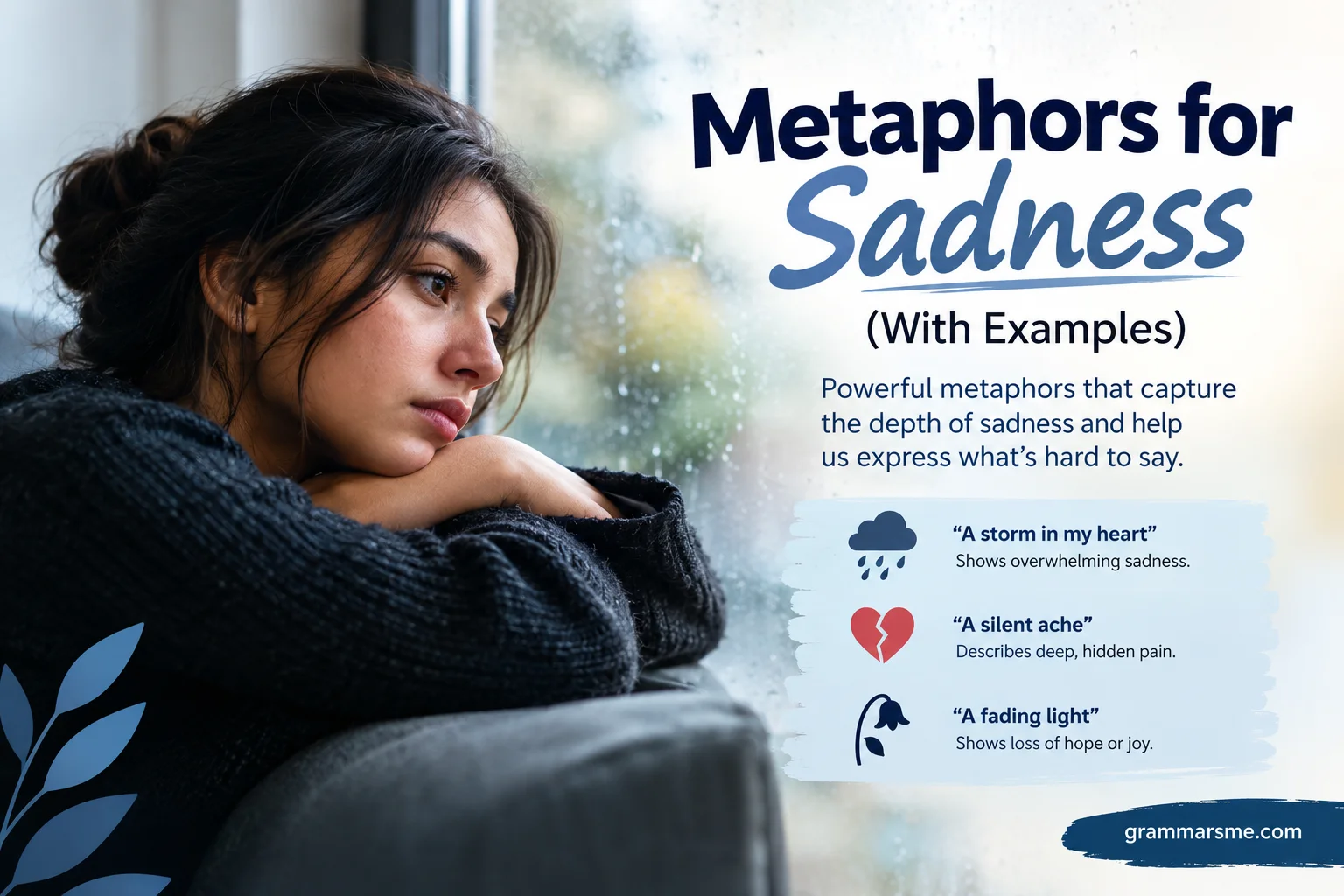

Metaphors for Sadness (With Examples) can help people learning English as a second language express feelings beyond simple words.
Feelings expressions enable students to use English vocabulary knowledge in real situations, interact fluently with native English speakers, and express themselves more naturally. From real-life experience, students often struggle to explain sadness because saying I’m sad doesn’t always feel enough. You may feel a little low, low, or depressed, but interesting idiomatic expressions, including language formally known as phrasal verbs, can help you express.
yourself and describe emotions. For writing, poetry, social media captions, daily conversations, essays, and stories, a metaphor for sadness provides deeper, creative ways to describe heavy emotions. Writers may want better lines, while friends may need better words during tough times. A strong metaphor for sadness paints a picture, allowing people to feel the emotion instead of only hearing the words. A useful metaphor can also make a difficult feeling easier to understand and share.
1. Sadness Is a Heavy Cloud
Meaning: This metaphor compares sadness to a heavy cloud hanging over someone, making everything feel darker.
Detailed explanation: A cloud can block sunlight and change the atmosphere around us. In the same way, sadness can affect someone’s mood, thoughts, and ability to enjoy everyday moments. The metaphor suggests that sadness may feel constant, but clouds can eventually move.
Example:
“Sadness was a heavy cloud above her, following her through every room.”
Three other ways to say it:
- Sadness hung over him like a dark cloud.
- Her sorrow seemed to cover everything like clouds before a storm.
- A shadow of sadness followed her throughout the day.
2. Sadness Is a Quiet Storm
Meaning: This metaphor describes sadness as an internal storm that may be intense even when someone appears calm.
Detailed explanation: Real storms can be loud and visible, but emotional storms can happen silently. Someone may smile, work, talk, and interact normally while experiencing deep emotional pain inside.
Example:
“Behind his calm expression, a quiet storm of sadness was gathering.”
Three other ways to say it:
- He was fighting an emotional storm inside.
- Her heart was weathering a silent storm.
- Beneath the calm surface, sorrow was raging.
3. Sadness Is an Empty Room
Meaning: This metaphor compares sadness to being alone in an empty room, emphasizing loneliness and emotional emptiness.
Detailed explanation: An empty room can feel quiet, cold, and disconnected. The metaphor works especially well when sadness comes with loneliness or the feeling that something important is missing.
Example:
“After they left, her heart felt like an empty room with no familiar voices inside it.”
Three other ways to say it:
- His heart felt strangely vacant.
- Loneliness filled the space where happiness used to live.
- She felt as though she were standing alone in an abandoned room.
4. Sadness Is a Weight on the Heart
Meaning: This metaphor presents sadness as a physical weight that makes emotional life feel difficult.
Detailed explanation: When people are deeply sad, they often describe themselves as feeling heavy or tired. This metaphor captures that emotional pressure without suggesting that sadness is literally a physical object.
Example:
“The memory became a weight on her heart that she carried everywhere.”
Three other ways to say it:
- Grief sat heavily on his heart.
- Her sorrow felt like a burden she couldn’t put down.
- Pain weighed heavily on her emotions.
5. Sadness Is a Dark Ocean
Meaning: This metaphor compares sadness to a vast, dark ocean that can feel deep and difficult to navigate.
Detailed explanation: An ocean has no obvious boundaries when viewed from within it. Likewise, intense sadness can make someone feel surrounded by emotion without knowing exactly when the feeling will end.
Example:
“He felt as though he were floating alone in a dark ocean of sadness.”
Three other ways to say it:
- She was drowning in sorrow.
- His emotions felt like an endless sea.
- Sadness surrounded her like deep water.
6. Sadness Is a Winter
Meaning: This metaphor compares sadness to winter, a season associated with coldness, stillness, and reduced warmth.
Detailed explanation: Winter can make landscapes appear quiet and lifeless, but it is temporary. This makes the metaphor especially useful when expressing a period of sadness while leaving room for the possibility of emotional renewal.
Example:
“Her sadness was a long winter, covering her days in silence and cold.”
Three other ways to say it:
- His heart had entered an emotional winter.
- Sorrow made her world feel cold and still.
- She was living through a season of sadness.
7. Sadness Is a Shadow
Meaning: This metaphor describes sadness as a shadow that follows someone wherever they go.
Detailed explanation: A shadow stays close to its source, making it an effective image for persistent sadness. It can suggest that painful feelings remain present even during ordinary or pleasant moments.
Example:
“Sadness followed him like a shadow, even on days when he tried to smile.”
Three other ways to say it:
- Sorrow stayed close behind her.
- His pain followed him everywhere.
- A dark feeling remained beside him.
8. Sadness Is a Wound
Meaning: This metaphor compares emotional pain to a wound that needs time and care to heal.
Detailed explanation: Physical wounds aren’t always visible, and neither are emotional wounds. This metaphor reminds readers that sadness can require patience, support, and healing rather than immediate solutions.
Example:
“Her sadness was an unseen wound that needed time to heal.”
Three other ways to say it:
- His heart carried an invisible injury.
- Emotional pain left a wound inside her.
- Some memories felt like scars that had not yet healed.
9. Sadness Is a Broken String
Meaning: This metaphor compares sadness to a broken string on a musical instrument, suggesting that something once harmonious has been disrupted.
Detailed explanation: A broken string can prevent an instrument from producing the sound it once made. Similarly, sadness can interrupt someone’s normal sense of balance, joy, or connection.
Example:
“After the loss, her happiness felt like a broken string that could no longer produce its familiar melody.”
Three other ways to say it:
- Her joy had lost its familiar rhythm.
- His emotions felt out of tune.
- Something inside her no longer sounded the same.
10. Sadness Is a Distant Echo
Meaning: This metaphor describes sadness as an echo from something painful that happened in the past.
Detailed explanation: An echo repeats a sound after the original noise has disappeared. In emotional writing, this can represent memories that continue affecting someone long after an event has passed.
Example:
“Years later, the sadness remained as a distant echo of what she had lost.”
Three other ways to say it:
- The past still whispered through his emotions.
- Old sorrow continued to reverberate inside her.
- Memories carried the faint sound of earlier pain.
11. Sadness Is a Fog
Meaning: This metaphor compares sadness to fog that makes everything feel unclear and difficult to see.
Detailed explanation: Fog limits visibility and can make familiar surroundings seem strange. Emotional sadness can work similarly by making the future feel uncertain or everyday activities seem difficult to understand.
Example:
“A fog of sadness settled over him, making even simple decisions feel difficult.”
Three other ways to say it:
- Sorrow clouded her thoughts.
- His emotions were covered in a haze.
- Sadness made the future seem unclear.
12. Sadness Is a Leaking Roof
Meaning: This metaphor presents sadness as something that slowly enters a person’s life despite their efforts to keep it out.
Detailed explanation: A leaking roof may appear manageable at first, but repeated drops can eventually affect an entire room. Similarly, unresolved sadness can gradually influence thoughts, relationships, and daily routines.
Example:
“She tried to ignore her sadness, but it kept dripping into her thoughts like rain through a leaking roof.”
Three other ways to say it:
- Sorrow kept finding its way into his day.
- Pain slowly seeped through her defenses.
- Her emotions kept breaking through the surface.
13. Sadness Is a Thorn
Meaning: This metaphor compares sadness to a thorn that causes pain whenever it is touched.
Detailed explanation: A thorn is small but capable of causing sharp discomfort. This metaphor works well for emotional pain connected to a particular memory, person, or experience.
Example:
“That old memory remained a thorn in his heart.”
Three other ways to say it:
- The memory was a sharp point of pain.
- Her sorrow pricked whenever she remembered the past.
- Some memories still hurt like tiny wounds.
14. Sadness Is a Candle Going Out
Meaning: This metaphor describes sadness as the gradual disappearance of light, warmth, or hope.
Detailed explanation: A candle provides light in darkness, so watching its flame disappear can represent losing emotional energy or optimism. It can create a gentle and poetic image of fading happiness.
Example:
“Her sadness felt like watching the last candle of hope slowly go out.”
Three other ways to say it:
- His hope seemed to flicker in the darkness.
- Her inner light felt dim.
- Joy seemed to fade like a dying flame.
Read More: Metaphors for Sand (With Examples)
15. Sadness Is a Long Road
Meaning: This metaphor compares sadness to a long road that someone must travel before reaching emotional relief.
Detailed explanation: Roads suggest movement, distance, and progress. This metaphor can communicate that healing isn’t always immediate and that difficult emotions may be part of a longer personal journey.
Example:
“Grieving became a long road, and she learned to take it one step at a time.”
Three other ways to say it:
- Healing was a journey through difficult days.
- He walked slowly through his season of grief.
- Her recovery felt like traveling toward a distant horizon.
16. Sadness Is a Locked Door
Meaning: This metaphor presents sadness as a locked door separating someone from connection, joy, or emotional openness.
Detailed explanation: A locked door creates distance between one space and another. When someone is overwhelmed by sadness, they may withdraw from others or struggle to express what they are feeling.
Example:
“His sadness became a locked door that made it difficult for him to let anyone get close.”
Three other ways to say it:
- Pain closed her off from others.
- His sorrow built walls around his heart.
- She struggled to open herself to connection.
17. Sadness Is a Silent Guest
Meaning: This metaphor describes sadness as a quiet visitor that enters someone’s life and stays longer than expected.
Detailed explanation: A guest usually arrives temporarily, but sadness can sometimes remain for an extended period. The metaphor makes the emotion feel present without making it sound frightening or overwhelming.
Example:
“Sadness became a silent guest in his home, sitting beside him through long evenings.”
Three other ways to say it:
- Sorrow quietly stayed by her side.
- Grief became an unexpected companion.
- A quiet sadness remained in his everyday life.
18. Sadness Is a Cracked Mirror
Meaning: This metaphor compares sadness to a cracked mirror, suggesting that emotional pain can change how someone sees themselves or their surroundings.
Detailed explanation: A cracked mirror still reflects an image, but the reflection is divided or distorted. Similarly, sadness may affect someone’s perception, causing ordinary experiences to look different from before.
Example:
“Her sadness was a cracked mirror through which every happy memory looked different.”
Three other ways to say it:
- Pain distorted the way he saw the world.
- Her emotions fractured her sense of normality.
- Sorrow changed the reflection of her memories.
19. Sadness Is a Fading Photograph
Meaning: This metaphor compares sadness to a photograph slowly losing its color, often representing memories, relationships, or moments that can no longer be recovered.
Detailed explanation: Old photographs can fade with time while still preserving traces of the past. This makes the metaphor useful for writing about nostalgia, loss, and memories that remain emotionally significant.
Example:
“His sadness was like a fading photograph of a life he wished he could return to.”
Three other ways to say it:
- The past felt like a picture losing its color.
- Memories were slowly fading at the edges.
- She held onto an image of what once was.
20. Sadness Is a Song in a Minor Key
Meaning: This metaphor compares sadness to music written in a minor key, creating a feeling of melancholy or emotional depth.
Detailed explanation: Music can communicate emotion without directly naming it. A minor key is often associated with reflective or sorrowful moods, making this metaphor especially useful for poetry, creative writing, and emotional descriptions.
Example:
“Her days became a song in a minor key, beautiful in places but touched by sadness.”
Three other ways to say it:
- His life seemed to carry a melancholy melody.
- Her heart was playing a quieter tune.
- Every memory sounded like a sorrowful song.
MCQs:
1. Which metaphor describes sadness as something that follows you?
A. A long road
B. A shadow
C. A broken string
D. A candle
2. “Sadness was a heavy cloud above her” suggests that sadness is:
A. Completely forgotten
B. Difficult to notice
C. Hanging over her
D. Making her laugh
3. Which metaphor emphasizes emotional emptiness?
A. An empty room
B. A thorn
C. A road
D. A song
4. “A quiet storm” mainly represents:
A. A peaceful vacation
B. Hidden emotional turmoil
C. Physical exercise
D. A happy celebration
5. Which metaphor suggests emotional pain that needs healing?
A. A distant echo
B. A wound
C. A winter
D. A photograph
6. “Sadness was a fog” suggests that the person feels:
A. Confused or unclear
B. Energetic
C. Excited
D. Completely relaxed
7. Which metaphor represents fading hope?
A. A locked door
B. A dark ocean
C. A candle going out
D. A heavy cloud
8. “Her heart felt like an empty room” most strongly suggests:
A. Celebration
B. Loneliness or emotional emptiness
C. Confidence
D. Excitement
9. Which metaphor describes sadness as something connected to an old memory?
A. A distant echo
B. A leaking roof
C. A winter
D. A locked door
10. “A thorn in his heart” suggests:
A. A source of emotional pain
B. A new friendship
C. A happy memory
D. A moment of excitement
11. Which metaphor emphasizes sadness as a process or journey?
A. A long road
B. A cracked mirror
C. A candle
D. A shadow
12. “Sadness became a locked door” suggests that the person:
A. Became more social
B. Felt emotionally closed off
C. Found a new hobby
D. Forgot the past
13. Which metaphor is most closely connected with fading memories?
A. A fading photograph
B. A quiet storm
C. A heavy cloud
D. A broken string
14. “A song in a minor key” creates an image of:
A. Melancholy and emotional depth
B. Anger and violence
C. Comedy and excitement
D. Confusion and fear
15. Why are metaphors useful when describing sadness?
A. They make every sentence longer.
B. They remove emotion from writing.
C. They give abstract feelings a vivid image.
D. They make communication less personal.
Answer Key:
1-B, 2-C, 3-A, 4-B, 5-B, 6-A, 7-C, 8-B, 9-A, 10-A, 11-A, 12-B, 13-A, 14-A, 15-C
FAQs:
What is a metaphor for sadness?
A metaphor for sadness is a comparison that describes emotional pain through a familiar image or experience. Examples include “sadness is a heavy cloud,” “sadness is a shadow,” and “sadness is a quiet storm.”
What is a powerful metaphor for deep sadness?
“Sadness is a dark ocean” can represent deep sadness because an ocean is vast, powerful, and difficult to see across. It can communicate the feeling of being surrounded by intense emotions.
What is a metaphor for feeling lonely and sad?
“Sadness is an empty room” is an effective metaphor for loneliness and sadness. It suggests that someone feels emotionally isolated, as though something important is missing from their surroundings.
How can I describe sadness without saying sad?
You can use imagery such as “a shadow followed me,” “a heavy cloud hung over me,” or “my heart felt like an empty room.” These expressions communicate emotion without directly using the word sad.
Why do writers use metaphors for sadness?
Writers use metaphors because they make abstract emotions easier to visualize and understand. A carefully selected comparison can communicate loneliness, grief, emotional exhaustion, or longing in a way that feels more personal and memorable.
Conclusion:
Sadness can be difficult to put into words, but a thoughtful metaphor can make complicated emotions easier to express. Images such as a heavy cloud, a quiet storm, a shadow, an empty room, or a fading photograph give readers something concrete to imagine while preserving the depth of the feeling. The most effective metaphor is the one that matches the emotion you actually want to communicate. Whether you’re writing creatively or trying to explain your feelings to someone you trust, these metaphors for sadness can help you choose language that feels sincere, gentle, and meaningful.




1 thought on “Metaphors for Sadness (With Examples)”