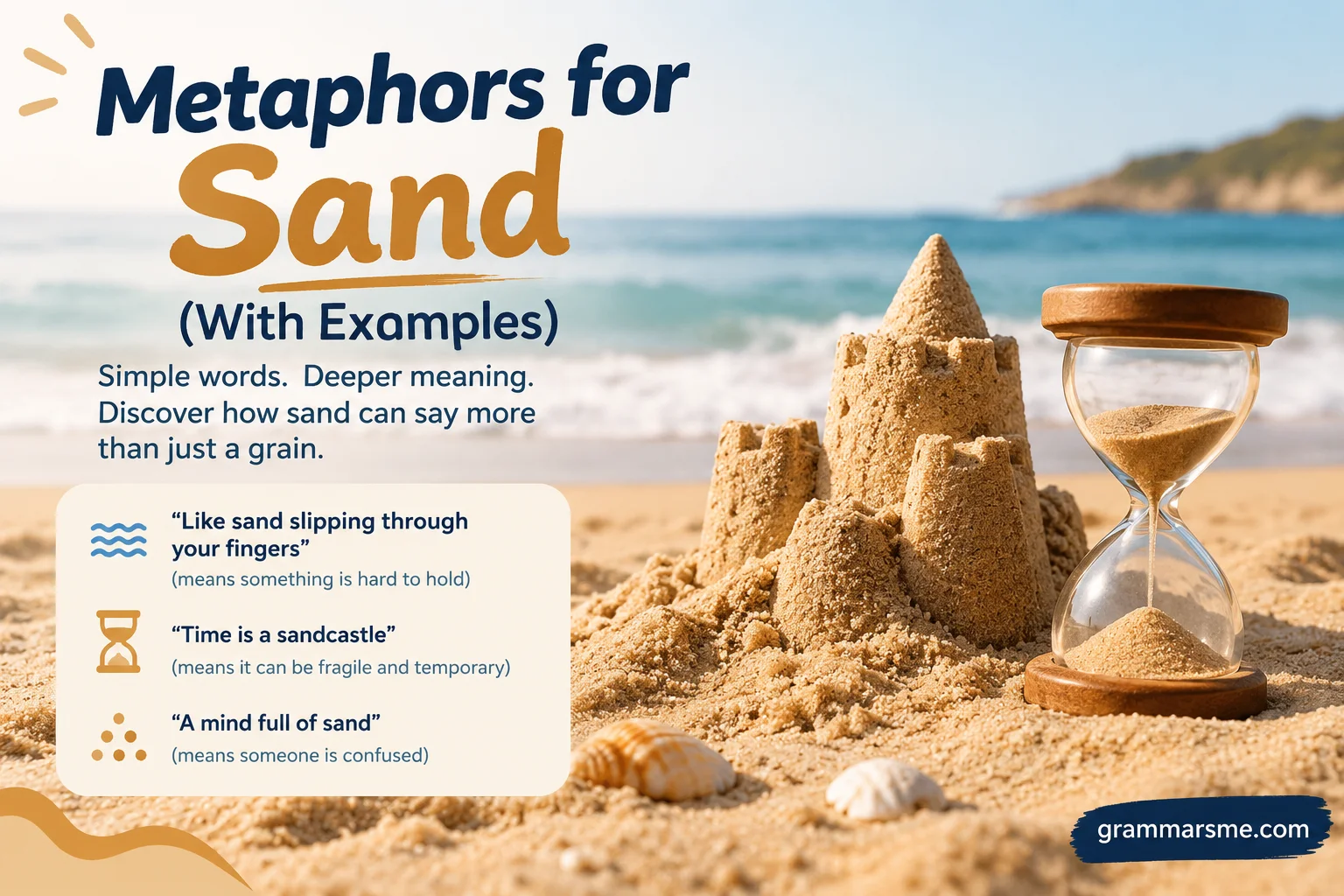

20 Metaphors for Sand (With Examples) can show how sand represents beauty, freedom, peace, and new beginnings in vivid ways.
Beach moments feel unforgettable when rolling waves touch your ankles, the smell of the air reaches your nose, and the sky changed color at sunset. Sand can become a gateway to dreams, a blanket of calm, a meeting place of worlds, or a canvas painted by nature. Such comparisons add stronger imagery and emotional depth to writing, making it more engaging and memorable. This style works well in poetry, essays, stories, and personal reflections, helping writers capture the deeper meaning of a beach creatively.
Sand also represents change and uncertainty through sandstorms, violent wind storms in the desert where high winds lift particles of sand into the air, forming a turbulent, suffocating cloud that may arrive unexpectedly and last few minutes or few months. Their effects can be abrasive and blinding to exposed skin and exposed eyes, so people must survive by finding the right position, staying covered, learning to cover exposed skin, and riding the storm.
1. Sand Is a Sea of Gold
Meaning: This metaphor compares sand to a vast sea of golden treasure.
Detailed explanation:
When sunlight falls across a sandy beach or desert, the grains can appear golden and endless. Calling sand a sea of gold highlights its beauty, warmth, and expansive appearance. The metaphor doesn’t suggest that sand is literally valuable like gold. Instead, it emphasizes how precious and visually stunning the landscape can feel.
Example sentence:
At sunset, the beach became a sea of gold, glowing beneath the fading sunlight.
Three other ways to say it:
- Sand is a golden ocean.
- Sand is a field of treasure.
- Sand is a blanket of gold.
2. Sand Is a Clock
Meaning: This metaphor presents sand as a symbol of time passing.
Detailed explanation:
Sand is closely associated with hourglasses, where grains fall steadily from one chamber to another. This makes it a powerful metaphor for moments slipping away. Just as you can’t stop every grain from falling, you can’t completely stop time from moving forward.
Example sentence:
The sand beneath my fingers felt like a clock, reminding me that every moment was passing.
Three other ways to say it:
- Sand is a measure of time.
- Sand is a silent hourglass.
- Sand is time falling grain by grain.
3. Sand Is a Memory Keeper
Meaning: This metaphor describes sand as something that holds memories of the past.
Detailed explanation:
Beaches often become connected with special experiences, such as family vacations, childhood adventures, romantic walks, or peaceful afternoons. When you see or touch sand again, those memories can return. In this sense, sand becomes a keeper of moments that might otherwise fade.
Example sentence:
The old beach was a memory keeper, holding traces of summers we had almost forgotten.
Three other ways to say it:
- Sand is an archive of memories.
- Sand is a diary of old moments.
- Sand is a treasure chest of memories.
4. Sand Is a Soft Blanket
Meaning: This metaphor compares sand to something soft, comforting, and protective.
Detailed explanation:
Warm beach sand can feel gentle beneath your feet or body. Describing it as a soft blanket creates an image of comfort and relaxation. The metaphor works especially well when describing a quiet beach, a peaceful afternoon, or a moment of rest.
Example sentence:
The warm sand wrapped around my feet like a soft blanket.
Three other ways to say it:
- Sand is a warm cushion.
- Sand is a gentle mattress.
- Sand is a comforting layer of earth.
5. Sand Is a River of Time
Meaning: This metaphor represents sand as time continuously flowing forward.
Detailed explanation:
A river never stops moving, and neither does time. Sand can shift, fall, and travel from one place to another, making it a natural image for life’s constant movement. This metaphor suggests that every moment flows into the next.
Example sentence:
The desert stretched before us like a river of time, carrying countless stories across its dunes.
Three other ways to say it:
- Sand is a current of moments.
- Sand is a flowing timeline.
- Sand is a stream of passing days.
6. Sand Is a Blanket of Stars
Meaning: This metaphor describes countless grains of sand as though they were tiny stars spread across the ground.
Detailed explanation:
When sand sparkles under sunlight or moonlight, individual grains can resemble tiny points of light. The comparison creates a sense of wonder, beauty, and vastness. It’s particularly effective for poetic descriptions of deserts and beaches.
Example sentence:
Under the moonlight, the beach looked like a blanket of stars beneath our feet.
Three other ways to say it:
- Sand is a field of tiny stars.
- Sand is a carpet of light.
- Sand is a galaxy beneath our feet.
7. Sand Is a Shape-Shifter
Meaning: This metaphor shows that sand is constantly changing form.
Detailed explanation:
Sand can become dunes, beaches, ripples, castles, paths, and patterns. Wind and water can reshape it without warning. Calling sand a shape-shifter emphasizes its flexible and ever-changing nature.
Example sentence:
The desert sand was a shape-shifter, forming new dunes whenever the wind changed direction.
Three other ways to say it:
- Sand is a master of transformation.
- Sand is an ever-changing canvas.
- Sand is nature’s moving sculpture.
8. Sand Is a Story Written by the Wind
Meaning: This metaphor presents patterns in sand as stories created by nature.
Detailed explanation:
Wind constantly moves sand across beaches and deserts, leaving behind lines, waves, and ripples. These patterns can look like writing across the ground. The metaphor suggests that nature is telling a story without using words.
Example sentence:
The dunes were a story written by the wind, with every ripple revealing another chapter.
Three other ways to say it:
- Sand is a diary written by nature.
- Sand is a message from the wind.
- Sand is a book of natural patterns.
9. Sand Is a Thousand Tiny Journeys
Meaning: This metaphor describes each grain of sand as having its own long journey through nature.
Detailed explanation:
Sand can originate from rocks, shells, minerals, and other materials that have been broken down over time. Water and wind may transport these particles across great distances. Thinking of sand as tiny journeys gives an ordinary grain a deeper sense of history.
Example sentence:
Every grain beneath my feet felt like a thousand tiny journeys brought together by the sea.
Three other ways to say it:
- Sand is a collection of natural adventures.
- Sand is countless journeys in one place.
- Sand is a gathering of traveling grains.
10. Sand Is a Fleeting Dream
Meaning: This metaphor presents sand as something beautiful but difficult to hold onto.
Detailed explanation:
Try holding a handful of dry sand, and much of it quickly slips through your fingers. This makes sand a powerful symbol for experiences that feel wonderful but cannot last forever. It can represent youth, happiness, relationships, or precious moments.
Example sentence:
Our summer together was a fleeting dream, beautiful but impossible to hold forever.
Three other ways to say it:
- Sand is a disappearing dream.
- Sand is a moment that slips away.
- Sand is a fragile memory.
11. Sand Is Nature’s Canvas
Meaning: This metaphor compares sand to a blank surface waiting to be transformed.
Detailed explanation:
Footprints, waves, shells, wind patterns, and animal tracks can all leave marks in sand. These temporary designs make sand resemble a canvas. The metaphor emphasizes creativity, change, and impermanence.
Example sentence:
The beach became nature’s canvas, covered with footprints and delicate patterns from the tide.
Three other ways to say it:
- Sand is a blank page for nature.
- Sand is an open artistic surface.
- Sand is a living canvas.
12. Sand Is a Carpet of Memories
Meaning: This metaphor describes sand as a surface that seems to collect traces of experiences.
Detailed explanation:
Footprints disappear eventually, but for a short time they remain visible. This makes sand a beautiful metaphor for memories: they may not last forever, yet they leave an impression. A carpet of memories works especially well when describing a meaningful place from the past.
Example sentence:
The beach felt like a carpet of memories, covered with the footprints of our childhood.
Three other ways to say it:
- Sand is a floor of memories.
- Sand is a trail of forgotten moments.
- Sand is a landscape of the past.
13. Sand Is a Restless Traveler
Meaning: This metaphor portrays sand as something that is always moving from one place to another.
Detailed explanation:
Wind can carry sand across beaches and deserts, while water can transport it along coastlines and rivers. Sand rarely stays completely still for long periods. Calling it a restless traveler gives it a lively personality and suggests constant movement.
Example sentence:
The desert was filled with restless travelers, as the wind pushed grains across the dunes.
Three other ways to say it:
- Sand is a wandering traveler.
- Sand is a nomad of nature.
- Sand is a traveler without a destination.
Read More: Metaphors for Scared (With Examples)
14. Sand Is a Whisper of the Ocean
Meaning: This metaphor connects sand with the memory and presence of the sea.
Detailed explanation:
Many beaches are formed partly through the long interaction of waves, rocks, shells, and other natural materials. Even when the ocean is far away, a handful of beach sand can remind someone of it. The metaphor creates a quiet emotional connection between sand and the sea.
Example sentence:
The sand in my pocket was a whisper of the ocean, carrying the feeling of the beach home with me.
Three other ways to say it:
- Sand is the ocean’s quiet voice.
- Sand is a memory of the sea.
- Sand is the sea speaking softly.
15. Sand Is a Puzzle of the Earth
Meaning: This metaphor presents sand as a collection of countless small pieces formed by nature.
Detailed explanation:
Sand contains many tiny particles, and each can have a different origin, shape, texture, or mineral composition. Together, these pieces form beaches and deserts. Calling sand a puzzle of the Earth highlights how many small elements can create something vast and beautiful.
Example sentence:
The beach was a puzzle of the Earth, built from millions of tiny pieces shaped by nature.
Three other ways to say it:
- Sand is Earth’s collection of fragments.
- Sand is a mosaic of natural pieces.
- Sand is a miniature history of the Earth.
16. Sand Is a Golden River
Meaning: This metaphor compares moving sand to a flowing golden river.
Detailed explanation:
In deserts, wind can make sand appear to flow across dunes like water. When sunlight strikes the moving grains, they may look golden. This metaphor combines movement, beauty, and natural power.
Example sentence:
The wind sent the sand racing down the dune like a golden river.
Three other ways to say it:
- Sand is a river of sunlight.
- Sand is a flowing golden stream.
- Sand is a liquid landscape.
17. Sand Is Life’s Loose Threads
Meaning: This metaphor compares individual grains of sand to small pieces that contribute to a larger story.
Detailed explanation:
A single grain seems insignificant, but millions of grains can form an enormous beach or desert. Similarly, individual moments may appear small while collectively creating a person’s life. The metaphor encourages us to notice the small experiences that shape something much larger.
Example sentence:
Each ordinary day felt like one of life’s loose threads, eventually weaving itself into a larger story.
Three other ways to say it:
- Sand is the small pieces of life’s story.
- Sand is the tiny threads of existence.
- Sand is a collection of little moments.
18. Sand Is a Silent Witness
Meaning: This metaphor describes sand as something that quietly observes events without speaking.
Detailed explanation:
Beaches and deserts can exist for centuries, witnessing people, animals, storms, journeys, and changing landscapes. Sand doesn’t literally remember these events, but it can symbolize a quiet observer of history.
Example sentence:
The ancient desert stood as a silent witness to generations of travelers crossing its dunes.
Three other ways to say it:
- Sand is a quiet observer.
- Sand is a witness to history.
- Sand is nature’s silent recorder.
19. Sand Is a Lesson in Letting Go
Meaning: This metaphor uses sand to represent the importance of accepting change and releasing what we cannot keep.
Detailed explanation:
When you squeeze sand tightly, it often escapes through your fingers. The image can represent how trying too hard to control something may cause it to disappear faster. Sand therefore becomes a gentle reminder that some things must be appreciated without being possessed.
Example sentence:
The sand slipping through my fingers became a lesson in letting go.
Three other ways to say it:
- Sand is a reminder to release control.
- Sand is a teacher of acceptance.
- Sand is a symbol of graceful surrender.
20. Sand Is a Million Tiny Moments
Meaning: This metaphor compares countless grains of sand to the small moments that make up life.
Detailed explanation:
A beach may look like one enormous surface, but it is actually made from countless individual grains. Life works in a similar way. A person’s story is created through small conversations, choices, memories, challenges, and joyful moments. The metaphor makes sand a powerful image for the value of everyday experiences.
Example sentence:
Our life together was a million tiny moments, each one as small as a grain of sand yet meaningful in its own way.
Three other ways to say it:
- Sand is countless little memories.
- Sand is a collection of meaningful moments.
- Sand is the small pieces that build a life.
MCQs:
1. What does “sand is a clock” symbolize?
A. Wealth
B. Passing time
C. Physical strength
D. Silence
2. Which metaphor best represents changing sand dunes?
A. Sand is a shape-shifter
B. Sand is a blanket
C. Sand is a clock
D. Sand is a diary
3. “Sand is a memory keeper” mainly suggests that sand:
A. Creates storms
B. Holds or evokes memories
C. Measures temperature
D. Changes color
4. Which metaphor describes sand as a beautiful golden landscape?
A. Sand is a silent witness
B. Sand is a sea of gold
C. Sand is a puzzle
D. Sand is a restless traveler
5. What does “sand is a fleeting dream” emphasize?
A. Permanence
B. Strength
C. Something beautiful that doesn’t last
D. Danger
6. Which metaphor connects sand with the ocean?
A. Sand is a whisper of the ocean
B. Sand is a clock
C. Sand is a puzzle
D. Sand is loose threads
7. “Sand is nature’s canvas” suggests that sand:
A. Cannot change
B. Can display temporary patterns and marks
C. Is extremely heavy
D. Always stays indoors
8. What does “sand is a restless traveler” emphasize?
A. Sand’s movement
B. Sand’s color
C. Sand’s temperature
D. Sand’s hardness
9. Which metaphor represents letting go?
A. Sand is a lesson in letting go
B. Sand is a sea of gold
C. Sand is a blanket of stars
D. Sand is a puzzle of the Earth
10. “Sand is a silent witness” suggests that sand:
A. Talks to travelers
B. Quietly represents the passage of history
C. Produces music
D. Controls the weather
11. Which metaphor describes sand as many small experiences forming a larger life?
A. Sand is a million tiny moments
B. Sand is a golden river
C. Sand is a soft blanket
D. Sand is a clock
12. “Sand is a story written by the wind” refers to:
A. Books made from sand
B. Patterns created by moving wind
C. Ocean pollution
D. Sand sculptures made by people
13. Which metaphor emphasizes the comfort of warm sand?
A. Sand is a soft blanket
B. Sand is a restless traveler
C. Sand is a clock
D. Sand is a silent witness
14. Which metaphor compares sand to countless small pieces of the natural world?
A. Sand is a puzzle of the Earth
B. Sand is a fleeting dream
C. Sand is a clock
D. Sand is a soft blanket
15. Which metaphor is most suitable for describing sand as countless meaningful experiences?
A. Sand is a million tiny moments
B. Sand is a golden river
C. Sand is a whisper of the ocean
D. Sand is a shape-shifter
Answer Key:
1-B, 2-A, 3-B, 4-B, 5-C, 6-A, 7-B, 8-A, 9-A, 10-B, 11-A, 12-B, 13-A, 14-A, 15-A.
FAQs:
What is a good metaphor for sand?
A strong metaphor for sand is “sand is a clock” because it connects sand with the idea of time passing. Other choices include “sand is a sea of gold,” “sand is a memory keeper,” and “sand is a shape-shifter.”
What does sand symbolize in literature?
Sand can symbolize time, change, impermanence, memories, freedom, journeys, and the passage of life. Its meaning depends on how the writer uses it within the surrounding context.
What is a metaphor for sand slipping through your fingers?
“Sand is a lesson in letting go” is an effective metaphor. It suggests that some experiences, people, or moments cannot be controlled or permanently held.
How can I describe sand creatively?
You can describe sand through metaphors such as “a golden river,” “a soft blanket,” “a restless traveler,” or “a story written by the wind.” Choose the comparison based on the emotion or image you want readers to experience.
Why are metaphors useful when describing sand?
Metaphors make ordinary descriptions more visual, emotional, and memorable. Instead of simply saying that sand is moving or beautiful, a metaphor can help readers imagine it as a golden river, a silent witness, or a million tiny moments.
Conclusion:
Sand may seem ordinary, but it offers countless ways to express beauty, memory, time, change, and life’s fleeting nature. A grain can represent a moment, while an entire beach can represent a lifetime of experiences. Metaphors such as “sand is a clock,” “sand is a memory keeper,” and “sand is a lesson in letting go” give familiar scenes deeper meaning. Whether you’re writing creatively or trying to express a personal feeling, these comparisons can make your words feel more vivid, thoughtful, and emotionally meaningful. The best metaphor is the one that naturally captures what you want your reader to feel.



1 thought on “20 Metaphors for Sand (With Examples)”