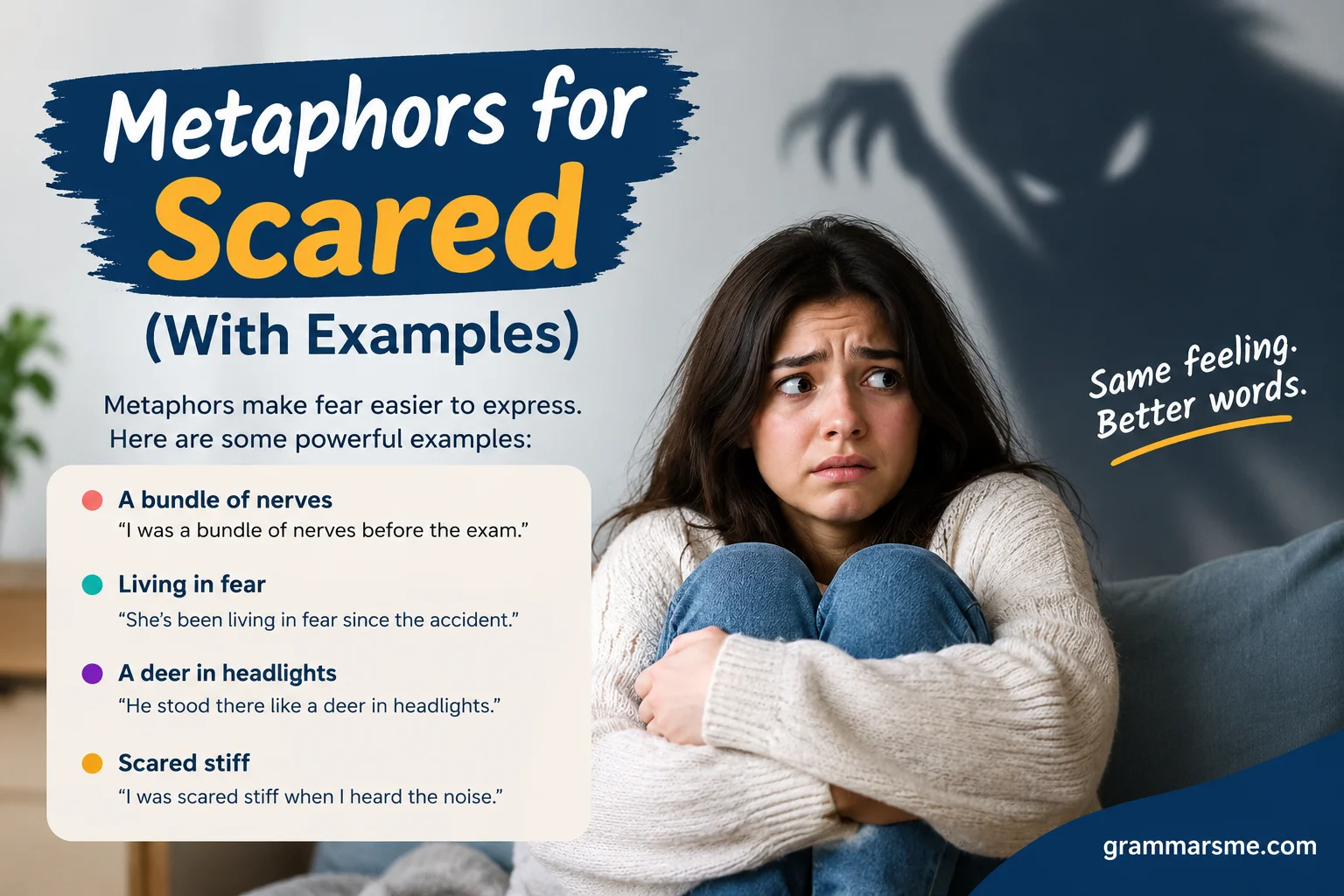

Metaphors for Scared (With Examples) can make fear easier to picture, helping readers feel the emotion instead of simply reading a plain description of fear.
Finding the right words for fear can make a metaphor for someone feeling scared much stronger. A shadow, cage, or cold hand around the throat can help a reader feel fear instead of simply reading about it. The main issue is that people often cannot see an invisible emotion, but an image can appear in the mind’s eye. The secret is to give readers an image, not only a fact, because images remain longer than a plain description.
A description of fear such as “fear had me by the throat” shows how a metaphor gives a person an image. Writers use this approach in poems, novels, movies, and even a colleague’s rendition of a job interview when describing problems people encounter frequently. It is hard to miss how writers use ice, veins, shadow, chest, storm, and mind to help readers see fear. Phrases such as “ice crawling through your veins,” “shadow tightening around your chest,” and “storm exploding inside your mind” create stronger imagery and let readers experience terror as wildfire moves through the dark.
1. Scared as a Deer in Headlights
Meaning: This metaphor describes someone who is suddenly frightened and unable to react.
Detailed explanation: A deer caught in headlights may freeze because it doesn’t know which direction to take. The metaphor works well when fear causes someone to become confused, shocked, or temporarily motionless.
Example: “When the teacher suddenly called on him, he stood there like a deer in headlights.”
Three other ways to say it:
- Frozen with fear
- Caught completely off guard
- Too shocked to move
2. Scared as a Leaf in the Wind
Meaning: This metaphor represents someone who feels fragile, helpless, and frightened by circumstances beyond their control.
Detailed explanation: A leaf moving in strong wind has little control over where it goes. Comparing a scared person to a leaf emphasizes vulnerability and uncertainty rather than overwhelming terror.
Example: “After hearing the strange noise outside, she felt like a leaf trembling in the wind.”
Three other ways to say it:
- Feeling vulnerable
- Shaking with uncertainty
- Feeling powerless
3. Fear Is a Shadow
Meaning: This metaphor suggests that fear follows a person wherever they go.
Detailed explanation: A shadow stays close to its owner and can seem impossible to escape. Describing fear as a shadow shows how an uncomfortable feeling can remain in someone’s thoughts even when there is no immediate danger.
Example: “His fear followed him like a dark shadow after the accident.”
Three other ways to say it:
- Fear follows me
- I can’t escape the fear
- Anxiety stays close
4. Scared as a Cornered Animal
Meaning: This metaphor describes someone who feels trapped, threatened, and desperate to protect themselves.
Detailed explanation: A cornered animal may become frightened because it has nowhere obvious to escape. The expression is especially useful when someone feels pressured or surrounded by a difficult situation.
Example: “With everyone demanding an answer, he felt like a cornered animal.”
Three other ways to say it:
- Feeling trapped
- Backed into a corner
- Desperate to escape
5. Fear Is a Storm
Meaning: This metaphor compares fear to a powerful storm that overwhelms the mind and emotions.
Detailed explanation: Storms can arrive suddenly, become intense, and make everything feel uncertain. Calling fear a storm communicates emotional turbulence and a sense that the feeling may eventually pass.
Example: “A storm of fear swept through her when she heard the alarm.”
Three other ways to say it:
- Overwhelmed by fear
- Caught in an emotional storm
- Flooded with anxiety
6. Scared as a Small Boat on Rough Water
Meaning: This metaphor represents feeling unstable, uncertain, and vulnerable in a difficult situation.
Detailed explanation: A small boat can be tossed around by powerful waves. The image communicates fear caused by uncertainty and circumstances that seem much bigger than the person experiencing them.
Example: “Starting at a new school made him feel like a small boat on rough water.”
Three other ways to say it:
- Feeling overwhelmed
- Unsure of what comes next
- Struggling to stay steady
7. Fear Is a Cage
Meaning: This metaphor suggests that fear prevents someone from acting freely.
Detailed explanation: A cage restricts movement and limits choices. When fear becomes a cage, a person may want to move forward but feels mentally or emotionally unable to do so.
Example: “Her fear became a cage that kept her from pursuing her dream.”
Three other ways to say it:
- Held back by fear
- Trapped by anxiety
- Afraid to take the next step
8. Scared as a Candle in the Wind
Meaning: This metaphor describes someone who feels fragile and easily shaken by danger or uncertainty.
Detailed explanation: A candle flame can flicker or nearly disappear when exposed to strong wind. The comparison creates an image of someone whose confidence is struggling to remain steady.
Example: “His confidence was like a candle in the wind when the competition began.”
Three other ways to say it:
- Easily shaken
- Losing confidence
- Feeling fragile
9. Fear Is an Ice-Cold Hand
Meaning: This metaphor describes the sudden physical and emotional sensation of fear.
Detailed explanation: Fear can create chills, tension, and a feeling of being touched by something frightening. An imaginary cold hand captures that sudden, uncomfortable sensation.
Example: “An ice-cold hand of fear seemed to grip her when she heard footsteps behind her.”
Three other ways to say it:
- A sudden chill of fear
- Fear gripped me
- A frightening sensation
10. Scared as a Bird in a Cage
Meaning: This metaphor represents someone who feels frightened, restricted, and unable to find a way out.
Detailed explanation: A frightened bird may repeatedly look for an escape while remaining trapped. The image works particularly well when fear is connected to helplessness or confinement.
Example: “He felt like a frightened bird in a cage during the unfamiliar situation.”
Three other ways to say it:
- Feeling confined
- Searching for an escape
- Frightened and helpless
11. Fear Is a Dark Cloud
Meaning: This metaphor describes fear that hangs over someone’s thoughts and emotions.
Detailed explanation: A dark cloud can make a bright day feel gloomy. In the same way, fear can affect someone’s mood even when nothing frightening is happening at that exact moment.
Example: “A dark cloud of fear hung over her as she waited for the results.”
Three other ways to say it:
- Fear hangs over me
- A sense of dread
- A heavy feeling of anxiety
12. Scared as a Rabbit in the Woods
Meaning: This metaphor describes someone who is alert, nervous, and constantly watching for danger.
Detailed explanation: Rabbits are often portrayed as cautious animals that quickly react to unfamiliar sounds. This comparison is useful for mild or moderate fear mixed with nervous awareness.
Example: “He looked like a rabbit in the woods, listening carefully to every sound.”
Three other ways to say it:
- On high alert
- Nervously watching
- Easily startled
13. Fear Is a Tightrope
Meaning: This metaphor describes the feeling of walking through a situation where one wrong move seems dangerous.
Detailed explanation: Walking on a tightrope requires balance and concentration. Comparing fear to a tightrope suggests that a person feels they must be extremely careful because the consequences of failure seem serious.
Example: “Speaking in front of hundreds of people felt like walking a tightrope.”
Three other ways to say it:
- Walking on uncertain ground
- Treading carefully
- Afraid of making a mistake
Read More: Metaphors for School (With Examples)
14. Scared as a Ship Without an Anchor
Meaning: This metaphor represents feeling unstable, uncertain, and unable to find emotional security.
Detailed explanation: An anchor keeps a ship in place. Without one, the vessel can drift with the water. The metaphor captures the fear that comes from not knowing where you stand or what will happen next.
Example: “After everything changed so quickly, she felt like a ship without an anchor.”
Three other ways to say it:
- Feeling ungrounded
- Drifting through uncertainty
- Lacking a sense of security
15. Fear Is a Locked Door
Meaning: This metaphor suggests that fear creates a barrier between a person and something they want to do.
Detailed explanation: A locked door prevents someone from entering or moving forward. Fear can work in the same way by convincing a person that they cannot safely take the next step.
Example: “His fear was a locked door between him and his new opportunity.”
Three other ways to say it:
- Fear is holding me back
- Afraid to move forward
- Facing an emotional barrier
16. Scared as a Mouse in a Storm
Meaning: This metaphor describes someone who feels small and powerless in the middle of a frightening situation.
Detailed explanation: A mouse is tiny compared with the force of a storm. The contrast emphasizes how overwhelming a situation can feel when a person believes they have little power to change it.
Example: “Standing alone in the unfamiliar building, she felt like a mouse in a storm.”
Three other ways to say it:
- Feeling very small
- Overwhelmed by circumstances
- Feeling powerless
17. Fear Is a Whisper in the Dark
Meaning: This metaphor represents quiet fear that grows because of uncertainty.
Detailed explanation: A whisper in darkness can feel more frightening because you cannot clearly identify its source. This metaphor is especially effective for suspense, anticipation, or fear of something unknown.
Example: “The unanswered question became a whisper in the dark inside his mind.”
Three other ways to say it:
- A quiet sense of dread
- Fear of the unknown
- An unsettling feeling
18. Scared as a Child Lost in a Crowd
Meaning: This metaphor describes feeling confused, vulnerable, and unsure where to turn for safety.
Detailed explanation: A child separated from familiar people in a crowd may experience intense uncertainty. The image expresses fear mixed with loneliness and a strong desire for reassurance.
Example: “Without anyone familiar around, he felt like a child lost in a crowd.”
Three other ways to say it:
- Feeling lost and frightened
- Searching for reassurance
- Unsure where to turn
19. Fear Is a Wave
Meaning: This metaphor compares fear to a wave that suddenly rises, overwhelms you, and eventually moves away.
Detailed explanation: Waves can arrive with great force and temporarily cover everything in their path. This makes the metaphor useful when describing a sudden emotional rush that feels powerful but isn’t permanent.
Example: “A wave of fear washed over her when she realized she had forgotten the important document.”
Three other ways to say it:
- A rush of fear
- Suddenly overwhelmed
- Fear washed over me
20. Scared as a Flame Flickering in the Dark
Meaning: This metaphor describes someone who feels frightened while trying to hold on to a small amount of courage or hope.
Detailed explanation: A flickering flame provides a little light but remains vulnerable in darkness. The image captures fear without making the person seem completely helpless. It can suggest that courage still exists despite fear.
Example: “She stood before the difficult decision like a small flame flickering in the dark, afraid but still hopeful.”
Three other ways to say it:
- Frightened but hopeful
- Holding on to courage
- Trying to stay strong
MCQs:
1. Which metaphor describes someone who freezes because of sudden fear?
A. A ship without an anchor
B. A deer in headlights
C. A locked door
D. A dark cloud
2. What does “fear is a cage” suggest?
A. Fear creates freedom
B. Fear makes someone happy
C. Fear restricts someone’s actions
D. Fear disappears quickly
3. Which metaphor best represents fear that follows someone?
A. Fear is a shadow
B. Fear is a candle
C. Fear is a bridge
D. Fear is a garden
4. “A wave of fear washed over her” suggests that fear was:
A. Gradual and permanent
B. Sudden and powerful
C. Completely absent
D. Calm and peaceful
5. Which metaphor suggests feeling fragile and easily shaken?
A. A candle in the wind
B. A locked door
C. A tightrope
D. A cage
6. What does “a ship without an anchor” represent?
A. Confidence
B. Stability
C. Uncertainty and instability
D. Happiness
7. Which metaphor is especially suitable for fear of the unknown?
A. A whisper in the dark
B. A sunny garden
C. A strong bridge
D. A warm blanket
8. “Fear is a storm” mainly suggests:
A. Emotional calm
B. Emotional turbulence
C. Complete confidence
D. Physical strength
9. Which metaphor describes feeling trapped and threatened?
A. A cornered animal
B. A flowing river
C. A bright star
D. A growing tree
10. Which expression describes someone who is frightened but still has hope?
A. A locked door
B. A flame flickering in the dark
C. A cornered animal
D. A ship without an anchor
11. What does “a dark cloud of fear” suggest?
A. Fear that hangs over someone’s thoughts
B. Fear that has completely disappeared
C. A feeling of excitement
D. A moment of celebration
12. Which metaphor emphasizes feeling lost and vulnerable?
A. A child lost in a crowd
B. A candle in the wind
C. A tightrope
D. A locked door
13. “Fear is a tightrope” suggests that someone feels:
A. Completely relaxed
B. They must move carefully
C. Extremely confident
D. Ready to celebrate
14. Which metaphor best represents feeling small and powerless?
A. A mouse in a storm
B. A wave
C. A shadow
D. A locked door
15. Which phrase is the best example of a metaphor for fear?
A. She was very scared.
B. She felt nervous.
C. Fear was a dark cloud over her thoughts.
D. She experienced fear.
Answer Key:
1. B | 2. C | 3. A | 4. B | 5. A | 6. C | 7. A | 8. B | 9. A | 10. B | 11. A | 12. A | 13. B | 14. A | 15. C
FAQs:
1. What is a metaphor for being scared?
A metaphor for being scared compares fear to something else without using “like” or “as.” Examples include “fear is a storm,” “fear is a cage,” and “fear is a dark cloud.” These comparisons make an emotional experience easier to visualize.
2. What is a good metaphor for extreme fear?
For extreme fear, “fear is a storm” or “fear is an ice-cold hand” can work well. A storm suggests overwhelming emotional intensity, while an ice-cold hand emphasizes the sudden physical sensation associated with fear.
3. How can I describe someone who is scared without saying scared?
You can use expressions such as “frozen like a deer in headlights,” “a leaf trembling in the wind,” or “a small boat on rough water.” Each phrase communicates a slightly different type of fear.
4. What metaphor describes fear of the unknown?
“Fear is a whisper in the dark” is a strong metaphor for fear of the unknown. Darkness represents uncertainty, while the whisper suggests something unsettling that cannot yet be clearly identified.
5. Can metaphors for scared be used in everyday conversation?
Yes. Metaphors can work in conversations, text messages, creative writing, speeches, poems, and personal reflections. For casual communication, choose simple images such as “a wave of fear” or “a dark cloud” so the meaning remains easy to understand.
Conclusion:
There are many ways to describe fear without simply repeating the word scared. Metaphors such as a dark cloud, a storm, a locked door, a wave, or a deer in headlights give emotional experiences a vivid shape. The strongest choice depends on the type of fear you want to communicate. Whether you’re writing a story, explaining your feelings, or creating a meaningful message, the right metaphor can make your words feel more vivid, compassionate, and relatable. Remember that fear isn’t always weakness; sometimes, describing it honestly is the first step toward understanding and overcoming it.




1 thought on “Metaphors for Scared (With Examples)”